
State of India EOR 2026
The primary-source research report on Employer of Record in India. PE risk, contractor misclassification, ESOP tax, the real EOR-to-entity crossover, and the $1,800 landed cost reality.
Published: May 2026 · Last updated: 19 May 2026 · ~60 min read · Asanify Research


Contents
This is a research publication of Asanify Research. It is not legal, tax, or other professional advice. Statutory and regulatory positions reflect our understanding as of the cover date and may have changed since publication. Full notices at the end of this report and at asanify.com/research/notices. Corrections: research@asanify.com.
Top 5 Numbers From This Report
- Financially, your own entity (vs. EOR) may make sense only after you have 50+ employees. We modelled the full cost stack across three compliance scenarios and surfaced a counterintuitive finding: the widely cited ~20–25 employee crossover is off by a factor of 2x. Section B9 shows the math for all three. (Source: Section B9 — EOR vs. Own-Entity Crossover Model)
- Global startups and SMBs regularly use EOR as their India market-entry vehicle — the median global headcount at India EOR sign-on is less than 50 employees. India-specialist EOR is not just for large multinationals executing mature expansion plans. (Source: Asanify proprietary research)
- If you plan to grant stock options to your India EOR team, expect a cash tax bill at the time of exercise — with no delay option. Indian tax law treats the gain at exercise (market price minus exercise price) as salary income, taxable immediately at marginal rates of 30–40%, before any shares are sold. India’s startup tax deferral that delays this bill requires two government certifications that fewer than 2% of India-registered startups hold — and foreign-parented companies, including any US or UK parent, are structurally ineligible. Budget 2026 has not changed this. (Source: Section B5 — ESOPs and Equity for Indian Employees of Foreign Companies)
- Six tribunal and Supreme Court rulings in 18 months — one of the densest stretches of India-EOR-relevant PE jurisprudence in recent history. One Supreme Court ruling (Hyatt) upheld PE; five narrowed the dependent-agent test in ways that favour carefully structured foreign principals. The safe-harbor assumption no longer holds without independent PE analysis. (Source: Section B1 — PE Risk for Foreign EOR Users)
- A $1,700/month India EOR quote becomes ~$1,800/month in actual landed cost — a $98/month gap per employee. A $1,500 CTC hire plus a $200 EOR management fee looks like $1,700 on paper, but employer EPF, gratuity provisioning, GST exposure, FX markup, and bank charges push the real monthly cost to about $1,800. CFOs should model landed cost, not salary plus management fee. (Source: Section B6 — What India EOR Actually Costs.)
Executive Summary
India is not the back-office hire it was a decade ago. For companies in the US, UK, EMEA, and APAC, it is now one of the most serious places to build engineering, product, finance, operations, and customer teams. Deep talent, a cost gap that still matters in 2026, and English-language operating maturity across most of the urban hiring base.
That is why EOR adoption in India is accelerating.
What surprised us is who is adopting it. The popular image is a 500-person US tech company executing a planned India expansion. That is not what our data shows. In our closed-engagement cohort the median global headcount at sign-on is around 50, with the 25th percentile at 14 (n=22 closed-won India EOR engagements, April 2023 to April 2026). EOR has quickly become a market-entry operating model for companies in their first year of international hiring.
That is good news. A 50-person company can now hire engineers in Bengaluru without first opening an entity, hiring a local payroll team, or putting a finance controller on the ground.
Fast is not the same as informal.
Six tribunal rulings and one Supreme Court bench between July 2025 and March 2026 meaningfully changed the test for when a foreign company’s India hires create a taxable presence. An engineer building internal product is a very different risk profile from a sales leader negotiating customer terms. Whether your India contractor’s code actually belongs to you turns on a Section 19 (of the Copyright Act 1957)-compliant assignment most US-style boilerplate fails. And the quoted monthly EOR cost is rarely the total cost: a $1,500 CTC engineer with a $200 management fee costs closer to $1,800 once employer EPF, gratuity provisioning, and the FX spread are added.
From the report, in short:
- EOR provides strong value but is not a blanket permanent establishment shield. What the hire does in India matters more than whose payroll they sit on.
- India cost savings are material. CFOs should model landed cost, not salary plus management fee.
- Contractor misclassification risk is high when the working relationship looks like employment.
- Equity grants need India-specific tax and FEMA planning before the grant, not at exercise.
- The “switch to entity at 25 employees” rule of thumb is surprisingly outdated. The crossover can possibly be at 50+ hires under the posture Indian counsel typically recommend.
In our view: India is absolutely worth hiring in. EOR is often the cleanest way to begin, and the best companies will use it deliberately, with clear visibility on role-level exposure and a line of sight to when the entity math actually flips.
This report is written for that company.
🗺️ WHERE TO START — FIND YOUR SECTION IN 30 SECONDS
Currently using contractors in India? → Read B4 immediately. The EPFO amnesty that let companies regularise misclassified workers cheaply closed April 30, 2026. The enforcement window is now open.
Hiring engineers or developers through EOR? → B3 (you may not own the IP you think you own), then B7 (your payroll structure may need updating as Labour Codes roll out state by state).
Hiring salespeople, country managers, or anyone customer-facing? → B1 is your most urgent read. The EOR wrapper does not protect you from Indian tax on your company’s profits if the wrong person is doing the wrong job in India.
Evaluating EOR cost before signing a contract? → B6 (the true landed cost), then B9 (when your own India entity becomes cheaper than EOR).
Planning equity grants for your India team? → B5. The cash-flow implications at exercise are material and cannot be restructured after the grant.
About to let someone go in India? → B8. India is not at-will. The exit cost waterfall is significantly larger than most US and European companies budget for.
This report covers nine India-specific risks and decisions:
- B1 — PE risk and the 2025–2026 ruling record (six tribunals, one Supreme Court bench)
- B2 — Moonlighting, dual employment, and the UAN detection mechanism
- B3 — IP assignment chain and the contractor copyright trap
- B4 — EPF/ESI misclassification and the EPFO amnesty that closed April 30, 2026
- B5 — ESOPs and equity for India EOR employees: the cash-flow trap at exercise
- B6 — GST structure, the full landed-cost waterfall, and what $200/month actually costs
- B7 — Labour Code state notification tracker: one law, 36 implementation schedules
- B8 — Termination cost waterfall, the 4-year-240-day gratuity rule, 2-day F&F settlement
- B9 — The three-scenario EOR-vs-entity crossover model: 2, 22, or 52 India-side employees (57 including US-side accounting overhead)
B1. Permanent Establishment: How Foreign EOR Users Stay on the Protected Side
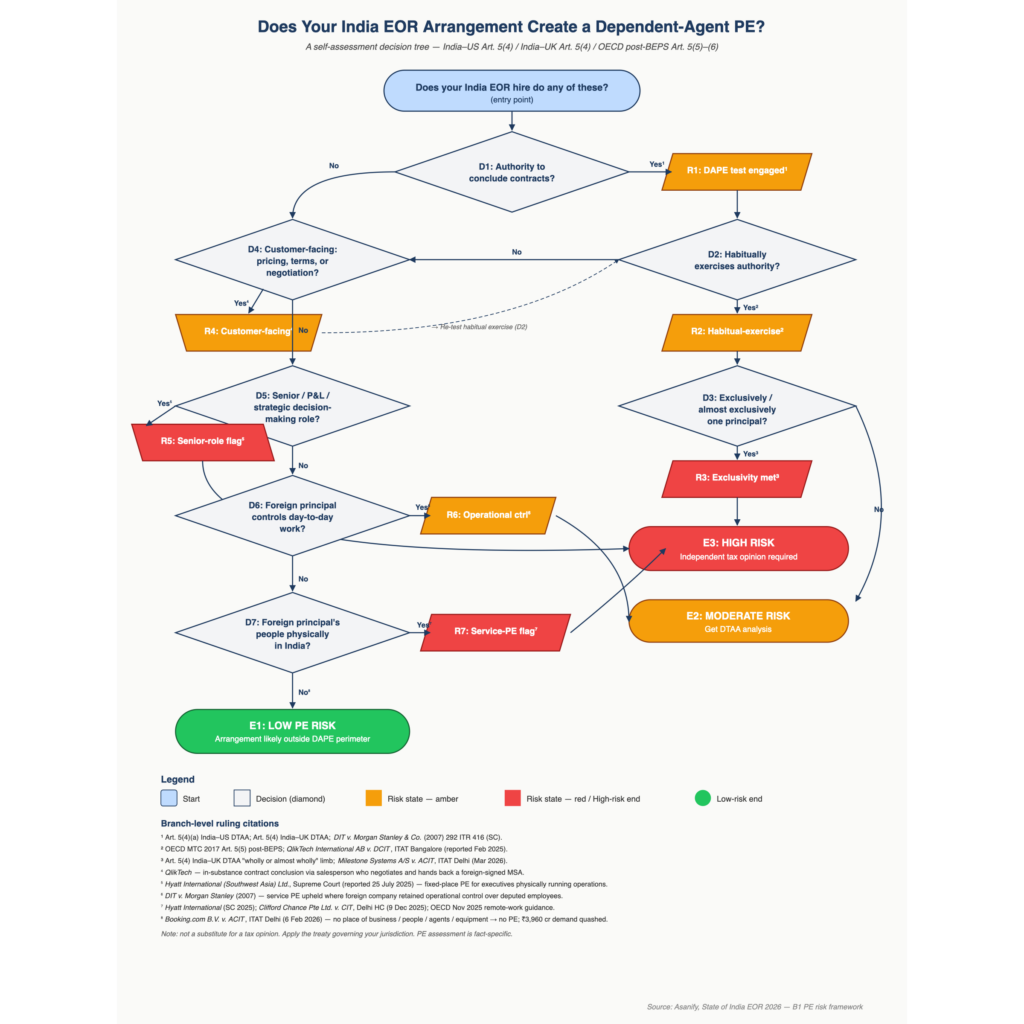
Figure D1 — Permanent Establishment risk decision flowchart for India EOR engagements.
TL;DR — B1: The EOR wrapper does not automatically shield your company from Indian tax on its profits. What matters is what your India employees do. Six court rulings in 18 months have tightened the test. Engineers building internal product are generally safe. Salespeople with customer authority, and country managers running local P&L, are generally not. Three questions at the end of this section tell you what to ask your EOR provider. The work is in the role design at onboarding and the engagement documentation that follows. The four-test framework below is the lens Asanify uses to flag exposure with clients before it crystallises.
Between July 2025 and March 2026, six Indian tribunals and one Supreme Court bench handed down PE rulings that, taken together, redrew the line between a safe foreign-principal-with-Indian-help arrangement and a taxable permanent establishment. The headline numbers are not subtle. The Delhi ITAT, in February 2026, set aside a ₹3,960 crore demand against Booking.com B.V. on the finding that the platform’s third-party Indian hotels did not constitute a PE under Article 5 of the India–Netherlands DTAA (Taxscan). Five months earlier, the Supreme Court went the other way on Hyatt International, ruling that “even in the absence of an exclusive lease or physical office, the continuous and systematic use of another entity’s premises” can create a fixed-place PE (Worklaw; underlying Delhi HC Full Bench at Indian Kanoon doc 124906522). Both rulings sit on the same factual axis a US Head of Global Expansion now confronts: when does an Indian person doing work for a foreign company become, in tax-law terms, that foreign company?
The Indian EOR market answered the same question in marketing copy for years — “EOR shields you from PE.” That answer was always too clean. The 2025–2026 record makes the question worth a re-read.
🗺️ NEW TO PERMANENT ESTABLISHMENT? START HERE.
A “permanent establishment” (PE) is the legal trigger that allows India to tax your company’s business profits — not just your Indian employees’ salaries. If the Indian tax authority finds a PE, it can assess tax on the profits your entire company earned from its Indian operations. This is a corporate income tax exposure, not a payroll issue.
The EOR does not automatically prevent this. Whether your India hires trigger PE exposure depends on what they do — whether they negotiate contracts, interact with Indian customers, or make pricing decisions — not on whose payroll they sit. The six rulings covered in this section show exactly where the line now sits.
The Article 5 hook, and why it matters for EORs
Permanent establishment is the trigger under every Indian DTAA for taxing a foreign enterprise’s business profits in India.
The Article 5 trigger most relevant to EOR arrangements is the dependent-agent PE (DAPE). The Supreme Court in DIT v. Morgan Stanley & Co. (2007) 292 ITR 416 SC summarised the Article 5(4) test: “an assessee shall be deemed to have a permanent establishment if, inter alia, a person other than an agent of an independent status habitually exercises an authority to conclude contracts on behalf of the assessee.”
The parallel India–UK clause — broader on its face — catches an agent who “has, and habitually exercises in that State, an authority to negotiate and enter into contracts for or on behalf of the enterprise” and extends to one who “habitually secures orders in the first-mentioned State, wholly or almost wholly for the enterprise itself” (Article 5(4), India–UK DTAA, 1993 Convention as amended by the 2013 Protocol and 2020 Synthesised Text with the MLI; UK HMRC-hosted treaty text at assets.publishing.service.gov.uk PDF). Same backbone. Both texts ask one question: is the Indian-side person concluding (or playing the principal role leading to) contracts the foreign enterprise is bound by.
The OECD’s post-BEPS commentary on Article 5(5) — the model the MLI imports into India’s treaty network — sharpens it further: a DAPE arises where a person “habitually concludes contracts, or habitually plays the principal role leading to the conclusion of contracts that are routinely concluded without material modification by the enterprise” (OECD MTC 2017 Commentary, condensed; language originated in the OECD BEPS Action 7 Final Report 2015).
The risk for an EOR arrangement is not that the EOR’s payroll administrator concludes contracts. The risk is the engineer or country manager whose salary the EOR pays. If that engineer is in substance taking pricing decisions, signing SOWs, or closing customers on behalf of the foreign principal, the EOR wrapper does not change the tax answer.
What 2025–2026 actually said (six rulings, one direction with caveats)
| # | Ruling | Court / Date | Treaty | Outcome | Operative test |
|---|---|---|---|---|---|
| 1 | QlikTech International AB v. DCIT, IT(IT)A No. 990/Bang/2023 | ITAT Bangalore, 16 Dec 2024 (reported Feb 2025) | India–Sweden | DAPE attribution set aside; remanded | Arm’s-length TP adjustment extinguishes separate DAPE attribution (Taxscan) |
| 2 | RGA International Reinsurance Co. v. DCIT | ITAT Mumbai, July 2025 | India–Ireland | No DAPE, no Fixed-Place PE | Anti-fragmentation rule (India–Ireland DTAA, MLI-modified) bites only where activities are “complementary…cohesive business operation” (KPMG TaxNewsFlash) |
| 3 | Hyatt International (Southwest Asia) Ltd. | Supreme Court, reported 25 July 2025 | India–UAE | PE upheld (Fixed Place) | “Continuous and systematic use” of another’s premises = Fixed-Place PE (Worklaw; underlying Delhi HC Full Bench at Indian Kanoon doc 124906522) |
| 4 | CIT v. Clifford Chance Pte Ltd. | Delhi HC, 9 Dec 2025 | India–Singapore | No Service PE | “Physical presence of employees in India providing services to clients is a precondition for the constitution of service PE” (KPMG TaxNewsFlash) |
| 5 | Booking.com B.V. v. ACIT, ITA No. 2033/Del/2025 | ITAT Delhi, 6 Feb 2026 | India–Netherlands | No Fixed-Place / No Agency PE; ₹3,960 crore demand quashed | Foreign platform with no place of business, personnel, agents, or equipment in India is not a PE (Taxscan) |
| 6 | Milestone Systems A/S v. ACIT, AY 2022-23 | ITAT Delhi, March 2026 | India–Denmark | No DAPE | Principal-to-principal distributor, bearing its own risk and free of detailed instructions, is not an agent (The Tax Corp) |
Five rulings narrowed PE; the sixth — Hyatt at the Supreme Court — widened it. Read the loss carefully. Hyatt’s executives were physically in India, repeatedly, running the hotel — exactly the fact pattern a US engineering VP creates when they fly to Bengaluru monthly to “run sprints with the team.” The dominant 2025–2026 thread is that tribunals are tightening the DAPE test: real legal and economic dependence, habitual contract conclusion, no preparatory/auxiliary carve-out abuse. The contra-thread is service PE through people who actually show up.
The four threshold tests, in the order an Assessing Officer might run them
The way an AO builds a PE case against a foreign EOR user — distilled from the six rulings above and the Morgan Stanley “lien on payroll” framework — is sequential. If the EOR arrangement passes all four, the structure holds. If it fails one, the rest do not save it.
-
Day-to-day control of the worker. Who sets the daily work, conducts performance reviews, and decides promotions? Morgan Stanley upheld a service PE precisely where the foreign company retained operational control and the deputed employees stayed on its payroll/lien. EOR arrangements where the foreign principal directly manages day-to-day output are functionally indistinguishable.
-
Customer-facing authority. Does the India-resident person interact with the foreign company’s customers — pricing, negotiation, scope, terms? QlikTech‘s Indian subsidiary did all three (customer identification, price negotiation, contract finalization), and the AO’s DAPE attribution only got knocked down because TP had already taxed the same flow. Milestone Systems survived because the Indian distributor stood on its own as principal.
-
Contract-signing authority — formal or in-substance. The India–US treaty wording requires habitually “exercising an authority to conclude contracts.” The OECD MTC post-BEPS test extends this to “habitually plays the principal role leading to the conclusion of contracts that are routinely concluded without material modification.” A salesperson who hands a US-signed MSA back to the customer with negotiated commercial terms qualifies even though the ink is American.
-
Economic substance and risk-bearing. Booking.com survived because no Booking-employed person, no Booking equipment, and no Booking place of business sat in India. Hyatt failed because Hyatt’s people and operational control did. Morgan Stanley settled the corollary: once an Indian affiliate is compensated at arm’s length for its functions, “no further profits would be attributable” (Indian Kanoon doc 584977) — but this defence presupposes that the Indian-side risk and reward genuinely sit with the Indian entity, not back-loaded onto the foreign parent.
PE risk at onboarding. Evaluating PE exposure is the foreign principal’s responsibility. Asanify’s clients who want a written role profile can request an engagement risk note before onboarding. The note checks the role against the four operational PE factors and flags it low-risk, attention-needed, or refer-to-counsel. It is operational triage, not a tax or legal opinion, and does not relieve the client of its own analysis.
EOR-protected vs EOR-vulnerable arrangements
The same fact pattern that creates exposure in one role can be designed out of exposure in a different role. The table sets out where each common India EOR role sits today on the dependent-agent PE axis. Asanify works with foreign principals at onboarding to keep roles on the protected side wherever the role design permits.
| Arrangement | Likely PE position | Why |
|---|---|---|
| EOR engineer building product the foreign principal sells globally, code committed to the foreign company’s repo, no Indian customer contact | EOR-protected | No customer-facing authority, no contracts concluded in India; the work is internal-facing R&D analogous to Morgan Stanley back-office (preparatory/auxiliary on a good day; arm’s-length TP if questioned) |
| EOR sales rep with a quota, Indian customer book, and authority to negotiate terms | EOR-vulnerable | Hits Article 5(4) clause (a) of the India–UK DTAA verbatim — “habitually exercises…an authority to negotiate and enter into contracts” — even if final signature is in San Francisco |
| EOR country manager who flies to client sites, signs LOIs, and runs the India P&L for the foreign principal | EOR-vulnerable | Triple-hit: dependent-agent role, customer-facing authority, and (per Hyatt) continuous and systematic presence at premises that are not the EOR’s |
| EOR customer-support engineer handling Indian customers of a foreign SaaS product | Grey | Depends on whether the foreign principal also has any physical presence; Clifford Chance‘s rule — no physical presence, no service PE — protects if the foreign company itself never sends people |
| Foreign-company VP who relocates to India “for personal reasons” and continues running their global team | EOR-vulnerable | OECD November 2025 remote-work guidance flags that sustained working hours at a non-employer location, when paired with a genuine commercial reason (e.g., serving local clients), can crystallise a place of business (KPMG SE summary |
Three questions to align with your EOR provider on PE Risk
-
Authority and role design. Who is responsible for ensuring your India hires’ customer-facing authority stays within the four-factor PE-safe zone, your engagement documentation, the EOR’s contract templates, or both? What does the answer mean for hires in sales or country-management roles where contract-conclusion authority is part of the job?
-
Indemnity allocation. How does your EOR provider allocate PE risk in the MSA, indemnity scope, per-engagement or per-employee cap, and client-conduct carve-outs, and how does that allocation compare to your realistic attributed-profits exposure on the role mix you plan to hire?
-
Service-PE day-counting. If your foreign-resident employees travel to India regularly, how is the engagement set up to support service-PE day-counting evidence under the common-day rule applied in Clifford Chance, through your own travel records, through your EOR’s logs, or by a documented protocol between you?
The 2025–2026 case law gives a foreign EOR user more cover than the pre-2025 secondment jurisprudence suggested. Where the facts look like Hyatt’s, no employment structure changes the answer. Where the facts look like Booking.com’s or Milestone’s, the structure does not have to fail. The four-factor test is where the work happens.
The work is in the role design and the documented engagement. Foreign principals who treat PE exposure as a continuous design problem, not a one-time onboarding check, are the ones the post-2025 record consistently treats favourably.
B2. Moonlighting and Dual Employment Under Indian Law
TL;DR — B2: India has no law against moonlighting — but your EOR employment contract can prohibit it, and Indian courts will enforce that prohibition during employment. The risk for foreign companies is threefold: IP leakage if the engineer is building a competing product, EPF compliance exceptions when dual contributions surface, and a weak termination case if the contract was generic. Moonlighting risk is best managed through a combination of pre-hire verification, in-service exclusivity in the employment contract, and ongoing visibility into the worker’s EPFO record. The operational mix and cadence vary by provider.
On 21 September 2022, Wipro’s then-Chairman Rishad Premji publicly stated that “there is no space for someone to work for Wipro and competitor XYZ” and that “I do think it is violation of integrity if you are moonlighting in that shape and form” (TechCrunch, Manish Singh, 21 September 2022). Wipro had just terminated 300 Indian employees discovered drawing a second paycheque while on Wipro’s rolls. Within ninety days, every tier-1 Indian IT services company had taken a public position on dual employment, and three years later the question still sits on the desk of every foreign engineering leader hiring through an Indian EOR. India never passed a statute against moonlighting. It did not need to. The risk lives in the contract, the EPF UAN, and the model standing orders — and a foreign employer hiring through an EOR inherits all three.
The 2022–2025 timeline, in the IT majors’ own words
Wipro (September 2022). Per the same TechCrunch dispatch: “Wipro terminated 300 of its Indian staff members on grounds that they had obtained secondary employment without consent.” Premji’s distinction was specific — “individuals can have candid and open conversations around playing in a band or working on a project over the weekend,” but a parallel role at a competitor was, in his framing, an integrity breach.
Infosys (September 2022, then reversed). The original Infosys appointment letter language read: “Employees agree not to undertake employment, whether full-time or part-time, as director/partner/member/employee of any other organization engaged in any form of business activity without the consent of Infosys, and consent may be withdrawn at any time at the discretion of the company” (Business Today, 30 August 2022). Within weeks the company reversed: Infosys emailed staff that “Any employee, who wishes to take up gig work, may do so, with the prior consent of their manager and BP-HR, and in their personal time, for establishments that do not compete with Infosys or Infosys’ clients” (Business Today, Tarab Zaidi, 20 October 2022). CEO Salil Parekh later confirmed on a Q2 earnings call that Infosys had terminated employees who moonlighted in the preceding twelve months.
TCS (September 2022). TCS’s appointment letter clause is the strictest of the four: “Either during the period of your traineeship or during the period of your employment as a confirmed employee of TCSL, you are not permitted to undertake any other employment, business, assume any public or private office, honorary or remunerative, without the prior written permission of TCSL” (Business Today, 30 August 2022). COO N. Ganapathy Subramaniam framed it publicly as an “ethical issue.”
Tech Mahindra and HCL Tech. All five — TCS, Infosys, Wipro, Tech Mahindra, and HCL Tech — carry appointment-letter clauses that prohibit secondary employment without consent (Business Today, 30 August 2022, as above). NASSCOM President Debjani Ghosh’s September 2022 framing was the industry’s diplomatic middle: “The problem happens when you are a full time worker and you decide to pursue other opportunities without informing your current employer about your decision. That’s where the trust between employer and employees breaks down” (Business Standard, 22 September 2022).
By 2025, the policy direction had split: punitive enforcement at the tier-1 IT majors; permissive carve-outs in the central government’s draft Model Standing Orders under the Occupational Safety, Health and Working Conditions Code 2020, which contemplate allowing “ethical moonlighting” provided employees obtain prior permission from their primary employer (Business Standard / NASSCOM, 22 September 2022).
What the statute actually says (and does not say)
“Indian laws are silent on moonlighting, and there is no explicit legal prohibition against holding multiple jobs” (Lexology synthesis). There is no section of any Act that says “do not work two jobs.” What exists instead is a four-layer scaffold that, taken together, gives an employer a credible termination case — if the employer drafted the contract correctly.
Layer 1 — Common-law duty of fidelity. An employee owes the employer a duty of good faith in performance of the employment contract. Indian courts have recognized this principle — consistent with English common-law doctrine — in the employment context. In Niranjan Shankar Golikari v. The Century Spinning and Mfg. Co. Ltd. (1967 AIR 1098), the Supreme Court held that negative covenants during the period of employment do not constitute a restraint of trade under Section 27 of the Indian Contract Act, affirming that in-service fidelity obligations are valid and enforceable. The Supreme Court in Manager, Pyarchand Kesarimal Ponwal Bidi Factory v. Omkar Laxman Thange and Ors. (AIR 1970 SC 823) further established that a subsisting contract of service with one employer is a bar to concurrent service with another, unless the contract provides otherwise or the primary employer consents (Cyril Amarchand Mangaldas, October 2022). This is the doctrinal anchor most often cited in moonlighting termination letters from tier-1 IT firms.
Layer 2 — Industrial Employment (Standing Orders) Act 1946, now subsumed by the Industrial Relations Code 2020. Schedule I of the Model Standing Orders has historically listed “habitual absence” and conduct prejudicial to the employer’s interest as misconduct grounds. Under the IR Code 2020 (consolidation effective 21 November 2025), the Model Standing Orders carry forward the misconduct framework, with a draft ethical-moonlighting carve-out described above (PRS Legislative Research — Labour Law Reforms Overview).
Layer 3 — Section 60, Factories Act 1948. The provision reads: “No adult worker shall be required or allowed to work in any factory on any day on which he has already been working in any other factory, save in such circumstances as may be prescribed” (IndiaKanoon, Section 60, Factories Act 1948). This is narrow — it covers factory workers, not software engineers — but it is the only piece of central legislation that directly bars dual employment, and it is the citation most commonly mistaken for a general rule.
Layer 4 — State Shops & Establishments Acts. State law varies. The Maharashtra Shops and Establishments (Regulation of Employment and Conditions of Service) Act 2017 restricts an employee from working in any establishment on a day on which the employee is on holiday or leave under that Act — a holiday-day curb, not a general dual-employment bar (India Code — Maharashtra Shops and Establishments Act 2017). Karnataka’s Shops and Commercial Establishments Act 1961 is structured similarly — the operative restriction on working hours sits outside a dedicated dual-employment section.
The non-compete trap. Section 27 of the Indian Contract Act 1872 voids agreements in restraint of trade. Indian courts have read this strictly during the term of employment — an in-service duty-of-fidelity restraint is enforceable (Niranjan Shankar Golikari, above) — and even more strictly after termination, where post-employment non-competes are largely unenforceable except on sale of goodwill. A foreign employer accustomed to Californian non-compete jurisprudence inverts the risk: the in-service restraint is usable; the post-exit clause is paper.
What this means for a foreign company hiring via an Indian EOR
The EOR is the legal employer. The contract the engineer signs is the EOR’s contract — not the foreign principal’s. If that contract is generic (a Word-template “employee agreement” the EOR uses for every client), three things break.
Dual-employment exposure on the EOR’s books. The Indian engineer is on the EOR’s payroll. If she also draws a salary from another Indian employer, both companies file EPF contributions against her single Universal Account Number. The EPFO’s UAN consolidation makes the dual contribution visible in payroll reports the moment the second employer files its first ECR. Reporting at the time — including Outlook Business — theorized that Wipro identified the 300 cases through EPF UAN cross-reference, when a second employer’s ECR filings surfaced against the same UAN. The foreign principal does not see this; the EOR does. Whether the EOR tells the principal depends on the SLA.
ESI and PF complications. A single employee with two PF accruals at once creates a payroll exception that ESIC and EPFO routinely flag. The penalty risk sits with the EOR as legal employer; the indemnity sits in the MSA the foreign principal signed.
IP-leakage risk. This is the operative concern, and it cross-references to B3. Indian copyright assignment requires a written instrument (Section 19, Copyright Act 1957); employer ownership of works made in the course of employment under Section 17(c) attaches only to the legal employer — which is the EOR. If the engineer is moonlighting on a competing product, the foreign principal’s contractual claim against the engineer is mediated through the EOR’s agreement. A weak EOR contract is a weak IP fence.
What a competent EOR actually does
A mature moonlighting program for an India EOR engagement combines three elements. First, pre-hire background verification that surfaces existing employment, ideally including EPF UAN history. Second, ongoing visibility into the EPFO record so dual-contribution signals can be flagged when they appear. Third, a confidentiality and exclusivity clause in the employment contract that specifies prior written consent for any secondary engagement, making termination defensible on contractual grounds, not on the unstable footing of an implied duty. The maturity and cadence of each element varies materially across providers.
Two operational mechanisms separate India-specialist EORs from generalist platforms on this dimension: (a) whether the EOR runs an active UAN cross-reference job against EPFO records each payroll cycle, and (b) whether the employment-agreement template names secondary employment as a Schedule-I-misconduct ground under the IR Code 2020 Model Standing Orders. The right diligence question is: “show me the exception report and the clause.” If the provider cannot produce both in writing, the moonlighting fence is paper. For an engineer building production code, that gap is where the IP claim leaks.
Moonlighting at onboarding and during employment. Asanify’s standard India employment agreement includes exclusivity and in-service restraint language enforceable under Section 27 of the Indian Contract Act 1872 (Niranjan Shankar Golikari v. The Century Spinning and Mfg. Co. Ltd., 1967 AIR 1098). Pre-hire background verification flags previously declared employment. Foreign principals concerned about dual-employment exposure on a specific hire can request a UAN-level employment-status check before onboarding.
Five contract clauses that India-specialist EORs should ideally include — and what each one does
- Exclusivity with consent carve-out. “Employee shall not engage in any other employment, consultancy, or business activity, paid or unpaid, without the prior written consent of the Employer, which consent shall not be unreasonably withheld for activities that do not compete with the Client’s business or impair the Employee’s duties.” Tracks the Infosys post-September-2022 model, not the pre-September Wipro absolutism.
- Confidentiality covering Client-derived information with explicit reference to Section 17(c) Copyright Act 1957 work-for-hire vesting and Section 19 written-assignment formalities — so the EOR holds and assigns the IP to the foreign principal cleanly.
- Section 27 ICA-compliant in-service restraint — enforceable during employment per Niranjan Shankar Golikari (1967 AIR 1098) — paired with a narrow, time-limited post-employment confidentiality covenant (not a post-employment non-compete, which Indian courts will not enforce).
- EPF UAN and PAN disclosure obligation at onboarding and on a quarterly affirmation, with a contractual right for the EOR to query EPFO records — turning UAN cross-reference from a forensic tool into a routine compliance check.
- Termination for misconduct aligned with Model Standing Orders under IR Code 2020 Schedule I — naming undisclosed secondary employment as misconduct. For non-workmen (the category most foreign-EOR technology hires fall into under the Industrial Disputes Act 1947 §2(s)), termination for proved misconduct proceeds without notice pay or retrenchment compensation. For workmen, a domestic inquiry establishing the misconduct is required before that outcome is available (AZB & Partners — Employment Termination in India, 22 September 2025).
These clauses are descriptive of best practice for an India-specialist EOR’s employment contract. They are not legal advice.
Three questions to align with your EOR provider on moonlighting
-
Contract design. Does the EOR’s standard India employment contract include an exclusivity clause with prior-written-consent? Where the absolutist version is in use, what is the operational practice for granting consent to non-competing side engagements like teaching, writing, or open-source contribution?
-
Detection cadence. What is the EOR’s standing process for surfacing dual-contribution signals from the EPFO portal, and how does that cadence compare to the rate at which signals typically appear for your engagement size?
-
Termination defensibility. If a moonlighting situation surfaces, what is the EOR’s standard documentation chain (charge-sheet, response opportunity, inquiry record) that would survive a labour-tribunal challenge for a workman-classified hire?
B3. IP Assignment Under Indian Law: The Contractor Leakage Trap
TL;DR — B3: Indian copyright law defaults to author ownership, not employer ownership. The employer exception only applies to employees under a “contract of service” — not to contractors. If your India team was engaged as contractors, they own the IP until a valid written assignment transfers it. That assignment must address four specific legal requirements where US-style “all IP hereby assigned” clauses are commonly under-specified. EOR fixes the employment status problem — but the EOR still needs to hold a Section 19-aligned assignment from the employee, and your company needs a back-to-back assignment from the EOR.
⚠️ THE IP CHAIN PROBLEM — HERE IS THE TRAP IN FIVE STEPS
- A US company hires “three contractors in Bengaluru” through a global platform.
- The contract has a standard US-style clause: “All IP created under this agreement is hereby assigned to the company.”
- The contractors build the product — code, ML model weights, the customer onboarding playbook.
- Two years later, the company starts a fundraising round. The investor’s counsel asks for the chain of IP title.
- There is no valid chain. Under Indian copyright law, the contractors own the code — because (a) they were not employees under a “contract of service,” so the employer-vesting rule never applied; and (b) the US-style assignment clause fails Indian law’s specificity requirements on at least four grounds.
EOR conversion fixes step 1. The rest of the chain is where the work happens. Copyright vests in the EOR entity — the legal employer — not in your company. Your company still needs a Section 19-aligned written assignment from the EOR. If the EOR’s employment agreement relies on a generic “all IP” clause without the Section 19 specificity, the chain has gaps your IP counsel will want to inspect.
The single most expensive mistake a foreign company makes when hiring in India is treating the country like a US-style “work for hire” jurisdiction. It isn’t. Indian copyright’s default rule is author-first ownership — and the employer exception that matters for your India hire does not apply to contractors. If your Bengaluru engineers have been on a contractor arrangement through a global platform, they own the code until a Section 19-compliant written assignment moves it. Section 17’s employer-vesting exception only fires when the work is made “in the course of the author’s employment under a contract of service or apprenticeship.” Contractors are not under a contract of service. That gap is the leakage mechanism.
This is not a theoretical wrinkle. It is the structural reason why a tier-1 US acquirer’s IP-diligence checklist will torch a deal where the India team was on a “contractor” arrangement and never went through the formality of a signed, work-identified, rights-enumerated assignment. The acquirer’s counsel knows what to ask. Most India hiring stacks were not built to answer.
What the statute actually says
Section 17, Copyright Act 1957 — First owner of copyright. “Subject to the provisions of this Act, the author of a work shall be the first owner of the copyright therein.” That is the default rule. The exceptions are the operative provisions for hiring:
- Proviso (b) — commissioned works: “In the case of a photograph taken, or a painting or portrait drawn, or an engraving or a cinematograph film made, for valuable consideration at the instance of any person, such person shall, in the absence of any agreement to the contrary, be the first owner of the copyright.” (Indian Kanoon doc 1404402.)
- Proviso (c) — employment: Where a work is made “in the course of the author’s employment under a contract of service or apprenticeship,” the employer is the first owner of copyright in the work — subject to any agreement to the contrary. (Indian Kanoon doc 1404402.)
The default (author owns) and the exception (employer owns works created in the course of employment under a contract of service) carry two consequences that matter for the EOR fact pattern:
First, where an EOR arrangement is in place, the EOR entity is the employer of record under the contract of service — so copyright vests in the EOR entity, not in the foreign client. The foreign client is a third party who must receive an explicit assignment from the EOR to hold title.
Second, where workers are classified as contractors (not employed under a contract of service), proviso (c) does not apply at all. The contractors retain first ownership of everything they create until a compliant assignment transfers it.
Note what proviso (b) does not cover: software, ML model weights, training datasets, sales playbooks, technical drawings. The commissioned-works exception is limited to photographs, paintings, engravings, and films. A contractor building a product is not producing any of these. That contractor retains first ownership.
Section 19, Copyright Act 1957 — Mode of assignment. (Indian Kanoon doc 262036; verbatim.)
Section 19(1): “No assignment of the copyright in any work shall be valid unless it is in writing signed by the assignor or by his duly authorised agent.”
Section 19(2): “The assignment of copyright in any work shall identify such work, and shall specify the rights assigned and the duration and territorial extent of such assignment.”
Section 19(3): “The assignment of copyright in any work shall also specify the amount of royalty and any other consideration payable, to the author or his legal heirs during the currency of the assignment and the assignment shall be subject to revision, extension or termination on terms mutually agreed upon by the parties.”
The three operative default rules that create the most practical risk:
- §19(4) — one-year lapse: “Where the assignee does not exercise the right assigned to him under any of the other sub-sections of this section within period of one year from the date of assignment, the assignment in respect of such rights shall be deemed to have lapsed after the expiry of the said period unless otherwise specified in the assignment.” (Indian Kanoon doc 34094353; verbatim.)
- §19(5) — five-year default duration: “If the period of assignment is not stated, it shall be deemed to be five years from the date of assignment.”
- §19(6) — India-only territorial default: “If the territorial extent of assignment of the rights is not specified, it shall be presumed to extend within India.”
Section 19(7) — Pre-1994 assignments. Section 19(7) provides: “Nothing in sub-section (2) or sub-section (3) or sub-section (4) or sub-section (5) or sub-section (6) shall be applicable to assignments made before the coming into force of the Copyright (Amendment) Act, 1994.” (Indian Kanoon doc 262036; verbatim.) For any post-1994 assignment — which covers every contemporary EOR arrangement — all five specificity requirements (§§19(2)–19(6)) are in full force.
Note on future copyright: the statutory mechanism for capturing works yet to come into existence is operative through §§19(2)–(3) read with standard Indian contractual drafting practice (the assignment identifies future categories of work by description). A well-drafted EOR employment contract that identifies work by category — “all software, ML models, technical documentation, and data created during employment” — sweeps in work created on Day 90 as well as Day 1, because the category-identification requirement of §19(2) can be satisfied prospectively. Without this forward-looking category description in the signed agreement, an onboarding assignment may not reach works created after the signing date.
A US-style “all IP arising under this agreement is hereby assigned” boilerplate fails every one of these specificity requirements: it does not identify the work, does not specify the duration, does not state the territorial extent, and does not address the royalty consideration element. Dropped into an EOR Master Services Agreement, that clause is void as a copyright assignment under Indian law.
Patents move differently — and the deadline is harder
Sections 6 and 7, Patents Act 1970. A patent application may be filed by the true and first inventor, by an assignee, or by a legal representative. Where the application is filed by an assignee, Section 7(2) requires the applicant to furnish proof of the right to make the application — either at filing or within six months under Rule 10 of the Patents Rules 2003.
Unlike copyright, the patentable invention carries no statutory employer-vesting default in India. This is a material difference from US law, where inventions made in the scope of employment generally vest in the employer by operation of law or implied trust. In India, the employer’s claim runs entirely through the employment contract — and the contract has to be specific enough to be admissible as proof of right at the Indian Patent Office.
The Delhi High Court addressed this proof-of-right standard in Nippon Steel Corporation v. The Controller of Patents, C.A.(COMM.IPD-PAT) 10/2025, where the court considered whether a deceased inventor’s employer-employee agreement and company basic regulations were sufficient proof of right for a patent application filed by the corporate assignee. The case illustrates the doctrinal point clearly regardless of final outcome: silence in the employment contract puts the patent filing at risk.
The case law that locks it in
Eastern Book Co. v. D.B. Modak, (2008) 1 SCC 1. The Supreme Court rejected the “sweat of the brow” doctrine and adopted a “modicum of creativity” standard — copyright subsists in derivative material only where it embodies the author’s skill and judgment and exhibits more than trivial creativity. (Indian Kanoon doc 1062099.) The practical implication for foreign hirers: even with a perfect assignment in place, datasets, mechanical compilations, and routine configuration files may not clear the originality threshold and may not be protectable under Indian copyright at all.
Burlington Home Shopping Pvt. Ltd. v. Rajnish Chibber, 1995 IVAD Delhi 732. Delhi High Court, R.C. Lahoti J. (Indian Kanoon doc 130087.) A former employee took the customer database to a competing mail-order business. The court held a strong prima facie case of copyright infringement and restrained the defendant from using the customer list — the database was “exclusively owned by the plaintiff.” The doctrinal anchor was Section 17(c): the employer is the first owner where the work is created in the course of employment under a contract of service.
Burlington is the case the foreign client’s IP counsel will cite if an ex-employee walks away with source code. It rests on contract-of-service status. A contractor is not under a contract of service. The injunction Burlington won would not have been available against a contractor in the absence of a Section 19-compliant assignment.
The contractor IP-leakage trap
Here is the trap, in five steps:
- A US Series-B company hires “three contractors in Bengaluru” through a global vendor.
- The contractor agreement contains a US-style “work for hire / hereby assigned” clause.
- The contractors build the product — code, ML model weights, training data, the customer-onboarding playbook.
- Two years in, the company starts a Series C round. The acquirer’s IP counsel asks for the chain-of-title.
- There isn’t one. Section 17(c) doesn’t apply because the contractors were not employees. Section 19 fails because the assignment doesn’t identify the works, doesn’t specify duration, doesn’t state territorial extent. Under the Section 19(5)–(6) defaults, anything older than five years may have lapsed; anything not exercised within a year of assignment has lapsed unless the agreement provides otherwise.
EOR conversion fixes step 1. Section 17(c) vests copyright in the EOR entity — the Indian employer of record — for works made during employment under a contract of service. That right vests in the EOR entity; it does not flow automatically to the foreign client. The foreign client still needs a clean back-to-back assignment from the EOR. This is where the EOR’s employment-agreement template warrants scrutiny. A foreign principal conducting IP diligence (for fundraising, M&A, or platform-acquirer review) should walk through the assignment chain with IP counsel, not assume the template works.
IP assignment chain. Asanify’s standard India employment agreement includes a comprehensive IP assignment clause that enumerates work categories across copyright, patent, design, trade-secret, and confidential-information rights. The Service Addendum carries a back-to-back assignment from Asanify to the foreign client, addressing the employee-to-EOR-to-foreign-principal chain. Foreign principals conducting IP diligence (for fundraising, M&A, or platform-acquirer review) can request copies of both clauses for their IP counsel’s evaluation against the Section 19 elements that matter for their specific fact pattern.
Not sure if your India IP chain is airtight? Asanify’s employment agreement includes a comprehensive IP assignment that enumerates work categories across copyright, patent, trade-secret, and related rights. If you have been using contractors, we will walk you through a compliant conversion. Review your IP chain with Asanify →
If the EOR template does not include a Section 19-aligned assignment from the employee to the EOR, and a back-to-back assignment from the EOR to the foreign entity, the EOR conversion addresses only part of the chain. The quality of each link is variable across providers and is a fact-specific assessment for the foreign principal’s IP counsel.
Five Section 19 elements to inspect in any India IP assignment
A Section 19-aligned assignment in an Indian employment agreement (or the back-to-back EOR-to-client deed) typically addresses five elements. Where US-style boilerplate is used in an Indian setting, three of the five are commonly under-specified:
- Identify the work. “All intellectual property created during employment” is too vague. The clause must name categories with specificity — source code, ML models and weights, training data, technical documentation, customer lists, product designs.
- Specify the rights assigned. Reproduction, adaptation, translation, communication to the public, broadcasting, commercial exploitation — each enumerated. A blanket “all rights” is litigated; an enumerated list is not.
- State the duration. Use “for the full term of copyright” or “in perpetuity, to the extent permitted by law.” If the duration is silent, Section 19(5) may render the assignment ineffective after five years.
- State the territorial extent. “Worldwide” — explicitly. Silence under Section 19(6) limits the assignment to India only.
- Address royalties, future works, and moral rights. Where the assignment is in consideration of the employee’s salary, state this expressly — the royalty obligation is satisfied, not eliminated, when the consideration is the employment itself. Add a Section 19(7) forward-looking clause covering works to be created during the employment term: rights in those works take effect when each work comes into existence. On moral rights under Section 57: Indian law on the enforceability of moral-rights waivers is unsettled. Practitioners commonly address Section 57 either by including moral rights within the broader assignment, or by acknowledging the author’s moral rights coupled with a covenant by the author not to assert them. Counsel guidance varies by fact pattern; both approaches have practitioner support.
Add to that a patents-specific proof-of-right clause — Section 7(2) of the Patents Act requires the assignee to furnish proof of right within six months of filing. The employment contract is the document the Patent Office expects to see. Make sure it says what it needs to say — and that the chain runs from employee to EOR to foreign client before filing day.
Three questions to align with your EOR provider on IP
-
Employee-to-EOR assignment. What does the EOR’s employment-agreement IP assignment clause actually say? Ask for the operative clause text and the residuary IP-rights paragraph, both. The Section 19 elements (categories enumerated, rights specified, duration stated, territorial extent stated, royalty/consideration addressed) often live across multiple clauses; the full picture matters more than any single clause read in isolation.
-
Back-to-back assignment. What does the MSA or Service Addendum say about the assignment from the EOR entity to your foreign company? Same five-element inspection. A back-to-back assignment that lapses for failure to exercise within twelve months under §19(4), or that defaults to a five-year duration under §19(5), is a different proposition from one that is express and indefinite.
-
IP diligence packet. Can the EOR provide a structured IP diligence packet on request (employment-agreement template, MSA back-to-back clause, sample assignment under a specific Service Addendum) for your IP counsel’s review before an M&A or fundraising event?
B4. The Contractor Trap: Why "Just Hire Them as a 1099" Stops Working in 2026
TL;DR — B4: Indian courts look through the contract label to the economic reality of the working relationship. A “contractor” who works exclusively for you, on your tools, at a fixed monthly fee, under your managers, is likely an employee under Indian law — regardless of what the agreement says. Misclassification creates EPF back-contribution exposure with 12% annual interest plus damages. The EPFO amnesty that let employers regularise this cheaply closed April 30, 2026.
⚠️ IS YOUR INDIA “CONTRACTOR” ACTUALLY AN EMPLOYEE? — A 60-SECOND CHECK
Answer these five questions about each India contractor your company uses:
- Do they work exclusively for your company (no other clients)?
- Does your company supply their laptop, software licences, or other tools?
- Do they receive a fixed monthly fee regardless of what deliverables they submit?
- Do they report to your internal managers, attend your standups, and have OKRs or performance reviews?
- Have they been working with you continuously for more than 12 months?
If you answered yes to 3 or more: read this section carefully. Indian courts apply an economic-reality test — the label on the contract does not decide the outcome. The relationship you just described looks like employment to an Indian tribunal.
Time-sensitive: The EPFO amnesty that let employers regularise misclassified workers at low cost closed on April 30, 2026. After that date, the statutory interest and penalty regime applies in full. The cheap exit is gone.
The EPFO’s Employees’ Enrolment Campaign 2025 — a national amnesty covering workers hired between July 2017 and October 2025 — closed on April 30, 2026. The terms were unusually lenient:
- Flat ₹100 penal damage per establishment (covering EPF, EPS, and EDLI)
- Employees’ share waived where it was never deducted
- No suo-motu compliance action against participating employers — written EPFO commitment
EPFO does not run an eight-year retroactive amnesty when misclassification is rare. The campaign’s scale is the tell: the regulator found enough mis-enrolment — contractors who should have been employees, staff onboarded without PF numbers in the 2021–22 hiring boom — to justify a national clean-up before enforcement escalated. After May 1, 2026, the cheap exit is gone.
For a Series B–D US company that hired its first three “Indian contractors” in 2023 on an Upwork-style consulting agreement, the amnesty is the last cheap exit. Once it closes, the statutory baseline reasserts itself: Section 7Q of the Employees’ Provident Funds and Miscellaneous Provisions Act, 1952 imposes simple interest at 12% per annum on any overdue contribution from the date it became due until the date of actual payment (Section 7Q, EPF & MP Act 1952 via Indian Kanoon). Section 14B of the same Act empowers EPFO to levy damages; following EPFO’s June 14, 2024 amendment, damages run at 1% per month — capped at 100% of arrears — replacing the older graded 5%-to-25%-per-annum schedule (AscentHR alert on the EPFO June 2024 damages amendment). Prosecution risk under Section 14 of the EPF Act runs alongside the recovery proceedings.
This section maps the doctrinal tests Indian courts apply, the new statutory category that the Labor Code consolidation has added, the enforcement infrastructure visible in the public record, and the specific double exposure — misclassification plus permanent establishment — that catches foreign companies hiring Indian “consultants.”
The tests an Indian court might apply
There is no statutory definition of “employee versus independent contractor” in Indian law. The question is litigated case-by-case under a body of Supreme Court precedent that has been remarkably consistent for two decades.
The controlling authority is Sushilaben Indravadan Gandhi v. New India Assurance Co. Ltd., AIR 2020 SC 1977, decided 15 April 2020 by R.F. Nariman and S. Ravindra Bhat, JJ. (Indian Kanoon doc/127871825). The case involved a surgeon engaged as an “Honorary Ophthalmic Surgeon” under a contract titled “Contract for Services.” When he died in a road accident in the institute’s minibus, the insurer denied liability under an employee-exclusion clause. The Court held he was an independent professional — but more importantly, it laid down the test that now governs every misclassification dispute in India.
The Court’s holding was that “no single test determines employment status. Instead, courts must apply a conglomerate of all applicable tests” considering control (whether the principal directs not just what work is performed but how), integration (whether the work forms an integral part of the business or remains merely accessory), remuneration (wages by time versus payment by results), tools and assets (who owns the equipment and bears financial risk), economic reality (whether the worker operates as an independent businessperson or depends on the principal for subsistence), and mutuality of obligation (fixed hours, mandatory attendance, termination mechanisms). The Court summarised this as the “economic reality test” and explicitly said “the level of control required is fact-specific and cannot be determined by a rigid formula.”
Sushilaben builds on Workmen of Nilgiri Coop. Mkt. Society Ltd. v. State of Tamil Nadu, AIR 2004 SC 1639, (2004) 3 SCC 514, decided 5 February 2004 (Indian Kanoon doc/1506370). Nilgiri stated the prior version of the same multi-factor framework: “No single test — control, organisation, or other — is determinative. Courts must examine: (a) appointing authority; (b) paymaster; (c) dismissal power; (d) service duration; (e) control extent; (f) job nature; (g) establishment type; (h) rejection rights.” Nilgiri found in favour of the principal — the 407 graders and porters were not employees — which is the right reminder that the test cuts both ways. A well-structured contractor relationship survives.
The practical effect of Sushilaben is that the label on the agreement does not control. A contract titled “Independent Consulting Agreement” gets pierced when the underlying relationship has enough indicia of employment — full-time exclusive work, daily standups, company laptop, fixed monthly payment, integrated reporting line. The Indian court will look through the form to the substance, and the burden of proof rests on the party claiming employer-employee status (Nilgiri).
The new third category: gig and platform workers
The Code on Social Security 2020, in force from 21 November 2025, introduces statutory definitions for “gig worker” and “platform worker” that did not exist in earlier Indian labour law (see Chapter I definitions). PRS Legislative Research summarises the definitions verbatim: a gig worker is “a person who performs work or participates in a work arrangement and earns from such activities outside of traditional employer-employee relationships,” and platform work is “a work arrangement outside of a traditional employer-employee relationship in which organisations or individuals use an online platform to access other organisations or individuals to solve specific problems or to provide specific services, or any such other activities which may be notified by the Central Government, in exchange for payment” (PRS Legislative Research, Code on Social Security 2020; cross-verified Mondaq, Khaitan & Co commentary). The Code’s Schedule 7 lists nine categories of “aggregator,” including ride-sharing, food and grocery delivery, content and media services, and e-marketplaces. The notification number for the 21 November 2025 in-force date is tracked at MoLE’s implementation page and the EY tax alert on the four-codes commencement.
The funding architecture is what should concern foreign payers: schemes are funded through contributions from the central government, state governments, and aggregators, at 1-2% of annual turnover, capped at 5% of amounts paid to gig/platform workers (PRS Bill summary). Neither PRS nor the Khaitan/Mondaq commentary cites the specific section number, and indiacode.nic.in returned 403 across re-fetch attempts; the language above is consistent across both secondary sources.
For a foreign company routing India hires through a “freelance” contract paid via Wise, Payoneer, or a vendor’s contractor-pay product, the practical question in 2026 is no longer the binary “employee or contractor” — it is whether the work fits the gig-worker / platform-work definition, which carries its own contribution obligation that does not depend on the Sushilaben employee test. The Code creates a third bucket that the old contract-of-service / contract-for-service framework was not designed to anticipate.
EPFO and ESI back-claims: the recovery mechanics
Once the amnesty closes, EPF recovery on a misclassified contractor runs on the statutory baseline above — 12% simple interest under Section 7Q plus damages under Section 14B at the post-June-2024 rate of 1% per month capped at 100% of arrears. ESI runs an analogous mechanism under the ESI Act 1948. Where the principal employer relationship is established under the Contract Labour (Regulation and Abolition) Act, 1970, the principal can be held liable for PF on the contractor’s workers — the Bombay High Court reinforced this on February 27, 2024 in Matheran Municipal Council v. Assistant Provident Fund Commissioner, holding that the principal employer carries the obligation to maintain records and pay statutory dues for contract workers where the contractor defaults (Legitquest case page). Beyond PF/ESI, misclassification rulings carry collateral exposure on TDS (Section 192 if employee versus Section 194J if professional — wrong withholding plus interest), gratuity once five years of “continuous service” is established, and bonus under the Payment of Bonus Act.
The wider wage definition imported by the four codes notified on 21 November 2025 — where HRA, conveyance and other excluded heads above 50% of gross now count as wages for PF — pulls more India hires into PF coverage at a higher contribution base. A contractor who could plausibly have been argued out of PF under the old wage definition has a thinner defence under the new one.
State and tribunal enforcement: what’s on the public record
Specific notice-quantum statistics for state labour-commissioner action are not in the public record at the granularity reported in U.S. wage-and-hour enforcement . What is visible is the doctrinal direction. The Bombay High Court’s Matheran ruling above is the recent named authority on principal-employer PF liability for contractor workers. Karnataka has published the Karnataka Platform Based Gig Workers (Social Security and Welfare) Draft Bill, 2024 (PDF item 37, dated 29 June 2024) — a state-level statute that would impose a welfare-fee levy on aggregators operating in Karnataka, on top of the central Code on Social Security. Maharashtra and Telangana have followed similar drafting tracks per Dentons Link Legal’s May 2025 Labour and Employment Newsletter. The contract-labour registration threshold in Karnataka is 20 or more workers — below the threshold, the principal-employer obligations under the Contract Labour Act do not engage, but the Sushilaben employee test does. The threshold is jurisdictional, not substantive.
The consultant trap (cross-reference to B1)
The most common contractor-trap pattern foreign companies fall into in India: a “consultant” in Bengaluru on a $4,000/month invoice, working full-time exclusively for the US parent, on a US-issued laptop, attending the US engineering standup at 9pm IST. Under Sushilaben, this is an employee on the economic-reality and integration prongs. Under the Code on Social Security, the platform-work category does not save them — there is no online platform mediating the engagement; the US company is the direct principal. The contractual label “Independent Contractor” loses.
The compounding exposure is to permanent establishment (covered separately in this report at B1). The same facts that make the consultant a misclassified employee under labour law — fixed remuneration, exclusive service, integration into the parent’s organisation, principal direction — are the facts an ITAT bench reads as constituting a fixed place of business or dependent agent under Article 5 of the India-US DTAA. A single mischaracterisation triggers both income-tax PE exposure on the parent’s India-source profits and EPF/ESI back-claims on the worker. The cost is asymmetric: the EPF back-claim is a multi-lakh-per-consultant-year exposure; the PE finding can run an order of magnitude larger once the attribution exercise is complete.
🛠️ Run the check on your India contractor. Asanify’s free 4-minute Misclassification Risk Quiz scores your engagement against the EPF Act §2(f), Code on Social Security 2020, and the Sushilaben/Hussainbhai line of cases — and outputs a tier-based risk rating with an EPF back-claim exposure estimator. Start the misclassification check →
Contractor conversion. Asanify converts contractor engagements to compliant Indian employment under a contract of service. The conversion addresses the Section 17(c) IP vesting question covered in Section B3 and removes the worker from the contractor-versus-employee economic-reality test for the forward engagement. Foreign principals planning a conversion of an existing contractor can request a pre-conversion engagement review (working hours, exclusivity, tools, reporting line, tenure) against the Sushilaben factors, with any pre-conversion EPF, ESI, or gratuity exposure flagged for the foreign principal’s own tax counsel to size. The review is operational triage to support the foreign principal’s own analysis, not a tax or legal opinion. Pre-conversion exposure is a function of the historical engagement pattern and is not eliminated by the forward conversion.
Clause patterns Indian tribunals treat as evidence of employment
Tribunals applying the Sushilaben and Nilgiri factors have repeatedly read the following clause patterns as indicia of an employment-like relationship rather than a true contract for services:
- Fixed monthly fee paid on the same date each month, regardless of deliverables or invoices submitted — characterised in the Sushilaben factor list as a “salary by another name” indicator on the remuneration prong.
- Exclusivity clauses preventing the contractor from working for other clients — mutuality-of-obligation factor in Sushilaben; Nilgiri test (f) “nature of work”.
- Defined working hours (“9am to 6pm IST” or “minimum 40 hours per week”) rather than deliverable-based engagement — Nilgiri test (e) “control extent”.
- Principal supplies all equipment — laptop, software licences, VPN credentials — the Sushilaben “tools and assets” prong.
- Notice-period termination rather than completion-of-deliverable termination — the longer the notice period, the more it resembles an employment contract.
- Confidentiality and IP-assignment clauses drafted as if for an employee — these are typically enforceable against contractors. Post-termination non-compete clauses, by contrast, face Section 27 of the Indian Contract Act 1872 (Indian Kanoon doc/1431516): Indian courts routinely void post-termination restraints regardless of whether the counter-party is an employee or a contractor.
- Reporting line into an internal manager with appraisal cycles, OKRs or performance reviews — direct evidence of integration under Sushilaben.
- Company-issued email address in the principal’s domain (
@parent.com) — tribunals have flagged this as one indicium of integration in the multi-factor analysis.
No single clause is individually fatal. The Sushilaben Court was explicit that the analysis is multifactorial. Two or three of these in a contract that runs for more than 12 months and pays a fixed monthly fee is the configuration tribunals find against the principal on.
Three questions to align with your EOR provider on contractor conversion
-
Engagement-pattern review. Will the EOR walk through your existing contractor’s working arrangement (working hours, exclusivity, tools, reporting line, tenure) against the Sushilaben economic-reality factors before formal conversion, and provide a written summary of what surfaces?
-
Pre-conversion exposure sizing. The Sushilaben test is fact-specific and the EPF, ESI, and gratuity back-claim quantum depends on wage history and tenure. How does the EOR work with your tax counsel to size pre-conversion exposure, and what data inputs does it expect from your side?
-
Forward-period statutory contributions. After conversion, when do statutory contributions begin? Confirm in writing that PF, ESI (where applicable), gratuity provisioning, and professional tax start from day one of compliant employment, not from the formal first payroll cycle.
B5. ESOPs and Equity for Indian Employees of Foreign Companies
TL;DR — B5: If you grant stock options to India EOR employees, they pay Indian income tax on the gain at exercise — in cash, before selling any shares. For a mid-senior engineer with significant options, this can be a six-figure rupee bill. India’s startup tax deferral mechanism is inaccessible to foreign-parented companies. Cash-settled stock appreciation rights (SARs) avoid the FEMA compliance layer entirely and may be the cleaner structure for EOR-hired employees.
A US-parented Series C company hires its first ten engineers in Bengaluru through an EOR. Three months later, the comp committee approves an option grant from the Delaware parent’s 2024 Stock Plan. The grant letter is identical to the one a New York hire would receive. At that moment the employer has just stitched together four regulatory regimes — three Indian, one global — and the EOR, who is the legal employer of record in India, is not a counterparty to any of the underlying grants and has no contractual relationship to the foreign parent’s equity plan. Whether it inherits withholding or reporting duties by default is the operative question.
This is the section the global EOR brochures do not write. The arbitrage-evaporation mechanism here is not in the salary line; it is in the cap table.
The four regimes a foreign-parent ESOP must navigate
Indian employees receiving stock from a foreign parent sit at the intersection of four bodies of law, each owned by a different regulator:
- FEM (Overseas Investment) Rules, 2022 — Ministry of Finance + RBI, notified August 22, 2022. Governs whether an Indian-resident individual may acquire foreign equity.
- RBI’s Liberalised Remittance Scheme (LRS) — caps how much foreign exchange the same individual may remit outward in a financial year.
- Section 17(2)(vi), Income Tax Act 1961 — taxes the exercise as a salary perquisite in the hands of the employee.
- Section 156(2) read with Section 192(1C), Income Tax Act 1961 (both inserted by Finance Act 2020) — narrow deferral mechanic for DPIIT-recognised, IMB-certified startups. Structurally inaccessible to foreign-parent grants.
Each regime has a different reporting form, a different filing entity, and a different consequence for non-compliance. None of them are designed around the EOR fact pattern.
FEMA OI Rules 2022 — the foreign-equity-acquisition gate
The 2022 OI Rules created an express ESOP carve-out for resident-employee acquisition of foreign-parent shares. The operative rule reads:
“A resident individual, who is an employee or a director of an office in India or branch of an overseas entity or a subsidiary in India of an overseas entity or of an Indian entity in which the overseas entity has direct or indirect equity holding, may acquire, without limit, shares or interest under Employee Stock Ownership Plan or Employee Benefits Scheme or sweat equity shares offered by such overseas entity, provided that the issue of Employee Stock Ownership Plan or Employee Benefits Scheme are offered by the issuing overseas entity globally on a uniform basis.”
The two operative phrases are without limit and globally on a uniform basis. The first removes the standard LRS cap for ESOP acquisitions. The second is what practitioners have read as the trap door: if the foreign parent grants on bespoke terms to its India hires that do not mirror the global plan, the carve-out fails. The acquisition then has to fit inside the ordinary OI Rules classification — ODI (Overseas Direct Investment) if 10% or more of paid-up capital with control, OPI (Overseas Portfolio Investment) otherwise — with corresponding Form FC and Form A-2 filings through an authorised dealer bank. Reporting for OPI falls on the Indian subsidiary or related entity on a half-yearly basis (September 30 and March 31 cut-offs).
For EOR-hired employees the related-entity reporting prong is precisely the friction point: there is no Indian subsidiary. The EOR is the legal employer; the foreign parent is the issuer; the OPI reporting hook has no obvious home. This is one of the few sub-topics where tier-1 Indian counsel advice has been to either (a) restructure the equity as a Stock Appreciation Right or phantom plan (cash-settled, no FEMA acquisition at all), or (b) have the foreign parent treat the EOR-hire grants as a residuary case requiring direct advisory engagement with the authorised dealer bank.
RBI LRS — what the carve-out actually does to the ceiling
Where the OI Rules ESOP carve-out applies, the LRS ceiling is functionally inoperative for ESOP acquisitions — that is the point of the “without limit” language. Where the carve-out does not apply (bespoke India-only terms, non-uniform vesting, materially different exercise mechanics from the global plan), the USD 250,000 per-financial-year LRS cap reverts to being the binding constraint. The Liberalised Remittance Scheme permits resident individuals to remit “up to USD 2,50,000 per financial year (April – March)” for permissible capital and current account transactions (RBI LRS FAQs, Id=1834;). The carve-out matters most for senior India hires whose option exercise costs run into hundreds of thousands of dollars — without it, a single exercise blows through the cap.
As a parenthetical: Budget 2025 raised the TCS threshold on outward remittances from ₹7 lakh to ₹10 lakh per FY, which softens the cash-flow hit but does not change the underlying ceiling. Cashless / sell-to-cover schemes are the cleanest path operationally because they minimise actual cash crossing the border in either direction; the employee never has to send dollars out, and the proceeds come back as portfolio income.
Section 17(2)(vi) — the cash-flow trap at exercise
The hard part of foreign-parent equity for Indian employees is not the foreign-exchange piece. It is the tax timing.
Under Section 17(2)(vi) of the Income Tax Act 1961:
“Taxable perquisite = Fair Market Value (FMV) of shares on exercise date − exercise price paid by employee” (Corporate Professionals analysis of Section 17(2)(vi);)
That spread is taxed as salary income in the year of exercise — subject to TDS under Section 192, payable in cash before selling any shares.
Illustrative impact — engineer exercises options at a $40 spread on 5,000 shares: – Perquisite: ~₹1.8 crore (~$2 million at ₹90/$) – Effective tax rate: ~39% (30% slab + 25% surcharge above ₹2 crore + 4% cess) – Tax bill: ~₹70 lakh (~$780,000) — due in the exercise year, before any share sale
FMV rules: – Listed parent: average of opening and closing price on the exercise date – Unlisted parent: merchant banker valuation within 180 days of exercise
The withholding hook falls on “the employer.” For a foreign-parent grant to an Indian employee who is on an EOR’s books, no party fits cleanly: the EOR did not issue the security, the foreign parent has no Indian payroll, the Indian subsidiary (if one exists) was not the grantor. In practice the EOR’s Indian payroll often becomes the withholding agent — running the perquisite through its India payroll on instruction from the foreign parent, with reimbursement flowing back through the service fee. The legal basis is unsettled: the EOR is not the grantor and Section 192 contemplates an employer-grantor relationship. The mechanic is workable when coordinated in advance among the foreign parent, the foreign parent’s equity plan administrator, the EOR’s India payroll, and the worker’s tax adviser. The modal failure pattern is treating ESOP coordination as a question to resolve at first exercise rather than at grant approval.
Section 156(2) read with Section 192(1C) — the founder-friendly deferral that almost no one qualifies for
Finance Act 2020 inserted Section 192(1C) (TDS deferral) and Section 156(2) (deferral of the demand-notice timing) to give DPIIT-recognised, IMB-certified startups a 48-month perquisite-tax deferral. The Section 156(2) text reads that the tax “shall be payable by the assessee within fourteen days” of the earliest of:
“(i) after the expiry of forty-eight months from the end of the relevant assessment year; or (ii) from the date of the sale of such specified security or sweat equity share by the assessee; or (iii) from the date of the assessee ceasing to be the employee of the employer.”
Section 192(1C) imposes a parallel 14-day window on the employer’s TDS obligation, triggered by the same three earliest events (taxguru.in analysis of Sections 156(2) and 192(1C), Income Tax Act, as inserted by Finance Act 2020;). Note the sub-parts are numbered (i)/(ii)/(iii), not lettered — earlier drafts of this section cited “Section 156(7)(c),” which does not exist in this context; the correct subsection is 156(2).
The funnel is brutally narrow. Per the Startup India portal, eligibility requires both DPIIT recognition AND IMB certification under Section 80-IAC (Startup India portal;). Public official reporting showed more than 3,700 startups approved under the §80-IAC (IMB) regime as of May 2025 (per official Government reporting on the 79th and 80th IMB meeting approvals ), against more than 2.23 lakh DPIIT-recognised startups as of 31 March 2026 (DPIIT ) — implying fewer than 2% of recognised startups qualify for ESOP tax deferral under this route.
For the foreign-parent fact pattern the deferral is structurally ineligible, not merely difficult. A Delaware C-corp is not a DPIIT-recognised startup — DPIIT recognition is available only to entities incorporated in India as private limited companies, partnerships, or LLPs. The Indian subsidiary route is also closed: per the published DPIIT guidelines, “Holding/Subsidiary Companies will not be permitted for recognition. Any startup becoming holding/subsidiary of any company after recognition will be derecognized,” and Indian promoters must hold at least 51% (Taxmann FAQ on DPIIT recognition, citing DPIIT guidelines;). A foreign parent’s Indian subsidiary with >50% foreign holding does not qualify for DPIIT recognition under the published criteria. The deferral therefore does not travel to grants made by the foreign parent, and there is no entity-level workaround through the subsidiary. The cash-flow trap at exercise is the operative tax outcome for foreign-parent ESOPs to Indian employees. Budget 2026 chatter about extending deferral to all DPIIT startups, if it lands, still does not reach foreign parents.
Capital gains on sale of foreign-listed shares
When the Indian-resident employee eventually sells the foreign-parent shares, the gain is the sale price minus the Section 17(2)(vi) FMV at exercise (not the original exercise price — that has already been taxed as perquisite). For shares of a foreign company that are not listed on a recognised Indian stock exchange, the long-term capital gains period is 24 months, and the rate is 12.5% (flat, no indexation), effective for transfers on or after 23 July 2024 per the Finance (No. 2) Act 2024. The ₹1.25 lakh exemption does not apply — that exemption is reserved for listed Indian equity under Section 112A (PIB / CBDT FAQs on the new capital gains tax regime, Press Release 2036604;). DTAA credit may be available for foreign withholding at sale; this is a fact-by-fact computation that belongs in the personal tax return, not in this overview.
The EOR-specific friction (for the foreign employer’s awareness)
When a foreign parent grants ESOPs to an Indian employee whose legal employer is an EOR, the FEMA reporting obligation rests on the individual employee (acquisition reporting under OI Rules) and the Indian related entity (half-yearly OPI reporting). The EOR is neither of these. The Section 192 withholding obligation needs an Indian payroll runner; in practice the EOR’s payroll has filled that gap by service-agreement amendment, though the legal basis remains unsettled (see Section 17(2)(vi) discussion above). The Section 17(2)(vi) perquisite valuation needs a merchant-banker certificate (for unlisted parents) or stock-exchange data (for listed parents); that work product comes from the foreign parent.
Equity compensation by a foreign parent does not, on its own, create permanent establishment exposure — PE turns on fixed place or dependent-agent tests under DTAA Article 5, neither of which is triggered by stock grants. See Section B1 for the operative case-law analysis.
ESOP perquisite withholding through Indian payroll. For India EOR employees who receive equity grants from a foreign parent, Asanify can, on the foreign parent’s written instruction and with the foreign parent funding the withholding amount in advance, run the Section 17(2)(vi) perquisite calculation and the Section 192 TDS deposit through Indian payroll at exercise. The Section 192 administration mechanic is operational. The FEMA OI Rules carve-out analysis, the merchant-banker valuation for unlisted parents, the half-yearly OPI reporting (where an Indian related entity exists), and any DPIIT eligibility question are for the foreign parent’s authorised dealer bank and Indian tax counsel to handle. Foreign principals planning their first India ESOP grant should coordinate with Asanify, the foreign parent’s equity plan administrator, and Indian tax counsel before the grant approval date, not at exercise time.
what the offer letter, the equity plan, and the FEMA filing typically coordinate
Indian counsel asks three documents to line up before the first India ESOP grant:
- The offer letter typically references the foreign parent’s equity plan by name and acknowledges that the grant is from the foreign parent, not the EOR. Drafts that name the foreign plan reduce the risk that the carve-out’s “globally uniform” condition is later challenged on documentary grounds.
- The equity plan usually has to extend on “globally uniform” terms to fit the OI Rules carve-out; counsel has flagged that India-specific schedules with different vesting cliffs or exercise mechanics are the first place uniformity tends to leak.
- The FEMA filing path — Form A-2 and Form FC at exercise, half-yearly OPI reporting at the Indian related-entity level — typically needs a named owner before the first exercise, not after. The OPI reporting prong becomes contentious where no named Indian related entity exists at the time of first exercise.
A failure pattern Indian counsel has flagged for EOR-hired ESOP recipients is the absence of an Indian related entity to absorb the half-yearly OPI reporting prong. Where there is no Indian sub, the practitioner answer has tended to be: switch the instrument to a Stock Appreciation Right or phantom plan, both of which are cash-settled and avoid FEMA acquisition entirely. The trade-off is that the employee gets cash, not shares — and the foreign parent loses the retention pull of equity that vests into a real cap-table seat. That trade-off is a board-level decision, not an EOR-level decision.
This section reflects publicly available Indian regulatory text and named-practitioner analysis as of May 2026. It is descriptive of the regime. It is not legal advice for any specific grant. Internal legal review by Indian tax counsel is required before structuring any India-employee equity plan.
Three questions to align with your EOR provider on India ESOP
-
Section 192 TDS administration. Will the EOR run Section 17(2)(vi) perquisite-tax withholding through Indian payroll at exercise, on what trigger, with what funding mechanism, and what documentation does the EOR need from the foreign parent (merchant-banker valuation, exercise date confirmation, plan documents)? Confirm in writing.
-
FEMA and OPI reporting allocation. The acquisition-side reporting under the OI Rules sits with the resident-individual employee. The half-yearly OPI reporting sits with the Indian related entity of the foreign parent. For EOR-hired employees there is typically no Indian related entity. Confirm with your authorised dealer bank where the OPI reporting prong lives in your specific structure before any grant is approved.
-
Cash-settled alternative. If grant volume is small or the FEMA acquisition mechanic is operationally heavy, has the EOR worked with you to evaluate a cash-settled Stock Appreciation Right or phantom equity structure as the alternative? The trade-off is cash at exercise instead of cap-table seat; the upside is no FEMA acquisition, no OPI reporting, and a cleaner administration mechanic.
B6. What India EOR Actually Costs — The Full Landed-Cost Breakdown
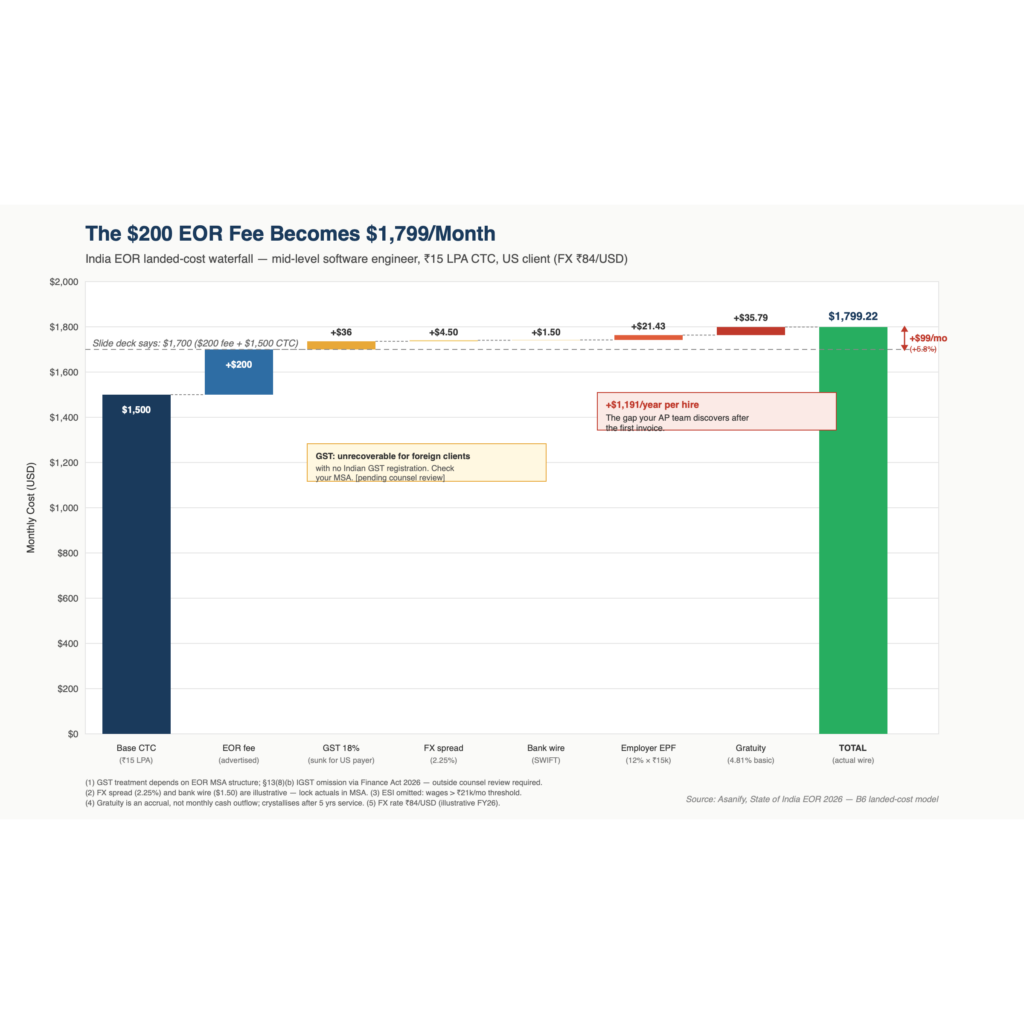
Figure D3 — India EOR landed cost waterfall: $1,500 base CTC → $1,799 actual landed cost.
TL;DR — B6: The advertised EOR fee is not what you pay. Add 18% GST (sunk if you have no Indian GST registration), an FX spread, employer EPF contributions, and gratuity provisioning — and a $1,500 CTC hire with a $200 management fee ($1,700 quoted) becomes ~$1,800/month in total. The gap between the quoted and actual cost is not a rounding error. The waterfall table in this section shows every line item.
Most India EOR quotes give you two numbers: the management fee ($150–$200/month) and the employee CTC (passed through at cost). Together on the proposal they look like ~$1,700. The actual loaded monthly cost for a mid-level engineer in Bengaluru is closer to $1,800. Here is where the $98 gap comes from.
The advertised EOR fee is the first number on the quote and the last number a CFO should trust. Between “$200 per employee per month” and what your AP team actually wires to India sits a stack of statutory provisions, an indirect-tax classification fight that the Indian government spent eight years not finishing, and an FX line item nobody puts on the slide.
📊 WHAT GST APPLIES TO YOUR EOR INVOICE? — THREE SCENARIOS
Scenario A — Zero-rated (you pay no GST): Your EOR has filed a Letter of Undertaking (LUT) with Indian tax authorities and invoices its service as a zero-rated export. This is the correct treatment for a well-structured India-specialist EOR. Ask for the LUT Application Reference Number (ARN).
Scenario B — 18% GST, recoverable: You have an Indian GST registration (i.e., your company is India-resident or has a GSTIN). The 18% is a working-capital drag, not a permanent cost — you claim it back as input tax credit against your output GST liability.
Scenario C — 18% GST, sunk cost: You are a foreign company with no Indian GST registration. The 18% is a permanent cost with no recovery mechanism. On a $200/month EOR fee, that is $36/month per employee, unrecoverable, for the life of the engagement.
The first question to ask any EOR provider: “Do you hold an LUT, and will my invoice be zero-rated?” If the answer is vague or deferred, you are likely in Scenario C.
The two statutory anchors
The Central Goods and Services Tax Act 2017 defines the taxable event. Section 7(1) provides that “supply” includes “all forms of supply of goods or services or both such as sale, transfer, barter, exchange, licence, rental, lease or disposal made or agreed to be made for a consideration by a person in the course or furtherance of business” (CGST Act §7, taxguru reproduction). Schedule III to the Act carves out “services by an employee to the employer in the course of or in relation to his employment” — the salary line between EOR and Indian employee is GST-free. The EOR fee invoiced by the Indian provider to the foreign client is not.
Whether 18% IGST actually sticks to that EOR fee, or whether the invoice qualifies as zero-rated export of services, is decided by Section 13 of the IGST Act 2017. The relevant sub-section for years was §13(8)(b), which “previously deemed the place of supply for ‘intermediary services’ to be the location of the supplier of services” (a2ztaxcorp on 56th GST Council) (b) as confirmed by article body and 56th GST Council press release). If the Indian EOR was tagged as an “intermediary” under §2(13) IGST — “a broker, an agent or any other person, by whatever name called, who arranges or facilitates the supply of goods or services or both… between two or more persons, but does not include a person who supplies such goods or services or both… on his own account” — the place of supply collapsed back to India, and 18% IGST became unrecoverable for the foreign payer.
The CBIC clarification, and the one that came eight years later
CBIC Circular No. 159/15/2021-GST (September 2021) set the four-part test for intermediary status:
- Minimum of three parties
- Two distinct supplies: a main supply between principals and an ancillary facilitation supply
- Supplier must have “the character of an agent, broker or any other similar person”
- Key carve-out: “intermediary does not include a person who supplies such goods or services on his own account”
The circular further stated (IndiaFilings reproduction of Circular 159). The circular also stated, in terms, that “sub-contracting is not an intermediary service” and that “services outsourced to India or performed in India for foreign entities will not be considered intermediary services” (CBIC Circular No. 159/15/2021-GST, §§ “Critical carve-outs,” reproduced via IndiaFilings). An EOR signing employment contracts in its own name, paying salary and EPF and ESI under its own PAN and TAN, and invoicing the foreign client for a defined deliverable is not facilitating anything between two principals. It is selling its own service.
The 56th GST Council, on 3 September 2025, recommended omitting clause (b) of Section 13(8) entirely, with the stated objective of “enabl[ing] Indian exporters of such services to claim export benefits” — moving the place of supply for intermediary services to the recipient’s location under the default rule of §13(2) (56th GST Council recommendation, a2ztaxcorp). The omission was enacted by Finance Act 2026.
That changes the historical risk picture. It does not remove the new one.
The new trap: manpower-supply characterisation
In Re: Pacific Staffing Solutions (UPAAR Order dated 30 October 2024), the Uttar Pradesh Authority for Advance Ruling held that “supply of manpower for work in India to foreign clients having no permanent establishment here will not be treated as export of services and accordingly attract GST,” reasoning that “the place of supply of service shall be the location where the services are actually performed” (TaxO summary of UPAAR Pacific Staffing).
AAR rulings are binding only on the applicant and the jurisdictional officer. But a state authority reading the place-of-supply rule this way is a precedent the litigation desk does not ignore. An EOR positioned in its MSA as a “facilitator” or “manpower agency” gives the assessing officer a clean argument. An EOR positioned as a principal employer providing a defined service does not.
Where the rate actually lands
For an Indian-resident client, the 18% IGST or CGST/SGST charged by the EOR is recoverable as input tax credit against the client’s output GST liability — input tax credit on GST-registered B2B invoices is governed by CGST Act §16(1), which makes ITC available to a registered person in respect of goods or services received, used in the course or furtherance of business (CGST Act §16, eligibility for input tax credit). It is a working-capital drag, not a P&L line. For a foreign client with no Indian GST registration, the same 18% is sunk: there is no Indian output liability to credit it against. This is the asymmetry the global EOR providers’ price comparisons quietly skip.
Principal-to-principal posture. Asanify operates on the principal-to-principal model that CBIC Circular No. 159/15/2021-GST recognises as outside the intermediary definition. The substantive markers are in place. Asanify signs employment contracts with each Consultant in its own name, pays salary, EPF, and ESI under its own PAN and TAN, and invoices the foreign client for a defined service deliverable rather than for the worker’s individual hours. Asanify holds a current Letter of Undertaking under the GST regime and invoices cross-border supplies to foreign clients without an Indian GST registration as zero-rated export of services. Foreign clients with an Indian GST registration recover the 18% IGST as input tax credit. The MSA’s tax-change clauses cover the cost allocation if a GST authority later reclassifies the supply.
The full landed-cost waterfall — $1,700 quoted vs. $1,800 actual
| Line | Amount | Note |
|---|---|---|
| Employee CTC | $1,500 | ₹16.2 LPA at ₹90/$ — the number in your offer letter |
| EOR management fee | $200 | Per employee per month |
| Total as quoted | $1,700 | What the CFO spreadsheet shows |
| + 18% GST on management fee | $36 | Sunk for US clients without an Indian GST registration |
| + FX markup on INR remittance | $4.50 | ~2.25% spread on USD→INR wire, illustrative |
| + Bank wire / TT charge | $1.50 | SWIFT corridor fee, amortised |
| + Employer EPF | $20 | 12% on ₹15,000 wage ceiling = ₹1,800/month at ₹90/$ |
| + Employer ESI | $0 | ₹16.2 LPA employee exceeds the ₹21,000/month ESI wage ceiling |
| + Gratuity provisioning | $36 | 4.81% × basic (50% of CTC = ₹67,500/month) = ₹3,247/month at ₹90/$ |
| Actual loaded monthly cost | ~$1,798 | ~$1,800 in practice — $98 above the quoted $1,700 |
Exchange rate: ₹90/$ (illustrative). EPF: 12% employer contribution on ₹15,000 statutory wage ceiling = ₹1,800/month. Gratuity: 4.81% × basic (50% of CTC = ₹67,500/month) = ₹3,247/month; formula per Payment of Gratuity Act 1972 §4. ESI: not applicable — ₹16.2 LPA employee exceeds ₹21,000/month gross wage ceiling. FX spread and bank charge are illustrative; lock actual spread in the MSA.
The $98/month gap per hire — the $200 management fee effectively costs $262 after GST and charges, and the $1,500 CTC effectively costs $1,556 after employer contributions — is the arbitrage-evaporation mechanism in one line.
what your AP team needs to ask before processing an India EOR invoice
- How is the EOR’s service characterised under the MSA, and does that characterisation support a principal-to-principal export-of-services position? Even post-omission of IGST §13(8)(b), a manpower-supply characterisation (UPAAR Pacific Staffing, October 2024) can strip export-of-services status under a different place-of-supply rule. The MSA’s recitals and operative description of the service together govern the characterisation question.
- Does the invoice show GST as zero-rated export, or as 18% IGST? If 18%, ask for the basis.
- Is the EOR holding an LUT (Letter of Undertaking) so it can invoice exports without paying tax upfront? Absence is a flag.
- Are statutory employer contributions (EPF, ESI, gratuity provisioning, Labour Welfare Fund) inside the per-employee fee or pass-through? “Inside” is cleaner; “pass-through” needs a reconciliation cadence.
- What FX rate and spread does the provider apply on INR-denominated employer costs? Lock the spread in the MSA.
- If GST treatment changes post-invoice (a re-assessment, a new AAR), who bears the tax — the EOR or the client? The MSA’s tax-gross-up clause decides this.
The §13(8)(b) omission — once its gazette-effective date is confirmed — is a genuine regulatory tailwind for India-specialist providers who can credibly hold principal-to-principal status. The UPAAR Pacific Staffing line is the offsetting risk for any provider whose MSA still reads like a labour-supply contract.
Want to model your actual India EOR cost? The variables that shift the waterfall most are salary level and whether you have an Indian GST registration. Get your cost breakdown →
Three questions to align with your EOR provider on GST and landed cost
-
LUT and zero-rated invoicing. Does the EOR hold a current Letter of Undertaking under the GST regime, and will it invoice cross-border supplies to foreign clients as zero-rated export of services? If yes, ask for the LUT reference number. If no, ask what the invoicing posture is and what your landed cost looks like with 18% IGST sunk.
-
MSA characterisation. How is the service described in the MSA recitals and the operative clauses? A principal-to-principal characterisation supports the export-of-services position; an intermediary or manpower-supply characterisation is the exposure UPAAR Pacific Staffing flagged. Ask your tax counsel to read the MSA against CBIC Circular No. 159/15/2021-GST.
-
Reclassification risk allocation. If a GST authority later reclassifies the supply (manpower supply, intermediary, or otherwise), who bears the incremental tax? The MSA’s tax-change or tax-gross-up clauses decide this. Read them before signing; the default in most India-specialist EOR MSAs is that the foreign client bears the incremental cost.
B7. The Labor Code state notification tracker: one law, 36 implementation schedules
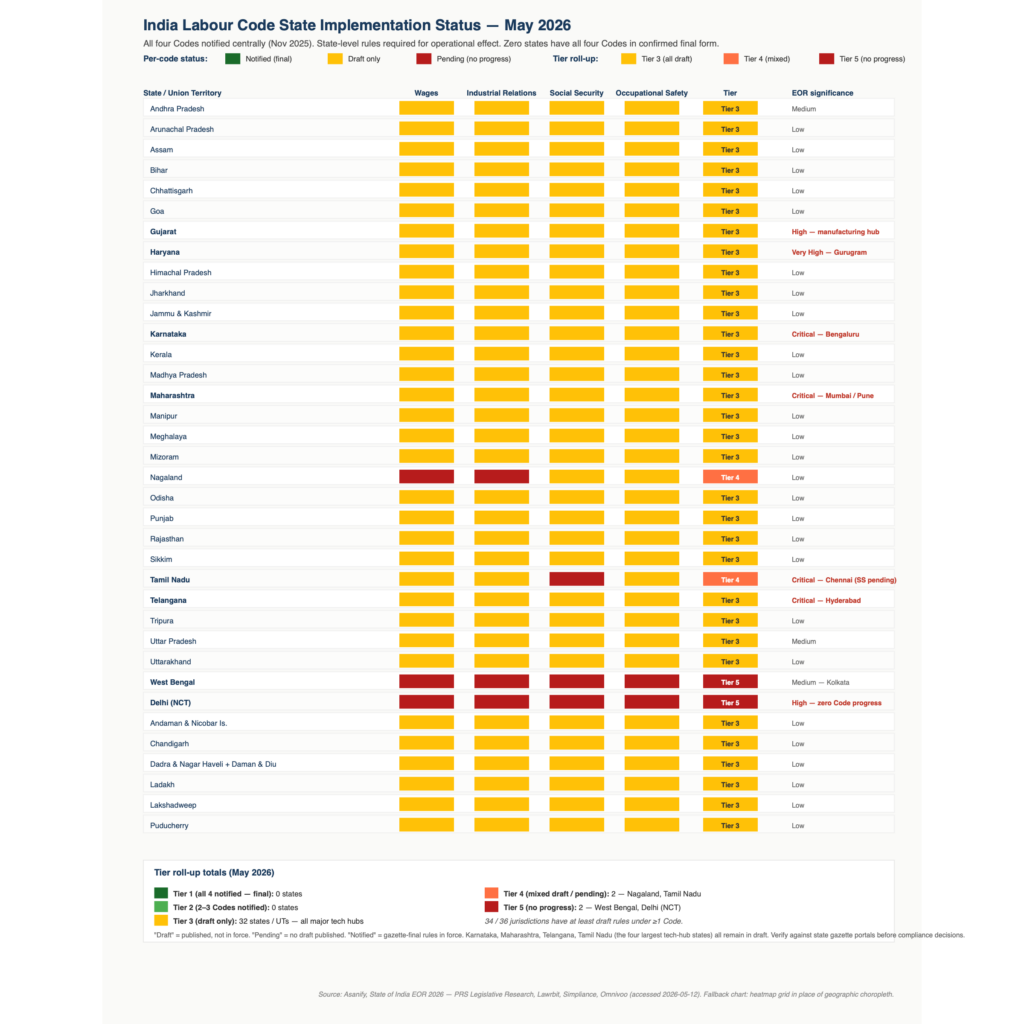
Figure D7 — Labour Codes 2026 notification status by state and code (critical EOR states bolded).
TL;DR — B7: Four new Labour Codes were centrally notified on November 21, 2025 — but state-level implementation rules remain incomplete across most of India’s major hiring states (Bengaluru, Mumbai, Chennai, Hyderabad). Until your state finalises its rules, your employment terms sit in a transition grey zone. The two most immediate cost impacts: the 50% wage allowance cap will increase EPF and gratuity obligations for salary structures built before 2025, and fixed-term employment is now explicitly legalised.
On November 21, 2025, India’s central government notified all four Labour Codes — the Code on Wages, 2019; the Industrial Relations Code, 2020; the Code on Social Security, 2020; and the Occupational Safety, Health and Working Conditions Code, 2020 — repealing the 29 central statutes they consolidate (PIB Press Release PRID=2147926). On 8 May 2026, central rules under all four Codes were gazetted, operationalising the Codes at the central level (KNN India; KPMG GMS Flash Alert 2026-007). What remains is the state-level notification cycle in each of India’s 28 states and 8 Union Territories. The headline read like simplification. The mechanics did not.
Labour is on the Concurrent List of the Indian Constitution: until a state notifies its final rules under a given Code, employers in that state operate on a hybrid of (a) the now-repealed underlying Acts where transitional provisions allow, and (b) the new Code’s substantive text without the procedural detail. PRS Legislative Research’s running tracker shows that as of May 2026 most states have draft rules across all four Codes — but “draft” is not “in force.”
The five states that decide foreign-EOR economics
Five states absorb the overwhelming share of foreign-parented India hiring: Karnataka, Maharashtra, Tamil Nadu, Telangana, Haryana. As of May 2026, four of these five have no Code in confirmed final form — draft rules only, with central-rule alignment still pending. Karnataka has additionally enacted its own Platform-Based Gig Workers Act (2025), which intersects with — and partially pre-empts — the Code on Social Security’s gig-worker chapter. Telangana has issued minimum-wage orders under the new wages definition effective 1 April 2026. The other three (Maharashtra, Tamil Nadu, Haryana) are in continuous draft-iteration as of publication.
A 50-engineer team distributed across Bengaluru, Mumbai, Chennai, and Hyderabad navigates four different rule-sets in the 2025–2027 window — and the rule-set in each state is itself a mix of new-Code substantive law and old-Act procedure.
Why this matters for a multi-state India workforce
The 50% allowance cap is the immediate payroll-cost exposure. The Code on Wages, 2019, Section 2(y) defines “wages” such that allowances excluded from the wage definition cannot exceed 50% of total remuneration. If they do, the excess is deemed wages for PF, gratuity, bonus, and leave encashment calculations (EY India Alert, November 2025). Many Indian salary structures historically had base wage below 40% of CTC, with the remainder in HRA, conveyance, and special allowances — structured precisely to minimise PF, gratuity, and bonus exposure. The 50% cap pulls the excess back into “wages,” materially increasing statutory contribution obligations on existing salary structures.
The retrenchment threshold has changed substantively — but procedurally, most states still run on the old IDA forms. The Industrial Relations Code raises the prior-government-permission threshold for retrenchment from 100 workers to 300 (PRS Legislative Research) — the single largest deregulation in Indian labour law in decades. For an EOR user at 50 employees, the procedural trigger is now well past their headcount plan. But until state IR Code rules are finalised, the procedural mechanics (forms, timelines, labour commissioner role) remain governed by the old Industrial Disputes Act 1947 regime in most hub states.
Three other Code changes are directly material to EOR structuring. (1) Fixed-term employment is now explicitly legitimised under the IR Code; project-based EOR hires that previously existed in a grey zone can be structured as fixed-term from day one, with the same statutory benefits as permanent employees on a pro-rated basis (PRS Legislative Research). (2) The “worker” definition under the IR Code (technical, clerical, operational, manual functions) is broader than the old IDA definition and may capture more roles in tech companies than previously assumed — particularly individual contributors who are neither managers nor supervisors (ICLG 2026). (3) The Code on Social Security, 2020, introduces a statutory “gig worker” and “platform worker” category — a third classification alongside employee and independent contractor, with contribution obligations on aggregators (Code on Social Security 2020, gig and platform worker chapter; consult primary text at indiacode.nic.in for the operative section number).
The transition window will close. The Codes are not going away. But the 18–24 months ending in 2027 are exactly when foreign hiring decisions get audited, and exactly when the gap between “we hired in India” and “we’re compliant in the state where they live” is widest.
Three questions to align with your EOR provider on the Labour Code transition
-
State-by-state tracking cadence. Does the EOR maintain a standing tracker of central and state Labour Code rule notifications across the 36 jurisdictions? What is the review cadence, and does the EOR flag changes proactively to the foreign principal, or update silently in the next payroll cycle?
-
Payroll structure review on notification. When a state in your team’s footprint notifies final rules under any of the four Codes, what is the EOR’s typical lead time before the engagement-specific payroll structure is reviewed and any required changes are implemented (50% allowance cap, statutory contribution base, fixed-term employment clauses)?
-
Multi-state coordination. If your team is distributed across multiple states (Bengaluru, Mumbai, Chennai, Hyderabad, Gurugram), how does the EOR coordinate compliance across the different state notification timelines and the different state Shops and Establishments and Labour Welfare Fund regimes? Confirm that PT, PF, ESI, and LWF filings are managed per state, not as a single national filing.
B8. Termination, Gratuity, and the Cost of an Indian Exit
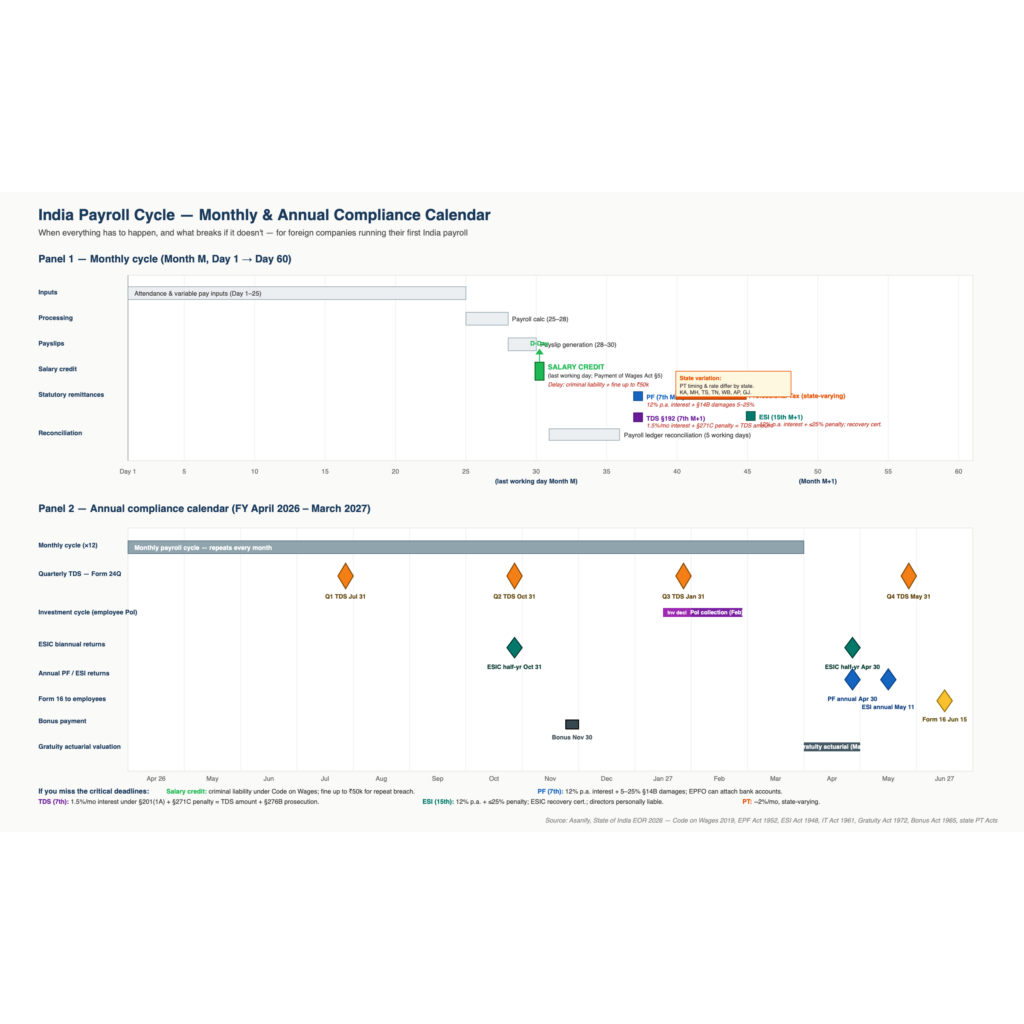
Figure D8 — India payroll compliance cycle: 60-day monthly view + FY 2026–27 annual overlay.
TL;DR — B8: India has no at-will employment. Exiting an India EOR employee costs significantly more than most foreign companies budget for — typically 2–4 months of total cost in a retrenchment scenario. The exit process has three legally distinct pathways (resignation, retrenchment, misconduct), each with different cost structures and procedural requirements. Skip the required procedure on a misconduct termination and it converts automatically into a retrenchment — with the full cost attached. Full-and-final settlement must be completed within 2 working days.
India is not at-will. That single fact, more than any other, is what foreign buyers underestimate when they price an India EOR engagement against an Austin or Berlin one. The contract a US founder signs in Delaware does not import to Mumbai. The legal employer is the EOR; the statutory floor is set by the Indian state; and the exit cost — when it comes — is a waterfall, not a line item.
Three pathways, three cost structures
Before the statute matters, the exit type matters. Indian law distinguishes three legally separate pathways:
- Resignation — initiated by the employee. Gratuity crystallises once the five-year (or 4-year-240-day) threshold is crossed; no statutory severance under Section 25F applies.
- Retrenchment / redundancy — employer-initiated, no misconduct alleged. Section 25F requires notice, retrenchment compensation, and government notification. Gratuity applies if the vesting period is met.
- Misconduct termination — no notice or Section 25F compensation is owed, but only if the employer follows a Standing Orders–compliant disciplinary inquiry first. Skip the inquiry and a misconduct dismissal becomes an unlawful retrenchment — with the full §25F cost attached.
📊 WORKED EXAMPLE — EXIT COST FOR A 3-YEAR INDIA HIRE
Engineer, $16,700/year CTC (₹15 LPA), Bengaluru, 3 years continuous service, employer-initiated retrenchment (not misconduct). FX assumed ₹90/$.
| Cost item | Amount | Notes |
|---|---|---|
| Notice pay | $1,389 (₹1,25,000) | 2 months contractual notice at $694/month (₹62,500) |
| Retrenchment compensation (§25F) | $801 (₹72,115) | 15 days avg pay × 3 completed years |
| Earned leave encashment | $694 (₹62,500) | 30 days basic+DA |
| Gratuity | $0 | Does not vest — 3 years is below the 4y-240d threshold |
| EPF settlement | Negligible | Final month contribution + Form 19/10C |
| Total employer cost | ~$2,900–$3,300 (~₹2.6–3.0 lakh) |
At 5 years tenure, add gratuity of ~$2,000 (₹1,80,288). At 4 years + 240 working days, the same gratuity applies — the Mettur Beardsell rule.
Settlement must be completed within 2 working days (except Gratuity) of the last working day under Code on Wages 2019, §17(2). An EOR running a monthly payroll batch cannot structurally meet this deadline.
A foreign buyer who reads only the statutory floor section and budgets for Section 25F on a resignation will overestimate exit cost. A foreign buyer who assumes at-will applies to a misconduct scenario and skips the inquiry will face the same bill as a retrenchment, plus the litigation cost.
The statutory floor (and who it binds)
Two statutes do the heavy lifting — for workmen.
The Industrial Disputes Act 1947 governs the dismissal of “workmen” — a category defined in Section 2(s) that, despite its industrial-era name, captures a meaningful slice of modern tech and back-office hires. Section 25F sets the conditions precedent to retrenching any workman with at least one year of continuous service. Per the verbatim text of the section as published on Indian Kanoon doc/1056316, the employer must satisfy three conditions before the retrenchment is lawful:
(a) the workman has been given one month’s notice in writing indicating the reasons for retrenchment, or wages paid in lieu; (b) the workman has been paid, at the time of retrenchment, compensation which shall be equivalent to fifteen days’ average pay for every completed year of continuous service or any part thereof in excess of six months; (c) notice in the prescribed manner is served on the appropriate Government or such authority as may be specified by the appropriate Government by notification.
The “or any part thereof in excess of six months” qualifier in condition (b) has practical weight: an employee with 3.8 years of continuous service earns four increments of the 15-day compensation, not three. A reader who takes the narrative summary and ignores the qualifier will under-model the cost at mid-tenure exit points.
Section 25N escalates the regime for “industrial establishments” employing one hundred workmen or more on average in the preceding twelve months: three months’ written notice, plus the prior permission of the appropriate Government before the retrenchment may proceed. The Industrial Relations Code 2020 (effective 21 November 2025 per the EY India Labor Codes advisory) raises that 100-workman threshold to 300, with delegated power for state governments to lift it further by notification — but the consent-of-the-state mechanic survives in the IR Code’s equivalent provision.
A foreign buyer with twelve India hires through an EOR rarely triggers Section 25N on its own. Per the IDA text, “industrial establishment” in the Section 25N context refers to the employing entity’s aggregate headcount — and the legal employer is the EOR, not the foreign client. The EOR’s aggregate headcount across all its clients may cross 100 workmen (or 300 under the IR Code) even if the foreign client has only a handful of India employees.
The second statute is the Industrial Employment (Standing Orders) Act 1946. Its mechanics are procedural: covered establishments must publish standing orders that define termination grounds, the categories of workers covered, and the inquiry process for misconduct. The Act covers industrial establishments employing 100 or more workers at its base threshold; the Central Government exercised its delegated power to reduce this to 50 or more workers for establishments in its appropriate-government jurisdiction (Central Government establishments, Railways, major ports, mines, and oil fields). These two thresholds are distinct from the §25N 100-workman figure: a Central-Govt-jurisdiction establishment with 60 workers must comply with Standing Orders but does not require §25N government permission for retrenchment. The Standing Orders Act is being subsumed by the Industrial Relations Code 2020, and the Model Standing Orders under the IR Code carry forward the same architecture — written rules, charge-sheet, opportunity to respond, witness examination — for any termination that the employer wants to defend later.
The “workman or not” question
The IDA’s procedural protections attach only to “workmen” as defined in Section 2(s). Non-workmen — senior managerial, administrative, supervisory — are governed by their employment contract and the relevant state Shops & Establishments Act. Per AZB & Partners’ 22 September 2025 employment-termination playbook, foreign-EOR India hires in software engineering, analysis, and design categories sit on what AZB describes as the “contested edge” of the workman definition — where the classification is litigated rather than clear-cut. Cross-reference B4: many termination disputes in India start as a misclassified-contractor claim and only become a termination claim once the contractor pleads, successfully, that they were an employee all along.
Notice period: where foreign employers get it wrong
The statutory minimum for a workman is one month’s notice (or pay in lieu) under Section 25F. The contractual minimum is whatever the employment letter says — and Indian employment letters routinely specify two or three months. Per AZB’s verbatim text, “contractual notice periods supersede statutory minimums when longer.” A US-headquartered company that drafts its India offer letter on a Delaware template and sets a “30-day at-will” notice clause discovers two things: the below-statutory notice clause does not govern (Indian courts apply the statutory minimum as a floor that a contract cannot undercut, per ICLG India Employment & Labour Laws 2026), and the longer of statute-versus-contract governs both directions.
The second common mistake is treating poor performance as misconduct. Per AZB, “poor performance alone doesn’t constitute ‘misconduct’ unless accompanied by insubordination.” A clean performance-based termination requires documented expectations, written notification of shortcomings, and a performance improvement plan. Skip the PIP and the dismissal is exposed.
Gratuity: the 4-year-240-day line
The Payment of Gratuity Act 1972 Section 4 is the second statutory cost. Per the verbatim text on Indian Kanoon doc/1934248, gratuity vests after five years of continuous service at separation — superannuation, retirement, resignation, death, or disablement. The formula is: last drawn (basic + DA) × 15/26 × completed years of service, capped at ₹20,00,000. The divisor is 26 (working days per month, not 30 calendar days) — the distinction matters when modelling exit cost: dividing by 26 produces a higher daily rate than dividing by 30, increasing the per-year gratuity accrual by approximately 15%.
Two wrinkles matter for exit planning.
First, the death-or-disablement exception waives the five-year requirement. Second — and this is the line foreign employers miss — the Madras High Court in Mettur Beardsell Ltd. v. Regional Labour Commissioner (Central), Madras (1998 LLR 1072) held that an employee with 4 years, 10 months, and 18 days of service was entitled to gratuity, on the reasoning that Section 2A of the Act deems 240 working days in the twelfth month of the fifth year as a completed year of continuous service. The rule — that gratuity crystallises at roughly 4 years and 240 days, not literal 5 years — is the operative planning assumption used by Indian counsel.
The “we’ll part ways at 4 years 11 months to avoid gratuity” plan therefore does not work. Under the Mettur Beardsell line of cases, the obligation has already crystallised.
Gratuity calculation: the formula that surprises most foreign CFOs
Gratuity = (Last drawn basic + DA) × 15/26 × completed years of service
For a ₹15 LPA hire with 50% basic (₹7.5L basic = ₹62,500/month basic): – Per year of service: ₹62,500 × 15/26 = ₹36,057 – After 5 years: ₹1,80,288 (~$2,000 at ₹90/$) – After 3 years + 240 days in year 4 (Mettur Beardsell threshold): ₹1,28,778
Note: The divisor is 26 (working days per month), not 30 (calendar days). Using 30 understates the liability by ~15%.
Full and final settlement: 2 working days
The Code on Wages 2019 compresses the historically slow Indian settlement timeline. Per AZB & Partners’ 22 September 2025 analysis of the Code on Wages: “an employee who is terminated and an employee who resigns from employment are entitled to receive their wages (including statutory severance if applicable) within two working days from the last working day.” In practice that means the EOR has 48 hours from last working day to compute and pay: final salary, encashment of earned leave, bonus pro-rata, reimbursements, and any contractual severance. Settlement within two working days of the last working day is structurally challenging for any EOR running on a monthly payroll cadence. Ask any prospective EOR how it has operationalised the Code on Wages §17(2) clock and what its actual settlement turnaround was on its last three offboardings.
The exit waterfall
The table below applies to a workman-classified employee with five-plus years of service in a retrenchment scenario. Item 3 does not apply to misconduct terminations or to non-workman employees; item 4 (gratuity) applies to all employees in establishments with ten or more workers once the five-year (or 4-year-240-day) threshold is met. A non-workman’s waterfall runs items 1, 2, 4, and 6 only.
Stacked together, the cost of a single Indian exit runs:
- Notice — one month statutory minimum under §25F, often two or three contractual months (paid out at full salary).
- Earned leave encashment — typically capped at 30–45 days of basic + DA depending on state Shops & Establishments rules.
- Statutory retrenchment compensation under Section 25F — 15 days’ average pay × (completed years of continuous service + any fractional year exceeding six months), applicable only where the employee is a workman under IDA §2(s) and the exit is a retrenchment (not misconduct, not resignation).
- Gratuity under Section 4 of the 1972 Act — last drawn (basic + DA) × 15/26 × completed years, capped at ₹20 lakh, payable once the 5-year (or 4-year-240-day Mettur Beardsell) threshold is crossed. Applies universally to all employees in establishments with ten or more workers, regardless of workman status.
- EPF — the employee withdraws or transfers the corpus; the employer’s obligation is settlement of the final month’s contribution and Form 19/10C processing.
- Any contractual severance the employment letter promised on top.
- Dispute reserve — the cost of defending the termination if it ends up before a Labour Court or Industrial Tribunal.
The dispute pathway
A workman whose termination breached Section 25F can file before the Labour Commissioner, who may refer the matter to a Labour Court or Industrial Tribunal under the IDA. A non-workman litigates as a civil claim — slower and more expensive, but without the workman-specific procedural floor. The practitioner range for an adversarial Industrial Tribunal proceeding is . Reinstatement with back wages remains a live remedy when retrenchment procedure was not followed. The foreign client signs the MSA in dollars; the dispute reserve is held in rupees by the EOR. Whether the MSA passes that liability through, caps it, or absorbs it is the most consequential clause in the contract and the one most often left at template default.
Exit waterfall modelling and execution. Foreign principals planning an India exit can request an exit-waterfall model from Asanify for the specific hire, tenure, and exit scenario (notice pay, leave encashment, §25F retrenchment compensation where the worker is classified as a workman and the exit is retrenchment-not-misconduct, gratuity where the 4-year-240-day threshold is crossed under the Mettur Beardsell line, and any contractual severance the offer letter promised). Once the foreign principal has pre-funded the statutory and contractual termination costs, Asanify coordinates the final payroll, the Code on Wages §17(2) settlement workflow, the §25F government notice where applicable, and the F&F documentation. Pre-funding is the standard structure in India-specialist EOR MSAs and protects both parties; an exit cannot lawfully proceed without the funded statutory costs in hand.
Eight termination mechanics to inspect in any EOR’s playbook
These eight items are where India termination disputes typically break down. The list below is descriptive of an EOR’s termination playbook; depth of practice on each item varies materially across providers and is worth verifying directly.
- Classification at offer. Confirm in writing whether the role is workman or non-workman under IDA Section 2(s). Don’t leave it for litigation to decide.
- Standing orders or IR-Code Model Standing Orders. For covered establishments (50+ workers in Central-Govt-appropriate-government establishments; 100+ otherwise), the EOR must have published, certified standing orders covering termination grounds and the inquiry process. Without them, every misconduct termination is exposed.
- Notice clause discipline. The longer of statute or contract governs. Indian courts treat the statutory minimum as a floor that contract cannot undercut. Templates copied from US offer letters fail.
- PIP documentation for performance terminations. Written expectations, written shortfall notice, documented opportunity to cure.
- Charge-sheet + inquiry for misconduct. Natural-justice procedure, witness examination, opportunity to respond.
- Section 25F notice to government where the exit is a retrenchment; §25N prior government permission where the EOR’s aggregate headcount crosses 100 workmen (or 300 under the IR Code 2020) — it is the EOR’s aggregate headcount, not the foreign client’s, that governs.
- 2-working-day full-and-final settlement under the Code on Wages 2019 (per AZB’s analysis) — computed and paid, not just initiated.
- Gratuity calculation at 4y 240d, not 5y, where the Mettur Beardsell line applies. Formula: last drawn (basic + DA) × 15/26 × years of service.
Planning to exit an India EOR hire? Asanify models the full exit waterfall — notice pay, retrenchment compensation, gratuity (including the 4y-240d Mettur Beardsell threshold), and earned leave encashment — for your hire’s specific tenure and structure. Book an exit planning call →
A foreign buyer cannot inspect any of this in a vendor demo. The right question to ask is whether the EOR’s last termination went through a Labour Court — and what the award was.
Three questions to align with your EOR provider on India exits
-
Pre-funding mechanics. What does the EOR require from you to initiate an exit (notice, retrenchment compensation, gratuity, leave encashment, contractual severance, dispute reserve)? When is funding due, and how does the EOR handle a Customer who funds late? An exit cannot lawfully proceed in India without the statutory costs in hand.
-
§17(2) settlement workflow. The Code on Wages 2019 requires full-and-final settlement within two working days of last working day. How does the EOR operationalise this clock on its payroll system, and what was its actual settlement turnaround on its last three offboardings?
-
Documentation chain. Does the EOR maintain a complete documentation chain (offer letter, performance reviews, written warnings, charge-sheet, inquiry record, settlement statement) for every exit, available for tax-assessment audit and for defence in any future labour-tribunal claim?
B9. When to Set Up Your Own India Entity — The EOR Crossover Model
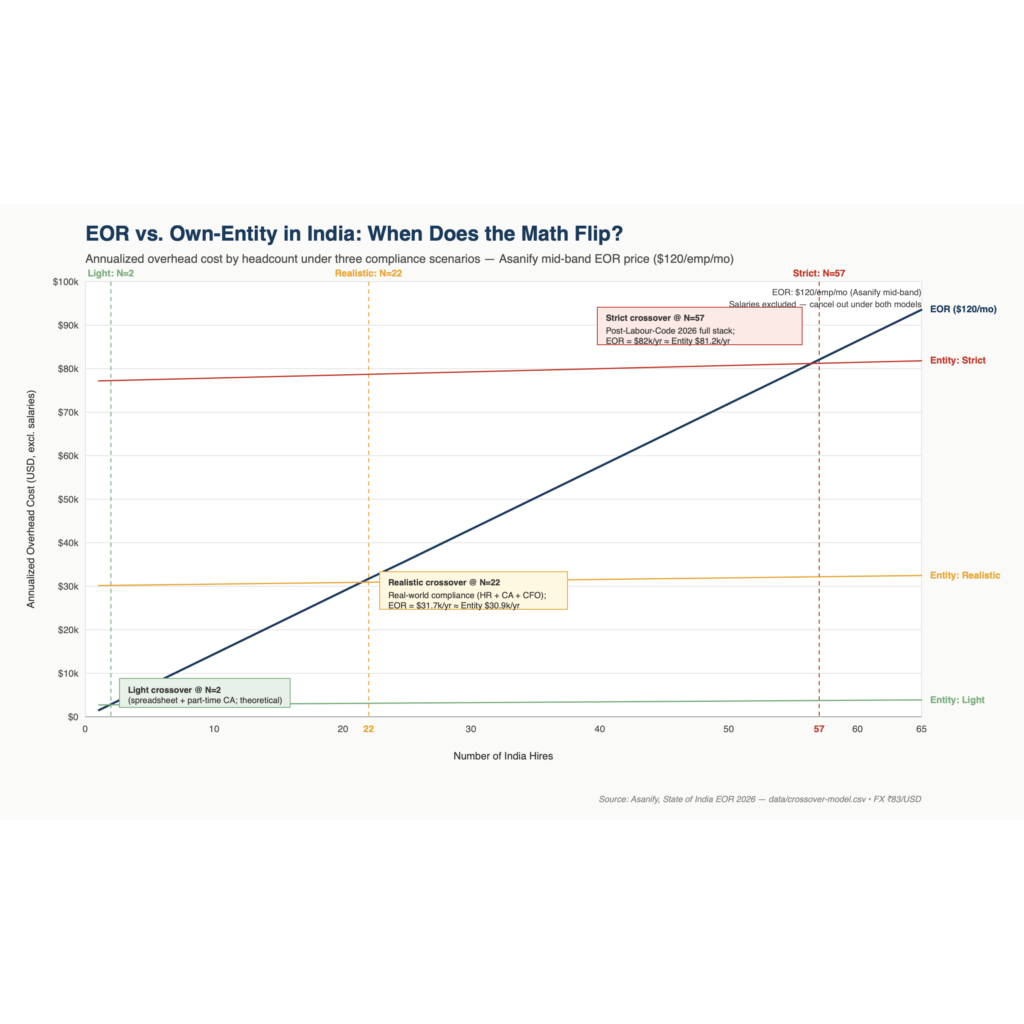
Figure D2 — EOR vs own-entity landed-cost crossover (52-employee threshold).
TL;DR — B9: The widely cited EOR-to-entity crossover figure is “around 25 employees.” That number models a compliance-light scenario that Indian outside counsel typically recommend strengthening. Under full post-Labour-Code compliance, the India-side crossover is ~52, or ~57 including US-side accounting overhead (Form 5471, US-side TP documentation, consolidated audit). Under the realistic scenario, US-side overhead shifts the crossover to ~28–35 employees. For most Series B–D companies, EOR is the right structure for their entire India hiring plan.
The question is not whether an India entity makes sense. It is at which headcount it becomes cheaper than EOR — and under which compliance scenario you are planning.
A broad sweep of global EOR provider websites and vendor decks returns the same crossover figure: around 20 to 25 employees. The number is mathematically defensible. It is also materially incomplete, because it assumes a compliance posture that does not survive contact with the Companies Act, the Income Tax Act, or the four Labour Codes.
What follows is a three-scenario model. Same EOR price band ($99–$200/employee/month). Same India CTC for the hires themselves (held constant; it cancels out). The only variable is the entity-side compliance posture. The strict scenario is the citable finding.
The line items, sourced
For a wholly-owned subsidiary in India, the cost stack splits cleanly into four buckets: (1) one-time incorporation, (2) annual fixed compliance regardless of headcount, (3) per-employee variable compliance, and (4) optional risk-mitigation overlays that crossover calculators commonly treat as discretionary but that Indian tax counsel typically recommend for any subsidiary intending to scale.
One-time setup. Government incorporation fees are nominal — SPICe+ filing fee is zero for authorised capital up to ₹1 lakh, MOA/AOA filing is ₹200 each, stamp duty is state-variable at ₹500–₹2,000 (legalsuvidha 2025; mca.gov.in 403-blocked). Real setup cost is professional: legal incorporation runs ₹40,000–₹150,000 depending on firm tier; DSC/DIN for two directors ≈ ₹5,000–₹10,000; PF/ESI/PT/GST registration (free statutory, paid professional) ≈ ₹15,000–₹40,000 combined; and the line item most crossover analyses omit: an initial transfer-pricing study at entity formation, ₹150,000–₹400,000 if the parent will transact with the Indian subsidiary at all, which it will.
Annual fixed running cost. Statutory audit under Companies Act 2013 §139 (read with §143) is mandatory regardless of revenue. ICAI’s Revised 2025 Guidance Note on Tax Audit confirms the floor: “A statutory audit ensures compliance with the Companies Act, while a tax audit ensures compliance with the Income Tax Act” (a2ztaxcorp / ICAI Revised 2025). A small subsidiary pays ₹75,000–₹200,000 for the statutory audit alone; once turnover crosses the Section 44AB tax-audit threshold (₹1 crore for business, extended to ₹10 crore in specified non-cash cases) a separate tax audit is added. Foreign-parent subsidiaries with any international transaction with the parent — intercompany services, IP licensing, cost recharges — also file Form 3CEB under Income Tax Act §92E; for any operating subsidiary that is every year from go-live, and the TP-certification line runs ₹300,000–₹600,000 annually. ROC annual filings (AOC-4, MGT-7, DIR-3 KYC) cost ₹15,000–₹50,000. CA retainer for bookkeeping, GST, and TDS filings runs ₹60,000 at the small end up to ₹480,000 at a tier-1 firm (Incorpx 2026).
Per-employee variable. Outsourced payroll bureau cost is ₹400–₹1,200 per employee per month — call it ₹4,800–₹14,400 per employee per year (Incorpx payroll 2026). State-level PT and Labour Welfare Fund filings add ₹1,200–₹2,400 per employee per year, and rise sharply when hires span more than one state.
Headcount-overhead. A subsidiary that hires past ~10 employees needs a real HR/compliance manager. India HR salary benchmarks put the senior compliance band at $20,000–$28,000/year (₹18–25+ LPA) in Bengaluru and $17,000–$22,000/year (₹15–20 LPA) in tier-2 cities. Fractional CFO via firm runs ₹30,000–₹100,000 per month; a full-time finance controller runs $11,000–$22,000/year (₹10–20 LPA) mid-band.
Post-Labour-Code overlay. This is the line item that did not exist two years ago. The four Labour Codes — Code on Wages 2019, Industrial Relations Code 2020, Code on Social Security 2020, and OSH Code 2020 — substantially notified by Centre and pending state-by-state rules as of late 2025, change the gratuity calculation base, expand social-security coverage to fixed-term and gig workers, and tighten standing-orders applicability. EY India’s 2026 alert and India Briefing’s transition tracker both flag 2026 as the year compliance cost spikes before amortising; the line items range from ₹100,000 (legal advisory only, light scenario) to ₹400,000+ (state-by-state rule navigation, gratuity actuarial valuation under AS-15/Ind-AS 19, and welfare-board contributions, strict scenario). This is not even considering other compliance costs such as POSH (Prevention of Sexual Harassment at the workplace).
Three scenarios
The crossover formula is fixed: crossover N = annual_fixed / (eor_per_emp − entity_variable_per_emp).
The EOR midpoint at $120/emp/mo (₹90/$) = ₹1,29,600 per employee per year. That number does not move across scenarios. What moves is the entity-side cost stack, depending on how aggressively the buyer chooses to under-build compliance.
At a glance: the three scenarios
| Scenario 1: Compliance-Light | Scenario 2: Vendor-Realistic | Scenario 3: Post-Labour-Code Strict | |
|---|---|---|---|
| Who runs compliance | Founder + one CA on retainer | Fractional HR + mid-tier CA firm | Full-time senior HR + Tier-1 CA |
| Transfer-pricing study | None | Basic (at formation) | Annual Form 3CEB certification |
| Labour Code readiness | None | Partial | Full — including state-by-state tracking |
| IP assignment templates | Generic | Standard | Reviewed annually by Indian IP counsel |
| Annual fixed cost (INR) | ~₹2.25 lakh | ~₹24.65 lakh | ~₹64 lakh |
| India-side crossover | 2 employees | ~22 employees | ~52 employees |
| Incl. US-side overhead | 2 employees | ~28–35 employees | ~57 employees |
| Who publishes this number | Not commonly published | Most commonly cited figure (“around 25”) | This report |
| Defensible against AO inquiry | No | Partially | Yes |
| Right for whom | Nobody — indefensible | Series A/B with limited India risk | Series B+ with India as a real market |
EOR midpoint used: $120/employee/month (₹1,29,600/year at ₹90/$). Full line-item methodology in the scenarios below.
Scenario 1 — Compliance-light (~2 employees)
Founder runs payroll in a spreadsheet. One CA does books, GST, TDS, and audit for ₹5,000/month. No dedicated HR. No fractional CFO. No D&O. No ESOP plan. Just the statutory floor: audit (₹75,000), CA retainer (₹60,000), MCA filings (₹15,000), registered office proxy (₹90,000 recurring). Annual fixed: ~₹225,000. Per-employee variable: ₹1,500.
Crossover: 225,000 / (129,600 − 1,500) = 1.8 employees. Round up to 2.
This is the number every vendor crossover calculator effectively models, even when they publish 25. It is also a number no Indian outside counsel would let a CFO sign off on, because it leaves the company structurally unable to defend a PE position, a labour-code applicability question, or a transfer-pricing inquiry.
Scenario 2 — Compliance-realistic (~22 employees, vendor-canonical)
This is the scenario that backs into the trade-press number. Audit at ₹200,000 (mid-market subsidiary, including basic TP review). Mid-tier CA retainer at ₹240,000. Payroll SaaS at ₹180,000 baseline. Fractional senior HR/compliance at 0.6 FTE = ₹900,000. Fractional CFO via firm at ₹500,000. Multi-state PF/ESI/PT coordination at ₹60,000. FBP design at ₹40,000. ESOP filings at ₹150,000 (FEM (OI) Rules 2022 Schedule III + Cat-I Merchant Banker / Registered Valuer annual valuation, per Cyril Amarchand 2024). D&O insurance at ₹150,000. RBI FC-GPR/FLA at ₹15,000. Annual fixed: ~₹2,465,000. Per-employee variable: ₹3,000.
Crossover: 2,465,000 / (129,600 − 3,000) = 19.5 employees. Round to 22 (including US-side overhead, ~28–35).
This is where the widely cited “~25 employees” figure comes from. It is real arithmetic. But notice what is in the stack and what isn’t: there is a fractional HR person, not a full-time one. There is no in-house transfer-pricing capability. There is no Labour Code transition advisory. There is no IP-assignment-template review. The realistic scenario assumes the buyer has accepted the risks of those gaps, not that the risks don’t exist.
Scenario 3 — Compliance-strict, post-Labour-Code (~52 India-side; ~57 blended)
This is the citable finding.
A buyer who actually wants the protections the EOR was supposed to provide — and who is operating in 2026, the Labour Code transition year — pays for them. Statutory + tax + TP audit: ₹500,000. Tier-1 CA firm retainer (including FEMA and ESOP-specific work): ₹480,000. MCA filings with ROC scrutiny prep: ₹50,000. Payroll SaaS: ₹180,000. Senior, full-time, Labour-Code-fluent HR/compliance manager: ~$22,000/year (₹20 lakh). Dedicated payroll executive: ₹800,000. Higher-touch fractional CFO with FP&A: ₹1,000,000. Multi-state coordination: ₹150,000. FBP + group medical broker: ₹100,000. ESOP filings at higher grant volume: ₹400,000. IP-assignment legal templates and annual review: ₹150,000. Gratuity actuarial valuation: ₹75,000. Labour Code transition advisory: ₹200,000. D&O at higher limits: ₹300,000. RBI compliance: ₹15,000. Annual fixed: ~₹6,400,000. Per-employee variable: ₹6,000.
Crossover: 6,400,000 / (129,600 − 6,000) = 51.8 employees. Round to 52 India-side; ~57 including US-side overhead.
For a Series B–D tech company hiring 5–50 in India — the primary audience of this report — the strict-scenario crossover is past the hiring plan. The own-entity ROI argument doesn’t survive the first audit cycle.
One cost the crossover calculators never model: US-side accounting complexity
When a US company sets up an India wholly-owned subsidiary (WOS), the US side gets more complex — not just the India side.
- Form 5471 (IRS). A US parent with a controlled foreign corporation files Form 5471 annually. Preparation cost: $2,000–$8,000/year at a standard US CPA firm, rising with transaction volume.
- US-side transfer-pricing documentation. The India subsidiary needs Indian Form 3CEB (₹3–6 lakh/year). The US parent simultaneously needs contemporaneous TP documentation under IRC §482 to defend intercompany pricing at the IRS level. Combined annual TP cost: $15,000–$40,000.
- Consolidated audit fees. A US GAAP audit with a foreign subsidiary component typically adds $5,000–$15,000 to the US audit fee.
- FX remeasurement. ASC 830 (foreign currency translation) requires monthly FX remeasurement of the India entity’s financials. At 30+ India employees this warrants a dedicated workflow.
Add $20,000–$65,000/year in US-side incremental cost before the India crossover model even starts. At the realistic compliance scenario (22-employee India-side crossover), US-side overhead shifts the blended crossover to approximately 28–35 employees. At the strict scenario (52 India-side; ~57 blended), the US-side cost is less material as a percentage of the fixed base.
Sensitivity — what actually moves the number
The crossover headcount is sensitive in predictable directions.
- Multi-state hiring (3 states vs. 1) adds ~8 employees to the crossover. Each additional state of hire compounds PT, PF, and S&E coordination.
- Tier-2 city only vs. Bengaluru subtracts ~6 employees — senior compliance salary bands compress.
- EOR price at top of band ($200) subtracts ~12 employees from the realistic crossover; bottom of band ($99) adds ~9.
- US-side accounting overhead adds 6–13 employees to the realistic scenario crossover and 3–8 to the strict-scenario crossover.
- Labour Code transition year (2026 vs. steady-state 2028+) adds ~15 employees in the strict scenario. The compliance cost amortises after the first 18 months; in 2026 the bulk of it lands at once.
- ESOP intensity (half the employees on a plan vs. none) adds ~4 employees. FEMA Schedule III + OI Rules 2022 reporting are quarterly, valuation refresh annual.
- Role mix shift toward sales/finance (vs. pure engineering) adds ~3 employees via variable compensation administration and audit complexity.
Crossover modelling for your specific roadmap. Foreign principals approaching the crossover threshold under any of the three scenarios above can request a customized crossover model from Asanify that reflects their specific role mix, geographic distribution across India states, ESOP grant intensity, and US-side accounting overhead. Asanify will share the model proactively when a client’s India headcount approaches the realistic-compliance threshold of approximately 22 hires. When the math tips in favour of entity setup, Asanify will tell you so and support the transition rather than retain the engagement on the EOR model past the point where it makes economic sense for you.
The headline claim
Under post-Labour-Code-strict India compliance assumptions, the crossover is at 55+ employees. Add the US-side accounting complexity of running a foreign subsidiary — Form 5471, TP documentation, consolidated audit — and the realistic crossover moves to approximately 28–35 employees. The strict-scenario crossover remains past the entire India hiring plan of most Series B–D companies.
The widely cited 25-employee figure is the realistic-scenario answer rounded. It assumes a compliance posture that Indian outside counsel and chartered accountants typically recommend strengthening for any subsidiary that intends to scale. The strict-scenario answer is the one a CFO who has read this section should be quoting in the next board deck. The arbitrage isn’t gone; it has just moved.
Three questions to align with your EOR provider on the crossover decision
-
Crossover modelling methodology. Will the EOR run a customized crossover model for your specific roadmap, with transparent line items for India-side annual fixed cost, per-employee variable, Labour Code transition overlay, and US-side accounting overhead (Form 5471, IRC §482 TP, consolidated audit)? A model with hidden assumptions is harder to compare against alternatives.
-
Threshold notification. Will the EOR proactively notify you when your India headcount approaches the realistic-compliance crossover (approximately 22 hires)? An EOR with a short-term revenue interest in keeping you on the EOR model will not volunteer this; the right provider has built the conversation into account management.
-
Transition support. When the math tips in favour of entity setup, what does the EOR commit to on the transition? Final-month payroll, statutory contribution handover, gratuity actuarial position, employee transition to the new subsidiary’s payroll. Confirm the transition support in writing as part of the MSA, not as a verbal sales promise.
Appendix A: 12 Questions to Ask Any India EOR Provider
Use this as a vendor scorecard. A good provider gives a specific, written answer to every question. A hedged, generalised, or deferred answer is itself a finding — note it.
These questions are vendor-neutral. A good EOR provider gives a specific, written answer to every one. A hedged, generalised, or deferred answer is itself a finding.
1. How do you analyse whether our EOR arrangement triggers dependent-agent PE under the India DTAA applicable to our parent company’s jurisdiction?
The 2025–2026 ITAT and Supreme Court record (six rulings, including the Hyatt Supreme Court decision upholding PE) makes clear that the EOR employment structure is not a PE safe harbor on its own. The operative question is what the Indian-side employee does — their customer-facing authority, their role in contract negotiation, their day-to-day control relationship with the foreign principal. A good answer identifies the four operational factors that drive dependent-agent PE exposure (day-to-day control, customer-facing authority, contract-signing authority, economic substance), explains how the EOR flags exposure at onboarding, and confirms that detailed treaty-level analysis is for the foreign principal’s own Indian tax counsel rather than the EOR. A bad answer is “EOR structures are PE-protected.”
2. As our India team grows from engineers to salespeople and country managers, how does your PE risk assessment update — and who triggers that re-assessment?
The PE risk profile changes materially when the India hire shifts from back-office R&D (lower DAPE exposure) to customer-facing, revenue-influencing, or contract-adjacent work (higher DAPE exposure). The QlikTech ITAT ruling turned on exactly this distinction. A capable provider has a documented role-change flag-and-refer process: when a role change with customer-facing or contract-conclusion implications is notified to the EOR, the engagement risk indicator is refreshed and any change in posture is referred back to the foreign principal for Indian tax counsel review. Providers that do not have this process are running the operational triage at onboarding and not again.
3. What mechanisms does your EOR contract and onboarding process include to detect and address dual employment among your enrolled employees?
India has no statute prohibiting moonlighting, but the duty of fidelity, the EPF UAN cross-reference mechanism, and state Shops & Establishments Act provisions collectively give an employer a credible termination case — if the contract was drafted to support it and the monitoring is active. Wipro identified its 300 moonlighting employees in 2022 through EPF UAN cross-referencing when a second employer’s ECR filings surfaced. A mature moonlighting program for an India EOR engagement combines three elements: pre-hire background verification that surfaces existing employment (ideally including EPF UAN history); ongoing visibility into the EPFO record so dual-contribution signals can be flagged when they appear; and an employment contract with an exclusivity clause that is enforceable under Section 27 of the Indian Contract Act 1872. Ask the EOR how each element is operationalised in your engagement.
4. Can you show us the IP assignment chain from the employee’s work-for-hire to your EOR entity to our company — in writing?
Under Section 17(c) of the Copyright Act 1957, copyright in works made in the course of employment under a contract of service vests in the employer — the EOR — not the foreign client. The foreign client is a third party who needs an explicit back-to-back assignment. Under Section 19 of the Copyright Act, that assignment must identify the works, specify the rights assigned, state the duration, and state the territorial extent. A US-style “all IP hereby assigned” boilerplate fails every one of these requirements. Ask the EOR to walk you through how its employment agreement enumerates the categories of IP captured by the assignment, and how the assignment travels from the employee to your company. A generic ‘all intellectual property’ clause without enumerated categories is the failure pattern Indian outside counsel most often flag during IP diligence.
5. If we want to convert an existing contractor to an EOR employee, what is your process for assessing the EPF and ESI back-contribution exposure — and who bears it?
The EPFO’s Employees’ Enrolment Campaign 2025 amnesty closed April 30, 2026. After that date, misclassification exposure reverts to the statutory baseline: 12% simple interest per annum on overdue EPF contributions under Section 7Q of the EPF & MP Act 1952, plus damages at 1% per month under the post-June 2024 Section 14B amendment, capped at 100% of arrears. The Sushilaben and Nilgiri multi-factor tests are what an EPFO inspector applies; the label on the consulting agreement does not control. A capable provider can run, on request, the economic-reality test against the contractor’s actual working relationship before conversion, and produce a written exposure flag for your tax counsel to size. The MSA should clearly allocate pre-conversion exposure to the foreign client (whose contractor engagement created the historical pattern), either through an explicit clause or through the MSA’s standard indemnity for direct-employment, misclassification, and deemed-employment claims.
6. If we want to grant our India EOR employees stock options from our foreign parent’s equity plan, what FEMA and RBI approvals does that require, and do you support the exercise and remittance workflow?
The FEM (Overseas Investment) Rules 2022 include an ESOP carve-out that removes the LRS cap for Indian-resident employees acquiring foreign-parent shares — but only where the plan is issued “globally on a uniform basis.” For EOR-hired employees there is no Indian subsidiary to hold the half-yearly OPI reporting obligation. Section 17(2)(vi) of the Income Tax Act taxes the exercise spread as a salary perquisite, triggering TDS under Section 192 — a withholding obligation that falls on the employer, which in this structure is the EOR acting by service-agreement amendment. The DPIIT startup tax deferral under Section 192(1C) is structurally inaccessible to foreign-parent grants. A capable provider explains exactly which of these obligations live where: the Section 192 TDS withholding mechanic through Indian payroll (typically the EOR, on the foreign parent’s written instruction with pre-funded withholding amount); the FEM (OI) Rules carve-out analysis and any merchant-banker valuation (the foreign parent’s authorised dealer bank and its valuer); the half-yearly OPI reporting (the Indian related entity of the foreign parent, where one exists). A good provider also flags whether a cash-settled SAR structure is worth evaluating with Indian tax counsel for your specific grant volume and authorised-dealer-bank relationship.
7. Are you the employer-principal on my Indian hires, or are you acting as an intermediary or arranger? Your GST treatment depends on the answer.
The classification question — principal-to-principal service vs. intermediary/manpower-supply — determines whether the EOR’s invoice qualifies as zero-rated export of services or carries 18% IGST that is sunk for a foreign client with no Indian GST registration. CBIC Circular No. 159/15/2021-GST set a four-part test for intermediary status; the 56th GST Council recommended omitting the problematic §13(8)(b) clause entirely, enacted via Finance Act 2026. But the October 2024 UPAAR Pacific Staffing ruling shows that a manpower-supply characterisation can strip export-of-services status under a different place-of-supply rule. An EOR whose MSA reads like a labour-supply or facilitation contract creates this exposure for itself. Ask the EOR to walk you through (a) the substantive markers that support its principal-to-principal position under CBIC Circular No. 159/15/2021-GST (does the EOR sign employment contracts in its own name, pay statutory contributions under its own PAN and TAN, invoice for defined service deliverables rather than for individual worker hours), and (b) the GST line on the invoice.
8. If your management fee carries 18% GST, can I recover that as input tax credit against my Indian GST registration — and do you issue a compliant GSTIN invoice?
For an Indian-resident client, 18% GST on the EOR fee is recoverable as ITC against output GST liability — a cash-flow drag, not a P&L line. For a foreign client with no Indian GST registration, the same 18% is sunk. Whether the provider holds an LUT (Letter of Undertaking) to issue zero-rated export invoices without upfront tax payment is the first check. The second is whether the invoice complies with CGST Act §16 ITC requirements for the recipient’s jurisdiction. An EOR that cannot confirm its GST position in writing is exposing the client to an unpriced cost line.
9. As the four Labour Codes come into force state by state, will your employment agreements and payroll processes update automatically — and how will you notify me of changes affecting my employees’ states?
All four Labour Codes were centrally notified on November 21, 2025. State-level rules remain in draft or pending confirmation in four of the five major India hiring states — Karnataka, Maharashtra, Tamil Nadu, Telangana — as of May 2026. The Code on Wages’ 50% allowance cap changes the PF and gratuity calculation base for salary structures built before November 2025; the IR Code raises the prior-government-permission retrenchment threshold from 100 to 300 workmen; the Code on Social Security adds a gig-worker and platform-worker contribution layer. An EOR whose payroll and contract templates do not track state-level notification on a structured cadence will be running on pre-Code assumptions in states that have already notified final rules. Ask specifically how the EOR monitors state notifications across Karnataka, Maharashtra, Tamil Nadu, and Telangana, what its review cadence is, and whether it notifies the foreign principal of material changes proactively or in the next standard compliance update.
10. If I need to exit a hire after three years, walk me through the full cost — notice pay, retrenchment compensation, gratuity, and full-and-final settlement timeline.
India is not at-will. The exit waterfall for a workman-classified employee with three years of service in a retrenchment scenario includes: one month’s notice (or pay in lieu) under Section 25F of the Industrial Disputes Act — often two or three months if the offer letter set a longer contractual period; retrenchment compensation at 15 days’ average pay for every completed year plus any fraction exceeding six months (so 3+ years of service earns three increments plus the fractional-year premium); gratuity only where the 4-year-240-day threshold under the Mettur Beardsell line has been crossed (at three years it has not); and notice to the appropriate government under §25F(c). For non-workmen the waterfall is shorter but still includes notice pay, earned leave encashment, and any contractual severance. The Code on Wages 2019 requires full-and-final settlement within two working days of the last working day. Ask the provider to run the numbers for a specific hypothetical and to confirm how it operationalises the Code on Wages §17(2) two-working-day settlement clock, and what its actual settlement turnaround has been on recent offboardings.
11. What is your committed timeline for full-and-final settlement processing, and who bears the statutory exposure if settlement is delayed past the Code on Wages deadline?
The Code on Wages 2019 compresses the settlement window to two working days from the last working day — covering final salary, earned leave encashment, gratuity where vested, bonus pro-rata, and reimbursements. Settlement within two working days of the last working day is structurally challenging for any EOR running on a monthly payroll cadence. Ask the provider how it has operationalised the Code on Wages §17(2) clock, what its actual settlement turnaround was on its last three offboardings, and who bears the penalty exposure for a delayed settlement if the employee files a claim. The MSA’s allocation of this exposure is usually left at template default and is more consequential than the fee schedule.
12. At what headcount does it make financial sense for us to set up our own India entity — and will you give us an honest answer when we approach that threshold?
The widely cited crossover figure is “around 25 employees.” That number models a compliance-light scenario — no senior HR manager, no dedicated transfer-pricing study, no Labour Code transition advisory, no IP-assignment legal templates. Under realistic 2026 India compliance assumptions, the India-side crossover lands at approximately 22 hires. Under post-Labour-Code-strict assumptions, it sits at approximately 52 India-side, or ~57 including US-side accounting overhead. An EOR provider with a short-term revenue interest in keeping you on the EOR model will not volunteer the strict scenario. The right provider has built a crossover calculator with transparent line items, shares it proactively when your headcount approaches the realistic threshold, and is willing to help you run the transition when the math tips. If the answer is “we don’t model that,” you now know what the incentive structure is.
Appendix B: Glossary
A quick reference for the most-used acronyms in this report. For deeper definitions on any term, see asanify.com/glossary.
EOR — Employer of Record. An entity that becomes the legal employer for a foreign company’s India hire, taking on payroll, statutory contributions, and compliance.
PE — Permanent Establishment. A taxable presence in India that lets the Indian tax authority tax a foreign company’s business profits, not just the employee’s salary.
DAPE — Dependent Agent PE. A type of PE created when an India-resident person habitually concludes contracts on behalf of a foreign company.
DTAA — Double Taxation Avoidance Agreement. A bilateral tax treaty between India and another country that allocates taxing rights on cross-border income.
ITAT — Income Tax Appellate Tribunal. The first-level Indian tax tribunal where most cross-border tax disputes are litigated.
EPF — Employees’ Provident Fund. India’s mandatory retirement-savings scheme; employer contributes 12% on the statutory wage ceiling.
ESI — Employees’ State Insurance. India’s mandatory medical and disability insurance for employees earning under the wage ceiling (currently ₹21,000 per month).
UAN — Universal Account Number. The unique EPF identifier for each Indian worker; allows tracking across employers.
CTC — Cost to Company. Total annual employment cost (salary, allowances, benefits). The standard salary-quoting unit in India.
GST / IGST / CGST — Goods and Services Tax. India’s value-added tax. IGST applies to interstate and cross-border supplies; CGST + SGST applies to intrastate supplies.
LUT — Letter of Undertaking. A filing that lets an Indian supplier invoice an export of services without paying GST upfront.
FEMA — Foreign Exchange Management Act. The Indian statute governing cross-border equity, debt, and remittance flows.
ESOP — Employee Stock Ownership Plan. Stock options granted to employees; in this report, options on the foreign parent’s stock.
Labour Codes — Four central statutes notified on 21 November 2025 (Code on Wages, Industrial Relations Code, Code on Social Security, OSHWC) that consolidate 29 prior central labour laws.
MSA — Master Services Agreement. The primary commercial contract between an EOR and the foreign client.
References
Key sources cited in this report. Primary statutory texts, court records, treaties, and government releases are linked to their source. Some items are cited by name where a stable public link is unavailable.
B1 — PE Risk and 2025–2026 Ruling Record – QlikTech International AB v. DCIT, IT(IT)A No. 990/Bang/2023 — ITAT Bangalore, Feb 2025. taxscan.in – RGA International Reinsurance Co. v. DCIT — ITAT Mumbai, Jul 2025. KPMG TaxNewsFlash – Hyatt International (Southwest Asia) Ltd. — Supreme Court, Jul 2025. worklaw.com; Indian Kanoon doc/124906522 – CIT v. Clifford Chance Pte Ltd. — Delhi HC, Dec 2025. KPMG TaxNewsFlash – Booking.com B.V. v. ACIT, ITA No. 2033/Del/2025 — ITAT Delhi, Feb 2026. taxscan.in – Milestone Systems A/S v. ACIT — ITAT Delhi, Mar 2026. thetaxcorp.in – DIT v. Morgan Stanley & Co., (2007) 292 ITR 416 SC — Indian Kanoon doc/584977 – India–US DTAA (1989) — irs.gov/pub/irs-trty/india.pdf – OECD MTC 2017 Commentary and BEPS Action 7 (2015) — oecd.org
B2 — Moonlighting and Dual Employment – Wipro moonlighting terminations — TechCrunch, Sep 22, 2022 – IT major appointment letters — Business Today, Aug 30, 2022 – Infosys policy reversal — Business Today, Oct 20, 2022 – NASSCOM position — Business Standard, Sep 22, 2022 – Niranjan Shankar Golikari v. Century Spinning, 1967 AIR 1098 — Supreme Court – Factories Act 1948 §60 — Indian Kanoon doc/161214 – AZB & Partners, Employment Termination in India — azbpartners.com, Sep 22, 2025
B3 — IP Assignment Under Indian Law – Copyright Act 1957 §§17, 19 — Indian Kanoon doc/1404402, doc/262036, doc/34094353 – Eastern Book Co. v. D.B. Modak, (2008) 1 SCC 1 — Indian Kanoon doc/1062099 – Burlington Home Shopping Pvt. Ltd. v. Rajnish Chibber, 1995 IVAD Delhi 732 — Indian Kanoon doc/130087 – Nippon Steel Corporation v. Controller of Patents, C.A.(COMM.IPD-PAT) 10/2025 — Delhi HC
B4 — Contractor Misclassification – Sushilaben Indravadan Gandhi v. New India Assurance, AIR 2020 SC 1977 — Indian Kanoon doc/127871825 – Workmen of Nilgiri Coop. Mkt. Society v. State of Tamil Nadu, AIR 2004 SC 1639 — Indian Kanoon doc/1506370 – EPFO Employees’ Enrolment Campaign 2025 — PIB Press Release PRID=2178478 – EPF & MP Act 1952 §7Q — Indian Kanoon doc/1771042 – EPFO June 2024 penal damages amendment — AscentHR alert, ascent-hr.com – Matheran Municipal Council v. Assistant Provident Fund Commissioner — Bombay HC, Feb 27, 2024
B5 — ESOPs and Equity – FEM (Overseas Investment) Rules 2022 — restated in Cyril Amarchand Mangaldas, Apr 2024 – RBI Liberalised Remittance Scheme FAQs — rbi.org.in – Income Tax Act 1961 §§17(2)(vi), 156(2), 192(1C) — taxguru.in; Finance Act 2020 – DPIIT Startup Recognition guidelines — startupindia.gov.in – PIB/CBDT FAQs on capital gains tax regime — PIB Press Release 2036604
B6 — GST and Landed Cost – CGST Act 2017 §§7, 16 — taxguru.in – CBIC Circular No. 159/15/2021-GST — indiafilings.com (secondary) – 56th GST Council recommendation, Sep 3, 2025 — a2ztaxcorp.net – Re: Pacific Staffing Solutions, UPAAR Order Oct 30, 2024 — taxo.online – Payment of Gratuity Act 1972 §4; EPFO Contribution Rates — epfindia.gov.in
B7 — Labour Code State Tracker – Labour Code notification Nov 2025 — PIB Press Release PRID=2147926 – EY India Alert, Nov 2025 — ey.com – KNN India, “Labour Ministry Notifies Industrial Relations Rules 2026” — knnindia.co.in – KPMG GMS Flash Alert 2026-007 — kpmg.com – PRS Legislative Research, Labour Law Reforms — prsindia.org – ICLG Employment & Labour Laws India 2026 — iclg.com – Lawrbit state-wise Labour Codes status tracker — lawrbit.com
B8 — Termination and Gratuity – Industrial Disputes Act 1947 §§25F, 25N — Indian Kanoon doc/1056316 – Payment of Gratuity Act 1972 §§2A, 4 — Indian Kanoon doc/1934248 – Mettur Beardsell Ltd. v. Regional Labour Commissioner (Central), Madras, 1998 LLR 1072 — Madras HC – Code on Wages 2019 §17(2); AZB & Partners Employment Termination — azbpartners.com, Sep 2025 – Ascent HR Labour Codes analysis, Dec 2025 — ascent-hr.com
B9 — EOR vs. Own-Entity Crossover – ICAI Revised 2025 Guidance Note on Tax Audit — a2ztaxcorp.net – MCA fee schedule — legalsuvidha.com, 2025; incorpx.io, 2026 – Cyril Amarchand Mangaldas ESOP analysis 2024 — corporate.cyrilamarchandblogs.com – Companies Act 2013 §§139, 143; Income Tax Act §92E, Form 3CEB – EPFO Present Rates of Contribution — epfindia.gov.in; IRS Form 5471 instructions
About This Report
This report is published by Asanify Research, the research arm of Asanify Technologies Private Limited (an India-headquartered Employer of Record operating as a wholly-owned Indian entity). It draws on three data sources. First, independent legal research across sections B1 to B9, with primary sources cited from Indian Kanoon, government portals, and named practitioner advisories from Big4 India firms and leading Indian law firms including Cyril Amarchand Mangaldas, AZB & Partners, and Nishith Desai Associates. Second, analysis of six 2025–2026 ITAT and Supreme Court rulings on dependent-agent permanent establishment. Third, anonymised aggregated data from Asanify’s India EOR client cohort.
Class-level observations about other EOR providers describe a category of generalist platforms and do not name any specific competitor. Readers comparing specific EOR providers should consult each provider’s own documentation.
Methodology note for proprietary data. Asanify proprietary data points in this report are drawn from a closed-won India EOR engagement cohort of n = 22 (April 2023 to April 2026; data locked as of 14 May 2026), and an active India EOR clients cohort of n = 20 (trailing 12 months to April 2026). Asanify also serves 3,000+ HR teams globally across HRMS, payroll, contractor-management, and EOR products; those broader datasets are not used in this report. All client-level data in this report is anonymised; figures are reported in aggregate only.
Research inquiries: research@asanify.com. Sales inquiries: visit asanify.com or use the scheduling links in this report.
Important Notice
This report is a research and educational publication of Asanify Research, the research arm of Asanify Technologies Private Limited. It analyses publicly available information about India-specific Employer of Record law, tax, and practice as understood by Asanify Research as of the publication date on the cover.
Not professional advice. Nothing in this report is legal, tax, accounting, investment, immigration, employment, or compliance advice. Asanify is not a law firm or a tax-practitioner firm registered under Section 288 of the Income-tax Act 1961. Readers should consult qualified Indian counsel and tax advisers on the specific facts of their arrangement before acting on any content.
Sources. The report draws on primary statutory text where available (indiacode.nic.in, e-Gazette India, the Reserve Bank of India website, and Indian Kanoon) and on named secondary practitioner sources from Big4 firms (KPMG, EY, Deloitte, PwC) and Indian law firms (Cyril Amarchand Mangaldas, AZB & Partners, Nishith Desai Associates, Khaitan & Co., and others) where primary text was inaccessible or commentary is helpful. Citation to a secondary source is attribution, not endorsement. None of the cited firms has reviewed or endorsed this report.
Currency. Indian labour, tax, exchange-control, and corporate law is undergoing active reform. Positions cited may have changed since publication. Court rulings cited may be modified, distinguished, or reversed on appeal. Readers should verify the current position before relying on any specific claim.
Comparative observations about Employer of Record providers. Class-level descriptions of “global EOR platforms,” “platform-style providers,” or “generalist EOR vendors” reflect Asanify Research’s general observations and are not warranted as a complete or current account of any individual provider’s practice. The report does not name any specific competitor. A standalone India EOR Provider Capability Matrix will be published separately as a companion piece.
Asanify operational data. Asanify-specific operational metrics in this report (onboarding time, payroll execution, closed-won and active-client cohort sizes) are descriptive of past performance against Asanify’s committed control window. They are not commitments, warranties, or service-level guarantees. Asanify’s actual service-level commitments to any client are contained in that client’s written Master Services Agreement.
Trademarks and named entities. Trademarks and trade names of third parties referenced in this report, including parties to cited judicial proceedings, named Indian IT companies and their executives, and named law firms and Big4 firms cited as sources, are the property of their respective owners. Mention does not imply endorsement, sponsorship, or affiliation.
Copyright and corrections. © 2026 Asanify Technologies Private Limited. All rights reserved. Excerpts may be quoted with attribution to “Asanify Research, State of India EOR 2026.” Full redistribution requires prior written permission of Asanify Research. To report a factual correction or provide feedback: research@asanify.com.
Full legal notices, including no-advisory-relationship, no-warranty, limitation-of-liability, forward-looking-statements, jurisdictional and governing-law provisions, are available at asanify.com/research/notices.

Daniela Lauria, EA to CEO, Prospection

Petra Daddy, Director of People, RangeForce UK
Frequently Asked Questions
Does an Employer of Record (EOR) shield my company from India permanent establishment (PE) tax exposure?
The EOR wrapper is not an automatic PE shield. Six 2025–2026 Indian tribunal and Supreme Court rulings (including Hyatt International, Booking.com, QlikTech, Milestone Systems, Clifford Chance, RGA Reinsurance) make clear that what the India hire actually does — their customer-facing authority, contract-conclusion role, and operational control relationship with the foreign principal — is what determines PE exposure, not the payroll structure. Engineers building internal product are generally safe. Salespeople with customer authority, country managers, and customer-facing role-holders are not. See Section B1 for the four-factor test, or run our free PE Risk Quiz.
Is the EOR-to-entity crossover really around 25 employees?
That figure is the most commonly cited crossover number on EOR-platform marketing pages, but it models only one of three compliance scenarios. Our research finds: under bare-minimum compliance, the crossover is 2 employees. Under realistic 2026 assumptions, it is 22. Under full post-Labour-Code compliance, the India-side crossover is approximately 52 employees, or ~57 with US-side accounting overhead (Form 5471, transfer-pricing documentation, consolidated audit). For most Series B–D companies, EOR remains the right structure across their entire India hiring plan. Section B9 shows the math for all three scenarios.
What is the EPFO Employees' Enrolment Campaign 2025 and why does it matter for contractor misclassification?
The EPFO Employees’ Enrolment Campaign 2025 was a national amnesty under which employers could regularise misclassified contractor workers at a flat ₹100 penal damage plus waiver of the employees’ share. It closed on 30 April 2026. After closure, the statutory baseline reasserts: 12% per annum simple interest on overdue EPF contributions under §7Q of the EPF & MP Act 1952, plus penal damages at 1% per month under the post-June-2024 §14B amendment, capped at 100% of arrears. If you currently use Indian contractors who look like employees on a Sushilaben economic-reality test, run our misclassification quiz and read Section B4.
What is the real landed cost per India EOR hire?
A $1,500 CTC engineer with a $200 management fee looks like $1,700 on the CFO spreadsheet. Add 18% GST on the management fee (sunk for foreign clients without an Indian GST registration), an FX spread on the USD→INR remittance, employer EPF at 12% on the ₹15,000 wage ceiling, and gratuity provisioning at 4.81% of basic salary — and the true monthly cost is approximately $1,800 per hire. Across a 20-engineer India team over three years, the $98/month gap totals roughly $70,000 in unbudgeted cost. Section B6 shows the full landed-cost waterfall line by line.
Can I grant ESOPs from my US parent's equity plan to my India EOR hires?
Yes, but the tax structure is non-obvious. Section 17(2)(vi) of the Income Tax Act 1961 treats the gain at exercise (market price minus exercise price) as salary income, taxable immediately at marginal rates of 30–40% — before any shares are sold. India’s startup tax deferral under Section 192(1C) requires two government certifications (DPIIT recognition + Inter-Ministerial Board certification) that fewer than 2% of India-registered startups hold. Foreign-parented companies are structurally ineligible regardless. FEMA OI Rules 2022 govern the foreign-equity acquisition itself. Cash-settled stock appreciation rights (SARs) are often the cleaner structure for EOR-hired employees. Section B5 details the four regulatory regimes a foreign-parent ESOP must navigate.
When does gratuity actually vest in India?
Gratuity vests at 4 years and 240 working days, not 5 years — per the Madras High Court’s ruling in Mettur Beardsell Ltd. v. Regional Labour Commissioner (Central), Madras (1998 LLR 1072). Section 2A of the Payment of Gratuity Act 1972 deems 240 working days in the twelfth month of the fifth year as a completed year of continuous service. The “exit at 4 years 11 months to avoid gratuity” plan therefore does not work — the obligation has already crystallised. The formula is: last drawn (basic + DA) × 15/26 × years of service, capped at ₹20 lakh. See Section B8.
What changed under the four Labour Codes notified in November 2025?
India’s central government notified all four Labour Codes — Code on Wages 2019, Industrial Relations Code 2020, Code on Social Security 2020, and Occupational Safety, Health and Working Conditions Code 2020 — on 21 November 2025, repealing 29 prior central labour statutes. The Code on Wages central rules and OSHWC central rules were gazetted on 8 May 2026. State-level rules remain in draft for most major hiring states (Karnataka, Maharashtra, Tamil Nadu, Telangana, Haryana) as of publication. The three most material changes for EOR users: (1) the Code on Wages 50% allowance cap increases PF and gratuity calculation bases for many existing salary structures; (2) the IR Code raises the retrenchment-permission threshold from 100 to 300 workmen; (3) the Code on Social Security introduces a statutory gig/platform worker category. Section B7 covers the state-by-state transition.
How fast can I onboard an employee in India via EOR?
Across the trailing 12 months ending April 2026, Asanify’s median India onboarding time from offer acceptance to first paid day was 2 business days (Bengaluru: 1 day; tier-2 metros: 5 days). Onboarding time excludes delays attributable to candidate-side document submission or client-side approval timing. The Code on Wages 2019 also compresses full-and-final settlement on exit to 2 working days — an EOR running a monthly payroll batch cannot structurally meet that clock. See our India Employer of Record service.
Download the report
Have a specific India hiring question this report raised? Talk it through with an Asanify India EOR specialist.