
EPFO HRMS

Intro to EPFO HRMS
EPFO HRMS refers to the Human Resource Management System used by the Employees’ Provident Fund Organisation of India. This digital platform manages employee data, provident fund contributions, pension schemes, and insurance benefits for millions of Indian workers. The system streamlines administrative processes, enhances transparency, and provides employees with self-service access to their retirement savings and social security information.
Definition of EPFO HRMS
The Employees’ Provident Fund Organisation HRMS is an integrated digital system that manages employee provident fund accounts, pension funds, and insurance schemes mandated under Indian labor laws. EPFO is a statutory body under the Ministry of Labour and Employment that administers social security schemes for organized sector workers.
The HRMS component facilitates employer compliance by enabling electronic submission of employee data, contribution payments, and regulatory filings. Employees can access their accounts through the unified member portal to check balances, download passbooks, submit claims, and track withdrawal requests. The system maintains comprehensive records linking Universal Account Numbers (UAN) to employment history across multiple organizations. While EPFO HRMS serves a specific regulatory function in India, modern global HRMS platforms offer similar compliance management capabilities across different jurisdictions.
Importance of EPFO HRMS
For Indian employers, EPFO HRMS compliance is legally mandatory for organizations with 20 or more employees. Proper management through the HRMS prevents penalties, legal complications, and employee disputes regarding retirement benefits. The system ensures accurate contribution calculations based on current salary structures and statutory rates.
From an employee perspective, the HRMS provides transparency and portability of retirement savings. Workers can transfer PF balances when changing jobs without manual intervention, ensuring continuity of their social security coverage. This portability reduces administrative friction during employee transitions and supports workforce mobility.
The digital infrastructure also accelerates claim processing for withdrawals, advances, and pension settlements. Instead of paper-based procedures taking months, employees receive approvals and fund transfers within days through the online system. This efficiency improves employee satisfaction and reduces HR administrative burden. Organizations operating across multiple countries can benefit from HRMS solutions in Singapore and HRMS platforms in Oman that handle local compliance requirements similarly.
Examples of EPFO HRMS
Example 1: New Employee Onboarding
A software company hires 15 new developers in Bangalore. The HR team collects each employee’s Universal Account Number (UAN) or generates new ones through the EPFO portal. They input employee details including name, date of birth, bank account, and Aadhaar number into their internal payroll system. This data automatically flows to EPFO’s ECR (Electronic Challan-cum-Return) for monthly contribution reporting. The integration ensures compliance from day one without manual form filling.
Example 2: Monthly Contribution Processing
A manufacturing firm with 500 employees processes monthly salaries. Their payroll system calculates 12% employee contribution and 12% employer contribution on basic salary plus dearness allowance. The system generates the ECR file containing contribution details for all employees and uploads it to the EPFO portal before the 15th of the following month. Payment is made electronically, and the HRMS automatically reconciles contributions to individual UAN accounts, maintaining complete audit trails.
Example 3: Employee Withdrawal Request
An employee resigns after five years and wants to withdraw their accumulated PF balance. They log into the EPFO member portal using their UAN credentials, submit an online withdrawal claim (Form 19), and provide bank account verification. The EPFO HRMS validates employment details with the employer’s records, processes the claim, and transfers funds directly to the employee’s bank account within 3-7 days. The employer HR team simply verifies the claim digitally without physical paperwork.
How HRMS Platforms like Asanify Support EPFO HRMS
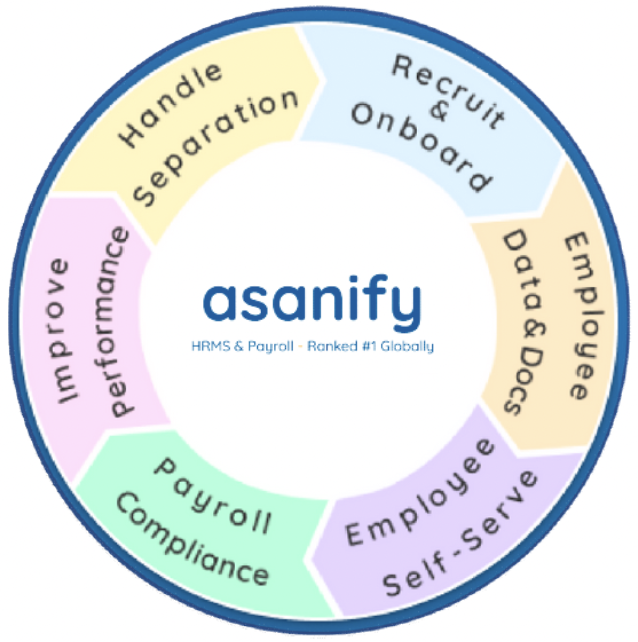
Comprehensive HRMS platforms integrate with statutory compliance systems like EPFO to automate data synchronization and reduce manual errors. These platforms maintain employee master data including UAN, Aadhaar linkage, and bank details required for EPFO reporting. Payroll modules automatically calculate PF contributions based on current statutory rates and salary components.
Advanced systems generate ECR files in EPFO-prescribed formats with a single click, eliminating manual data entry and validation errors. They track contribution payment status, maintain historical records for audits, and alert HR teams about upcoming filing deadlines. Integration with payment gateways enables direct challan payment from within the HRMS interface.
Employee self-service portals within HRMS platforms provide transparency by displaying PF contribution history, employer matching amounts, and accumulated balances. Some systems offer direct links to the EPFO member portal, guiding employees through claim processes. For organizations managing multi-country operations, these platforms handle EPFO compliance alongside provident fund requirements in other jurisdictions, providing unified management of diverse social security obligations.
FAQs about EPFO HRMS
What is the purpose of EPFO HRMS for employers?
EPFO HRMS enables employers to fulfill their statutory obligations by facilitating employee registration, monthly contribution reporting, and regulatory compliance. The system streamlines administrative processes, reduces paperwork, and provides digital proof of compliance with Indian labor laws. Employers use it to manage PF accounts for all eligible employees efficiently.
How do employees access their EPFO account through the HRMS?
Employees access their accounts through the unified EPFO member portal using their Universal Account Number (UAN) and password. After one-time registration and mobile number verification, they can view passbooks, download contribution statements, submit withdrawal claims, and update personal details. The system provides 24/7 access to retirement savings information.
What happens to EPFO accounts when employees change jobs?
EPFO accounts are portable across employers through the Universal Account Number system. When employees join a new organization, they provide their existing UAN to the new employer. The HRMS links the new employment to the same UAN, ensuring all contributions accumulate in one account. Employees can transfer previous balances or maintain them separately under the same UAN.
What are common compliance challenges with EPFO HRMS?
Common challenges include incorrect employee data leading to claim rejections, delayed monthly returns causing penalties, mismatches between contribution amounts and salary records, and incorrect UAN generation for new employees. Organizations also face difficulties with Aadhaar-UAN linkage and bank account verification. Integrated HRMS solutions minimize these issues through automated validation and timely alerts.
How often must employers update information in EPFO HRMS?
Employers must submit monthly ECR (Electronic Challan-cum-Return) by the 15th of each month, containing employee-wise contribution details for the previous month. New employee registrations should occur within the first month of employment. Any changes to employee details like bank accounts, contact information, or family details should be updated promptly to prevent claim processing delays.
Simplify HR Management & Payroll Globally
Hassle-free HR and Payroll solution for your Employess Globally
Your 1-stop solution for end to end HR Management
- Hire to Retire HR Process Automation
- EOR Services for your Global Employees
- Pay your Contractors Globally in 200+ Countries
Not to be considered as tax, legal, financial or HR advice. Regulations change over time so please consult a lawyer, accountant or Labour Law expert for specific guidance.