
In-House Company

Intro to In-House Company?
An in-house company refers to an organization that maintains internal departments or teams to handle specific business functions rather than outsourcing them to external providers. This approach gives companies direct control over operations, quality, and company culture. In-house teams work exclusively for the organization, allowing for closer alignment with business objectives and values.
Definition of In-House Company
An in-house company operates core business functions internally using its own employees and resources rather than contracting external agencies or service providers. This model applies across various departments including HR, payroll, IT, marketing, legal, and customer service. In the HR context, in-house specifically refers to managing HR operations with internal staff rather than through professional employer organizations (PEOs) or outsourcing firms. Companies choose this approach when they want direct oversight, need specialized expertise aligned with their culture, or handle sensitive information requiring confidentiality. The in-house model requires greater investment in infrastructure, technology, and personnel but offers complete autonomy over processes and decisions. Understanding the trade-offs between in-house payroll versus outsourcing helps organizations make informed decisions about their operational structure.
Importance of In-House Teams in HR
In-house HR teams provide deep organizational knowledge that external partners cannot replicate. They understand company culture, history, and unique challenges, enabling more contextualized decision-making. Direct employee relationships foster trust and improve engagement. In-house teams can respond quickly to internal issues without coordination delays inherent in outsourced arrangements. They also maintain better control over confidential employee data and sensitive business information. For companies with complex or specialized needs, in-house expertise ensures customized solutions rather than standardized external services. However, organizations must weigh these benefits against alternatives like professional employer organizations that offer different advantages. In-house teams excel at strategic initiatives that require intimate business knowledge, while also managing day-to-day operations like attendance management. This model works best when organizations have sufficient scale to justify dedicated internal resources.
Examples of In-House Operations
Example 1: In-House Recruitment Team
A growing e-commerce company builds an internal recruitment department with specialized talent acquisition professionals. This team develops deep understanding of company culture, technical requirements, and growth plans. They create tailored hiring strategies, maintain candidate relationships, and ensure consistent employer branding throughout the recruitment process.
Example 2: In-House Payroll Processing
A mid-sized manufacturing firm maintains an internal payroll department that handles salary processing, tax compliance, and benefits administration. The team works closely with finance and HR to ensure accurate, timely payments while maintaining direct control over sensitive compensation data and quickly adapting to policy changes.
Example 3: In-House Learning and Development
A technology company establishes an internal training department staffed with instructional designers and subject matter experts. This team creates customized learning programs aligned with company technology stacks, business processes, and strategic objectives—something generic external training providers cannot deliver effectively.
How HRMS Platforms Like Asanify Support In-House Teams
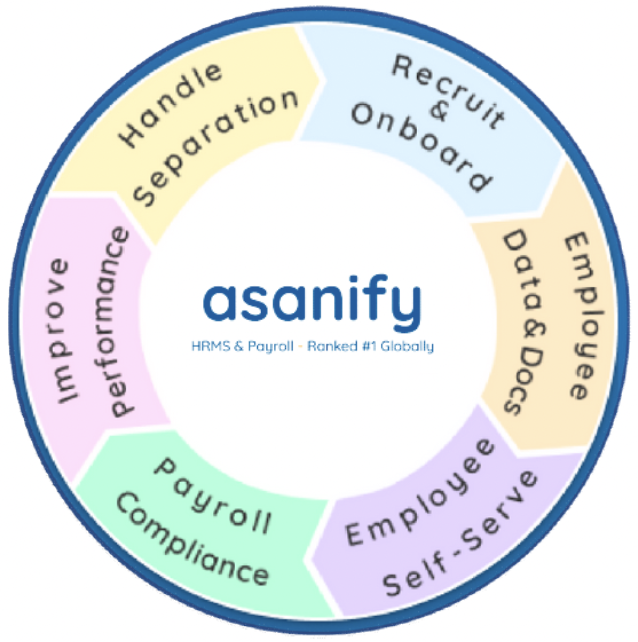
HRMS platforms empower in-house teams by automating routine tasks and providing enterprise-grade capabilities without extensive IT infrastructure. These systems centralize employee data, making it accessible to authorized in-house personnel across departments. Automated workflows reduce manual processing for payroll, leave management, and performance reviews, allowing in-house teams to focus on strategic initiatives. Self-service portals enable employees to access information independently, reducing administrative burden on in-house HR staff. Advanced analytics provide in-house teams with insights into workforce trends, helping them make data-driven decisions. Compliance modules keep in-house teams updated on regulatory changes and generate required documentation automatically. Integration capabilities allow in-house systems to connect with existing tools, creating seamless workflows. Cloud-based platforms eliminate the need for in-house teams to manage complex server infrastructure while maintaining data security. These platforms essentially give small in-house teams the capabilities of much larger departments.
FAQs About In-House Companies
What are the main advantages of maintaining in-house HR functions?
In-house HR provides greater control, deeper organizational knowledge, immediate responsiveness, better confidentiality, and closer alignment with company culture. It also allows for customized approaches tailored to specific business needs rather than standardized external solutions.
When should a company consider outsourcing instead of keeping functions in-house?
Companies should consider outsourcing when they lack internal expertise, need to reduce overhead costs, want to focus internal resources on core business activities, or operate in multiple jurisdictions with complex compliance requirements. Small businesses often benefit from outsourcing specialized functions like payroll or benefits administration.
How do in-house teams manage to stay updated on changing regulations?
In-house teams stay current through professional associations, continuing education programs, regulatory newsletters, industry conferences, and partnerships with legal advisors. Many also leverage HRMS platforms that provide automatic compliance updates and alerts about regulatory changes.
What is the typical cost difference between in-house and outsourced HR?
Cost comparisons vary significantly based on company size and complexity. In-house operations typically involve higher fixed costs (salaries, benefits, technology) but lower per-transaction costs. Outsourcing converts fixed costs to variable expenses, which may benefit smaller organizations but become expensive at scale. Each organization must evaluate costs based on its specific circumstances.
Can companies use a hybrid approach combining in-house and outsourced functions?
Yes, many organizations use hybrid models, maintaining in-house teams for strategic functions and core competencies while outsourcing specialized or administrative tasks. For example, companies might keep recruitment and employee relations in-house while outsourcing payroll processing or benefits administration. This approach provides flexibility and optimizes resource allocation.
Simplify HR Management & Payroll Globally
Hassle-free HR and Payroll solution for your Employess Globally
Your 1-stop solution for end to end HR Management
- Hire to Retire HR Process Automation
- EOR Services for your Global Employees
- Pay your Contractors Globally in 200+ Countries
Not to be considered as tax, legal, financial or HR advice. Regulations change over time so please consult a lawyer, accountant or Labour Law expert for specific guidance.