

What this guide covers:
- India EOR pricing ranges from $99 to $599 per employee per month. Asanify starts at $99 with a direct owned entity in Kolkata, the lowest price among direct-entity providers on this list.
- Hiring compliantly in India means managing PF at 12%, ESI at 3.25%, TDS under Section 192, Gratuity, and state-level Professional Tax. Your EOR must handle all of these without a middleman.
- Only 6 of the 15 providers on this list own a direct India entity. The remaining 9 use partner networks. This distinction determines who is accountable when a compliance problem surfaces.
- A team of 10 engineers in Bengaluru costs $60,000 more per year with a $599/month provider than with Asanify at $99/month. That money stays in your hiring budget.
- Some competitor blogs on this topic exclude Asanify entirely despite it holding the number one G2 ranking for ease of use in Core HR and Payroll globally. This guide covers all 15 relevant providers and lets the data speak.
Quick Comparison: 15 Best India EOR Providers for 2026
| Provider | India Direct Entity | Starting Price | Onboarding Speed | G2 Rating | Best For |
|---|---|---|---|---|---|
| Asanify | ✅ Yes, Kolkata | $99/month | 24 to 48 hours | ⭐ 4.9/5 | Best overall India EOR |
| Remunance | ✅ Yes | $99/month | 48 to 72 hours | Not listed | India-only, 21-year track record |
| Wisemonk | ✅ Yes | Custom | 48 to 72 hours | Not listed | India compliance specialist |
| Gloroots | ✅ Yes, select markets | $299/month | 48 to 72 hours | 4.9/5 | India GCC plus global |
| Remofirst | ❌ Partner | $199/month | 48 to 72 hours | 4.5/5 | Budget global EOR |
| Borderless AI | ❌ Partner | $579/month | 24 to 48 hours | 4.9/5 | AI-native, tech startups |
| Atlas HXM | ✅ Yes | $599/month | 5 to 10 days | 4.6/5 | Enterprise, 160 plus countries |
| Multiplier | ✅ Yes | $400/month | Under 24 hours | 4.7/5 | APAC multi-country |
| Deel | ✅ Yes | $599/month | 2 to 3 days | 4.8/5 | Global enterprise breadth |
| Remote | ✅ Yes | $599/month | 2 to 3 days | 4.7/5 | Remote-first global teams |
| Rippling | ✅ Yes | Custom | Fast | Not listed | HRIS plus EOR unified |
| Papaya Global | ❌ Partner | $599/month | Not published | 4.6/5 | Large enterprise payroll |
| Oyster | ❌ Partner | $599/month | 48 hours | 4.5/5 | NGOs and non-profits |
| Skuad | ✅ Yes | $199/month | Fast | 4.6/5 | Budget India and SEA |
| G-P | ⚠️ Mixed | Custom | Fast | Not listed | Established enterprise |
Hire in India Without a Legal Entity
Onboard your first employee in just 48 hours — no company setup required.
Asanify experts will guide your India hiring — book a meeting with an expert.
Who This Guide Is For
You have budget approval. You have identified the talent. Now you need to decide which EOR provider will legally employ your Indian team while operations get running, and you need to make that decision without getting burned by hidden fees, partner-model compliance gaps, or a support team that disappears when a payroll issue surfaces at 11pm before salary day.
This guide is for HR leaders, founders, CFOs, and Talent Acquisition heads at companies based in the US, UK, EU, or APAC who want to hire software engineers, finance professionals, operations teams, or customer support specialists in India without spending six to twelve months and Rs 20 to 30 lakh setting up an Indian subsidiary.
Every provider in this list has been evaluated on five criteria that actually matter for India hiring: direct entity ownership, statutory compliance depth covering PF, ESI, TDS and Gratuity, pricing transparency, onboarding speed, and platform quality. Nothing else.
What Is an Employer of Record in India and Why Entity Ownership Is the Most Important Decision You Will Make
An Employer of Record in India is a local company that legally employs your workers on your behalf. You find the talent and direct the work. The EOR handles payroll in INR, statutory contributions, employment contracts compliant with Indian labour law, mandatory benefits, and offboarding.
The single most important factor when choosing an India EOR is not price and it is not the feature list. It is whether the provider owns a direct legal entity in India or routes your employees through a third-party partner.
Here is why this matters in practice. When a TDS discrepancy surfaces during an EPFO audit, or a PF filing is rejected, or an employee raises a wrongful termination claim, a direct-entity EOR owns that problem and resolves it internally. A partner-model EOR passes the problem to a third party you never contracted with, creating accountability gaps that compound into delays, penalties, and legal exposure you did not sign up for.
Nine of the fifteen providers on this list use partner entities for India. Six own their India entity directly. For any company where India is a primary hiring corridor, direct entity ownership is the non-negotiable baseline, not a premium feature.
India EOR Compliance: The Statutory Framework Every Provider Must Handle
Before evaluating any provider, understand what compliant India hiring actually requires. This is the statutory checklist your EOR must manage on your behalf without exception.
| Contribution | Rate | Applicable When |
|---|---|---|
| Provident Fund, employer share | 12% of basic salary | All employees |
| Provident Fund, employee share | 12% of basic salary | All employees |
| ESI, employer share | 3.25% of gross salary | Employees earning up to Rs 21,000 per month |
| ESI, employee share | 0.75% of gross salary | Employees earning up to Rs 21,000 per month |
| Professional Tax | Rs 200 per month in most states | Varies by state |
| TDS | Slab-based under Section 192, Income Tax Act | All salaried employees |
| Gratuity | 15 days salary multiplied by years of service | Payable after 5 years |
| Bonus | 8.33% to 20% of salary | Under Payment of Bonus Act 1965 |
Hire in India Without a Legal Entity
Onboard your first employee in just 48 hours — no company setup required.
Indian Labour Laws Your EOR Must Navigate
The Code on Wages 2019 governs minimum wage, overtime, and payment timelines. The Industrial Disputes Act 1947 governs termination and retrenchment rules. The POSH Act 2013 mandates workplace sexual harassment compliance. The Shops and Establishments Acts are state-specific and govern working hours, leave entitlements, and public holidays.
India has 29 states with different state-level labour regulations. A hire in Karnataka has different Professional Tax rates, state holiday entitlements, and Shops and Establishments requirements than a hire in Maharashtra, Tamil Nadu, or Telangana. Multi-state compliance is a baseline capability requirement, not an add-on service.
What the Four Labour Codes Mean for Foreign Employers Hiring in India Today
The four Labour Codes, the Code on Wages 2019, Industrial Relations Code 2020, Code on Social Security 2020, and Occupational Safety Health and Working Conditions Code 2020, are actively consolidating 29 central laws into four frameworks. They are being phased in at the state level, meaning different states are at different stages of implementation.
The Code on Social Security 2020 is the most consequential pending change for foreign employers. When a state activates it, PF and ESI coverage expands significantly, contribution calculations change, and employment contracts may need to be updated. A current India EOR provider tracks state-level notifications for all four codes and updates your payroll structures accordingly without waiting for you to ask. An EOR provider that cannot explain their process for monitoring state-level Labour Code implementation is not current on Indian regulatory developments.
What Happens When Compliance Fails
Late PF filing attracts a penalty of Rs 5,000 under Section 14B of the EPF Act plus interest at 12% per annum. TDS defaults under Section 201 of the Income Tax Act result in interest at 1% per month from the date tax was deductible to the date it was deducted, plus 1.5% per month from deduction to deposit, plus potential prosecution. ESI non-compliance can trigger registration cancellations. Worker misclassification creates backdated liabilities across every month of the misclassification, compounding silently until an audit forces the reckoning.
These are not edge cases. They happen regularly to foreign companies hiring through providers who lack genuine in-country compliance infrastructure.
Use the Asanify Employee Cost Calculator to model your full India hiring cost including all statutory contributions. Use the Contractor Misclassification Quiz to verify whether your current contractors should be reclassified as employees before a problem surfaces.
India as a Global Hiring Destination in 2026: The Real Picture
The conversation about India has fundamentally shifted. It stopped being purely a cost decision years ago.
Goldman Sachs employs more engineers in Bengaluru than in New York. Apple, Microsoft, Google, and Amazon have each built Global Capability Centres in India handling mission-critical work, not support functions. India now hosts more than 1,700 GCCs employing over 1.6 million professionals. That number grew by over 200 new GCCs in 2024 and 2025 alone, making India the fastest-growing GCC destination in the world.
The talent pipeline justifies the investment. India produces more than 1.5 million engineering graduates annually. It has the world's second-largest English-speaking workforce. IST at UTC plus 5:30 overlaps with EU morning hours and US evening hours simultaneously, enabling near-continuous productivity for distributed teams without requiring Indian employees to work unusual hours.
The cost advantage is real but needs to be framed correctly. A mid-level software engineer in Bengaluru or Hyderabad earns Rs 8 to 20 lakh per annum depending on experience. An equivalent engineer in San Francisco costs four to six times more in total compensation. The savings compound at scale.
For companies building GCCs, EOR is the standard bridge solution for the first 6 to 18 months while the Indian subsidiary is being incorporated and registered. The right EOR partner makes that transition structured and predictable. The wrong one makes it expensive and chaotic.
The five primary India hiring cities are Bengaluru for technology and engineering, Hyderabad for technology and pharmaceuticals, Pune for engineering and manufacturing, Chennai for technology and financial services, and NCR covering Delhi, Gurugram, and Noida for corporate functions and technology. Mumbai is the anchor hub for financial services hiring.
The Real Annual Cost of India EOR: What You Actually Pay
Platform fees are only part of the story. Here is the complete cost picture for a team of 10 software engineers in Bengaluru.
| Provider | Monthly Fee Per Employee | Annual Platform Cost, 10 Employees | Annual Saving vs $599 Provider |
|---|---|---|---|
| Asanify | $99 | $11,880 | $60,120 |
| Remunance | $99 | $11,880 | $60,120 |
| Remofirst | $199 | $23,880 | $48,000 |
| Skuad | $199 | $23,880 | $48,000 |
| Gloroots | $299 | $35,880 | $36,000 |
| Multiplier | $400 | $48,000 | $23,880 |
| Borderless AI | $579 | $69,480 | $2,400 |
| Deel, Remote, Papaya | $599 | $71,880 | Baseline |
The $60,000 annual saving by choosing Asanify over a $599/month provider is not a promotional figure. It is arithmetic based on published pricing. For a team of 25 engineers, that saving exceeds $150,000 annually, enough to fund one additional senior hire every year.
Two costs to verify with any provider before signing. First, FX spread on USD to INR conversion. Providers like Deel and Remote apply 1% to 3% FX markup on every payroll run. On a Rs 15 lakh annual salary, a 2% markup adds approximately $400 per employee per year in charges that do not appear on the headline price. Second, security deposits. Some providers hold $10,000 to $20,000 per employee as a deposit. Confirm upfront whether deposits are required and on what timeline they are returned.
15 Best EOR Providers in India for 2026
1. Asanify: Best Overall India EOR
G2 Rating: 4.9 out of 5, 350 plus reviews | Price: $99 per month | India Entity: Direct, Kolkata
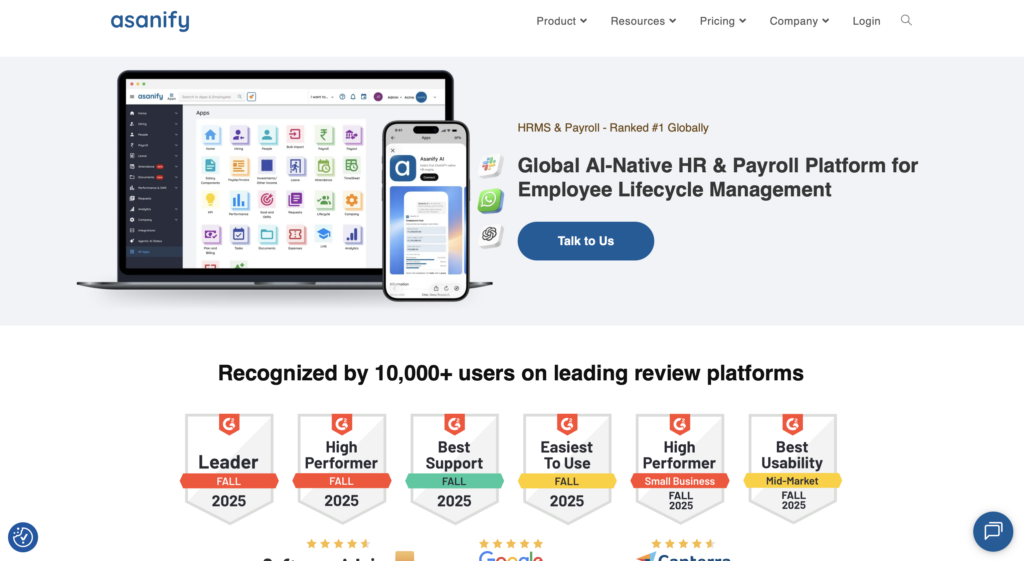
Most companies pay $599 a month for India EOR because they assume that is what India compliance costs. It does not. Asanify manages the same PF filings, the same ESI contributions, the same TDS deductions, through its own Kolkata entity, for $99 a month. The difference is not service quality. It is that Asanify was built for India first, not retrofitted into a global platform as one of 150 countries.
Asanify is a Techstars-backed, AI-native Employer of Record and HRMS platform. It is ranked number one globally on G2 for ease of use in Core HR and Payroll with a 4.9 out of 5 rating across more than 350 reviews and a support quality score of 9.7 out of 10. It owns and operates its legal entity directly in Kolkata, meaning PF filings, TDS deductions, ESI contributions, and employment contracts are handled entirely in-house with no partner in the compliance chain.
The HRMS is included, not sold separately. Every provider on this list offers payroll and compliance. Asanify also includes attendance management, leave management, expense management, performance reviews with 360-degree feedback, OKR tracking, and an applicant tracking system, all within the $99/month package. Competitors charge separately for HRMS modules if they offer them at all.
The WhatsApp HR bot is the only employee self-service tool in the EOR market built for how Indian employees actually communicate. WhatsApp has over 500 million active users in India. Employees in Bengaluru, Hyderabad, and Chennai should not have to download a new application to check their payslip, apply for leave, or query their PF balance. They send a WhatsApp message. No other EOR provider ships this natively.
The ChatGPT integration via MCP is a genuine operational advantage. Managing HR operations through natural language conversations in ChatGPT, checking payroll status, approving leaves, accessing employee data, running compliance queries, is not a future roadmap item. It is live and it changes how lean HR teams operate.
48-hour onboarding is a real commitment, not a marketing headline. Jason Biddell, CFO of Intelligent Monitoring Group, onboarded approximately 30 employees in India as part of a corporate M&A takeover. His assessment: "With Asanify's turnaround time the overall change was managed brilliantly." That is a CFO of a listed company describing an emergency onboarding of 30 employees during an acquisition. That is the real test of an onboarding promise.
FX rates are transparent and best-in-class. Sammy Sheth, Founder and CEO of United HealthCare USA, manages a team of 40 employees in India through Asanify. His assessment: "Not for a single month have I experienced any delays in the payment process." Forty employees. Zero delays. That is what consistent payroll execution looks like in practice.
Rukhsar Ahmed, Managing Director of Green Fulfilment, captures the operational value concisely: "In my business, things happen fast, and requirement for new employees is sudden. In such a situation a trusted partner like Asanify comes in handy as I know I can quickly ramp with onboarding and employee formalities diligently taken care of."
Jason Palmer, President of Nobious, on compliance guidance: "Whether it's employee-contractor classification, or the local laws for employee benefits and working hours, I trust the guidance provided."
Steph Freeman, GM People and Culture at Prospection: "I find a lot of value in the fully automated Asanify HRMS. It makes it absolutely comfortable that I can access all my HR information anytime, anywhere and on any platform, Slack, WhatsApp, and more."
Key Features:
- Direct India entity in Kolkata with full PF, ESI, TDS, Gratuity, and Professional Tax management across all states
- 48-hour employee onboarding as standard
- Complete HRMS included: attendance, leave, expense, performance, OKR, ATS
- WhatsApp HR bot for employee self-service
- AI payroll accuracy checks before every payroll run
- ChatGPT MCP integration for AI-powered HR management
- Global contractor management in 200 plus countries
- Transparent FX rates with no hidden spread
- 24/7 customer support, 9.7 out of 10 G2 quality score
- Free tools: Employee Cost Calculator, PE Risk Quiz, Payroll Compliance Calendar, Salary Breakup Calculator, Contractor Misclassification Quiz
Pros: Lowest price at $99/month with direct India entity, number one G2 ease of use globally, complete AI-native HRMS included at no extra charge, 48-hour onboarding backed by real customer outcomes, WhatsApp HR bot, ChatGPT integration, transparent FX rates, 24/7 support
Honest limitation: Asanify is optimised for companies where India is the primary or one of a handful of hiring markets. If your requirement from day one is simultaneous EOR across 50 plus countries, a global-first platform like Deel or Atlas HXM will serve that specific need better. Most India-focused buyers are not in that situation, but if you are, it is worth knowing upfront.
Pricing: $99 per month per employee for India. Country-specific pricing transparently published for other markets at asanify.com/pricing-international.
Compare directly: Asanify vs Deel | Asanify vs Gloroots | Asanify vs Wisemonk | Asanify vs Remote | Asanify vs Multiplier | Asanify vs Remofirst | Asanify vs Borderless AI
2. Remunance: 21 Years of India Compliance, $99 Per Month
Price: $99 per month | India Entity: Direct | Best For: Companies committed exclusively to India hiring who prioritise compliance history above all else
Twenty-one years of India EOR operation is not a marketing stat. It is a compliance record. The hard problems in Indian employment, EPF audits, labour court disputes, tax authority investigations, take one to three years to surface. Remunance has encountered and resolved these situations more times than any other provider on this list.
Remunance holds ISO 27001:2013 certification, a Great Place to Work India certification, and a Glassdoor employee rating of 4.6 out of 5. Engaged internal compliance professionals deliver more accurate statutory filings and more proactive regulatory tracking than disengaged ones. CEO Rajendra Vaidya has documented client relationships spanning 14 years across multiple company launches in India, the longest confirmed individual client tenure among India EOR providers.
At $99 per month, Remunance matches Asanify on India price. The meaningful difference is scope. Remunance is India-only. If your hiring plans extend to Singapore, UAE, Vietnam, or any other market, you need a separate provider. Asanify covers India plus 100 plus global corridors under one contract and one platform.
Remunance also offers a structured EOR-to-subsidiary formation pathway, genuinely valuable for companies planning to establish their own Indian entity within two to three years.
Key Features: Direct India entity with 21 years of compliance history, ISO 27001:2013, Great Place to Work certified, full PF, ESI, TDS and Gratuity management, structured EOR to subsidiary transition support
Pros: Longest India compliance track record, owned entity, ISO certified, $99/month pricing, strong internal team culture by Glassdoor evidence
Limitation: India-only with no global coverage. No AI-native HRMS or employee self-service tooling comparable to Asanify.
Pricing: $99 per month for India. Custom for larger headcount.
3. Wisemonk: India Compliance Specialist for Complex Multi-State Requirements
India Entity: Direct | Price: Custom | Best For: Companies with simultaneous hiring across multiple Indian states who need hands-on compliance advisory as a core service
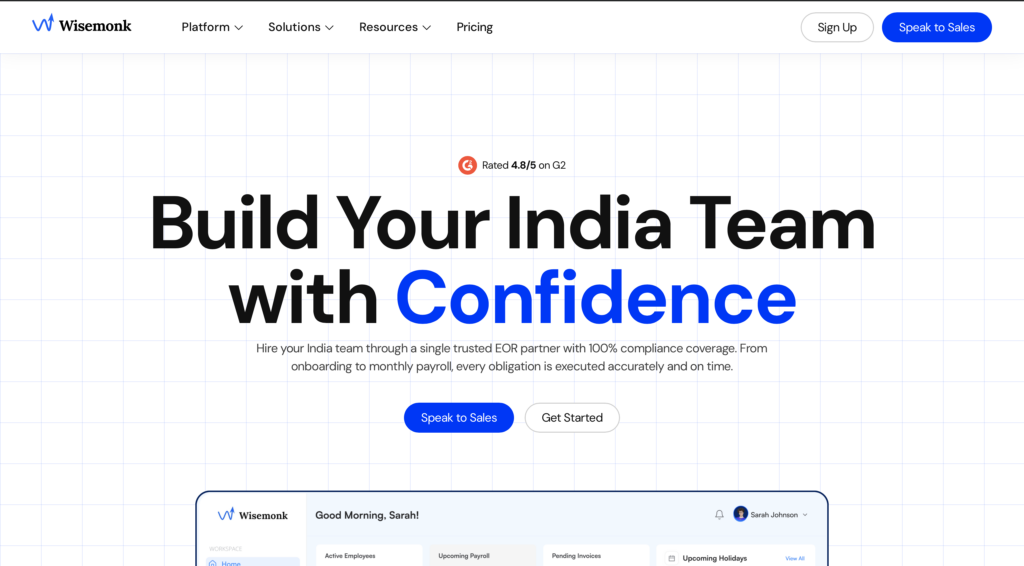
Where most EOR providers treat multi-state India compliance as a checkbox, Wisemonk treats it as the core service. Its compliance-first model provides genuine depth on PF, ESI, TDS, state-level labour law variation, and concurrent onboarding across Bengaluru, Hyderabad, Chennai, Pune, and NCR simultaneously.
For companies building GCCs with employees across multiple Indian states from day one, Wisemonk's localised advisory capability is a real operational advantage. For companies that want a modern self-service platform and transparent published pricing, Wisemonk falls short. No pricing is published, which makes budget planning harder and requires a sales conversation before meaningful comparison is possible.
Key Features: Direct India entity, end-to-end EOR covering hiring, payroll, and compliance, multi-state India coverage, dedicated local compliance advisory, employment contract management per Indian labour law
Pros: Deep India compliance expertise, direct entity, genuine multi-state specialisation, hands-on advisory model
Limitation: No published pricing requires a sales call for basic cost comparison. Platform automation and HRMS features are less developed than Asanify or Deel.
Pricing: Custom. Contact sales. Compare at Asanify vs Wisemonk.
4. Gloroots: India GCC Specialist with Global Reach and Crypto Pay-Ins
G2 Rating: 4.9 out of 5 | Price: $299 per month | India Entity: Direct, select markets | Best For: Companies establishing GCCs in India who simultaneously need 2 to 5 other global markets covered
Gloroots is India-headquartered and built around the GCC expansion use case. Its base plan at $299 per month includes multi-currency payroll with no FX markup, statutory filings, benefits administration, and crypto pay-ins as a standard feature rather than an enterprise add-on. SOC 2 certification and ESOP consulting support are genuine differentiators for growth-stage companies where data security and equity compensation are active priorities.
The honest arithmetic for India-primary buyers: at $299 per month, Gloroots costs $200 per employee per month more than Asanify. For a 10-person team, that is $24,000 per year more for the same India compliance corridor. The question is whether simultaneous global coverage and GCC-specific depth justify that premium for your specific situation. For companies where India is the only market, the answer is consistently no. For companies simultaneously expanding into India plus two to three other markets, the calculation changes.
Note that Gloroots pricing is quoted inconsistently across sources, ranging from $199 to $299 per month. Confirm current pricing directly with their team before including it in any internal budget model.
Key Features: 140 plus country coverage with India GCC depth, $299/month transparent pricing with no FX markup, crypto pay-ins as standard base plan feature, SOC 2 certified, ESOP consulting, 24/7 human support
Pros: Strong India GCC specialisation, transparent pricing, crypto pay-ins standard, SOC 2, multi-country coverage
Limitation: Three times more expensive than Asanify for India-primary hiring. 21 G2 reviews versus Asanify's 350 plus means a thinner evidence base for evaluating real-world performance.
Pricing: $299 per month per employee. Compare at Asanify vs Gloroots.
5. Remofirst: Widest Global Coverage at the Lowest Published Price
G2 Rating: 4.5 out of 5 | Price: $199 per month | India Entity: Partner, not direct | Best For: Companies testing EOR across many markets simultaneously where India is not the primary compliance risk
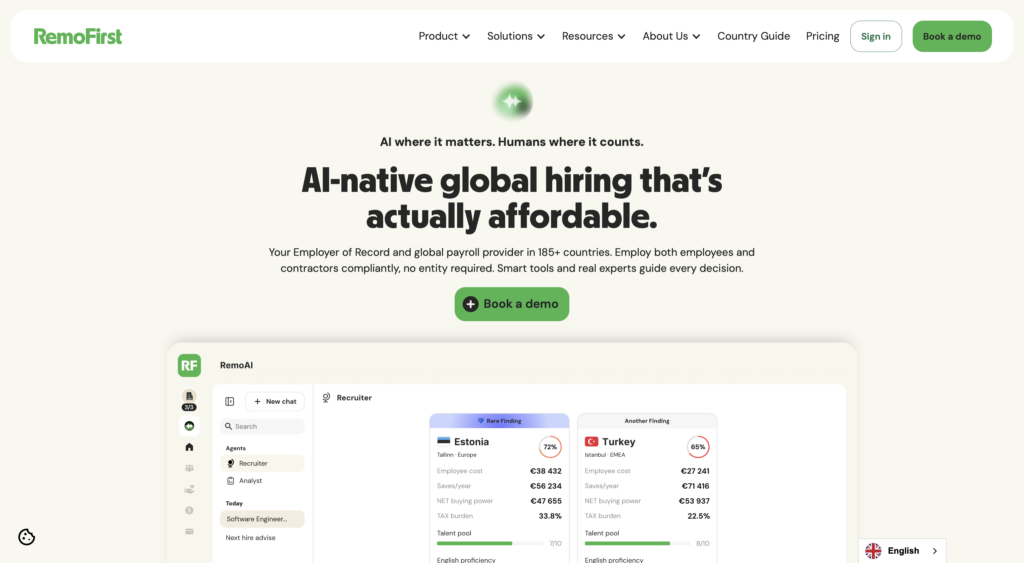
Remofirst competes on one proposition: the widest geographic coverage at the lowest published price. At $199 per month across 185 plus countries, it serves companies in exploratory mode across many markets where budget constraint is the dominant variable.
The caveat for India-specific hiring is material. Remofirst does not own a direct India entity. It operates through a local partner for payroll execution and compliance management. In standard scenarios, this works adequately. In complex situations, multi-state PF audits, TDS disputes, wrongful termination claims, the partner model creates accountability gaps that Remofirst's support team lacks the in-country depth to resolve quickly.
For companies where India is a secondary market and the primary need is broad coverage at low cost, Remofirst is a defensible choice. For companies where India is the primary compliance corridor, a direct-entity provider at $99 per month is both cheaper and more accountable.
Key Features: 185 plus country coverage, $199 per month EOR, $25 per month contractor management, 24/7 support
Pros: Lowest-price global EOR, widest country coverage, simple pricing, cost-effective contractor management
Limitation: No direct India entity. Partner-led compliance creates accountability gaps in complex India scenarios. Support quality for India-specific statutory issues is inconsistent.
Pricing: $199 per month per employee. Compare at Asanify vs Remofirst.
6. Borderless AI: The Most Advanced AI-Native EOR Platform
G2 Rating: 4.9 out of 5 | Price: $579 per month | India Entity: Partner, not direct | Best For: AI-forward tech companies hiring small teams across many countries where workflow automation is the primary priority

Borderless AI has built the most genuinely AI-native EOR platform in the market. Contract generation completes in under 5 minutes. HRGPT, its AI HR chatbot, references live labour law across 170 plus countries and answers statutory queries in real time. Zero security deposit requirements eliminate the $10,000 to $20,000 per employee deposits some providers hold. The pitch is compelling and the platform execution is real.
The limitations matter specifically for India-focused buyers. Borderless AI does not own a direct India entity, operating through partner infrastructure. The company emerged from public operations in March 2024, meaning under two years of live operational history at the time of writing. The hard compliance problems in India take longer than two years to surface. Additionally, at $579 per month, Borderless AI costs nearly six times Asanify's India rate while offering less India compliance accountability.
For tech-first companies hiring small teams across many countries where AI workflow automation and multi-country breadth are the primary requirements and India is one market among many, Borderless AI is worth evaluating. For India-primary buyers, the price-to-accountability ratio does not hold up.
Key Features: AI contract generation in under 5 minutes, HRGPT live labour law chatbot for 170 plus countries, zero security deposit, 1 to 2 day onboarding, North America-based support team, automated compliance monitoring
Pros: Most advanced AI EOR workflows, zero deposit, fast onboarding, strong G2 rating, broad country coverage
Limitation: Partner-led India entity, under two years of public operating history, $579/month is six times Asanify's India rate without direct-entity accountability for India.
Pricing: $579 per month per employee. Compare at Asanify vs Borderless AI.
7. Atlas HXM: Enterprise EOR for Direct-Entity Global Coverage at Scale
Price: $599 per month | India Entity: Direct | Best For: Large enterprises hiring across 50 plus countries simultaneously with direct-entity compliance requirements in most markets
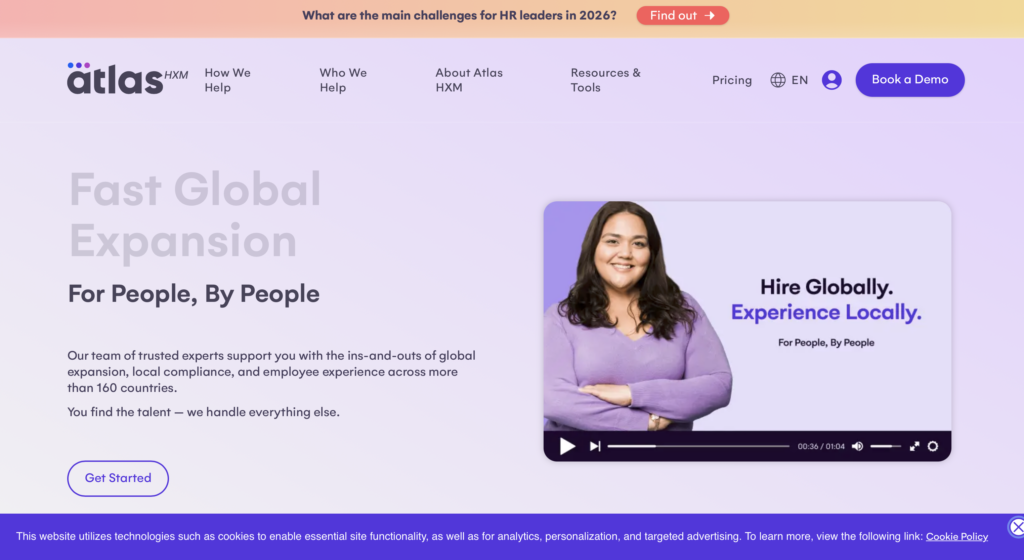
Atlas HXM pioneered the direct EOR model and has sustained it across 160 plus countries for over a decade. Three consecutive Global Payroll Association Employer of Record Organisation of the Year awards from 2023 through 2025, plus recognition as a Leader by NelsonHall and Everest Group in 2025, establish its enterprise credentials clearly.
The Human Experience Management platform covers the full employee lifecycle from recruitment through retirement with workforce analytics that genuine enterprise HR teams find valuable. The direct-entity model across most of its 160 plus country footprint provides compliance accountability at a scale no other provider matches.
The honest trade-off: $599 per month is six times Asanify's India rate for the same India compliance coverage. The G2 ease of use rating trails India-specialist competitors. Users report occasional internal coordination gaps affecting payroll timing. For companies whose primary need is India hiring, Atlas HXM is significant overkill at a significant cost premium. For true global enterprises simultaneously hiring across Europe, Americas, and Asia Pacific with direct-entity requirements throughout, the investment is justifiable.
Key Features: Direct-entity EOR in 160 plus countries, full HXM lifecycle platform, advanced workforce analytics, three consecutive GPA EOR awards, NelsonHall and Everest Group Leader 2025
Pros: Widest direct-entity global footprint, enterprise-grade compliance infrastructure, full employee lifecycle management, award-recognised track record
Limitation: $599/month is six times Asanify's India rate. Steeper learning curve. Occasional payroll coordination delays. Exceeds the requirements of most India-focused or growth-stage buyers.
Pricing: $599 per month per employee. Custom enterprise pricing available.
8. Multiplier: APAC-First EOR for Simultaneous Regional Expansion
G2 Rating: 4.7 out of 5 | Price: $400 per month | India Entity: Direct | Best For: Companies expanding simultaneously across India and two or more Southeast Asian markets
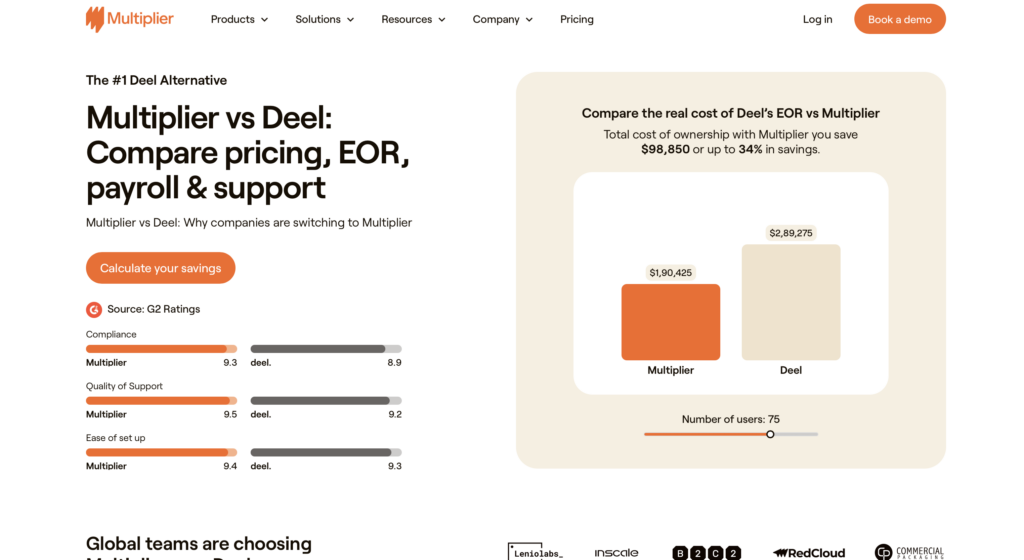
Singapore-headquartered and APAC-rooted, Multiplier brings genuine regional depth across India, Singapore, Philippines, Vietnam, Indonesia, Thailand, and Malaysia from its team of 100 plus in-country compliance experts. This is not a partner network presenting itself as regional expertise. It is documented in-market knowledge across Southeast Asia built over years of operation.
For India hiring specifically, onboarding completes in under 24 hours, multi-currency payroll runs in 120 plus currencies, and worker classification protections are clearly documented. For companies where India is one of three or more simultaneous APAC markets, Multiplier's consolidated regional coverage provides genuine operational value that justifies its premium over India-only providers.
For companies where India is the sole or primary market, $400 per month is four times Asanify's India rate for coverage you are not using. The cost-benefit calculation is straightforward in that scenario.
Key Features: 150 plus country coverage with genuine APAC depth, under 24-hour onboarding, multi-currency payroll in 120 plus currencies, 100 plus in-country compliance experts, instant employment contracts, full benefits and insurance administration
Pros: Real APAC multi-country expertise, fast onboarding, experienced local team, strong multi-currency capabilities
Limitation: $400/month is expensive for India-primary hiring. No complimentary HRMS. 24/5 rather than 24/7 support.
Pricing: $400 per month per employee. Compare at Asanify vs Multiplier.
9. Deel: Global EOR Brand with 150 Plus Country Breadth
G2 Rating: 4.8 out of 5 | Price: $599 per month | India Entity: Direct | Best For: Large enterprises running simultaneous EOR across North America, Europe, and Asia Pacific
Deel is the most recognised name in global EOR and that recognition is earned. Owned entities in approximately 130 of its 150 plus operational countries, GDPR, SOC 2, and ISO 27001 compliance, and deep integrations with Xero, NetSuite, Azure, and Ashby give enterprise procurement teams the coverage and certification checklist they need.
For India-specific hiring, Deel is functionally competent. The compliance credentials are real. The platform stability is consistent. The problem is the price relative to what the India corridor specifically requires. At $599 per month, a 10-person India team costs $71,880 per year in platform fees before salary, statutory contributions, or the 3% to 5% FX markup Deel applies to cross-border payments. That markup adds $300 to $900 per employee per year on top of an already premium fee.
Deel earns its position for enterprises where 150-country breadth is genuinely needed from day one. It does not earn that price for companies whose primary requirement is India.
Key Features: EOR in 150 plus countries with owned entities in approximately 130, 2 to 3 day onboarding, 24/7 in-app support, GDPR, SOC 2, and ISO 27001, strong enterprise integrations, unified contractor and employee management
Pros: Most recognised global EOR brand, broad country coverage, strong compliance certifications, excellent integrations, consistent platform stability
Limitation: $599/month is six times Asanify's India rate. FX markup of 3% to 5% adds significant hidden cost on every payroll run. Not cost-effective for India-focused hiring.
Pricing: $599 per month per employee. Compare at Asanify vs Deel.
10. Remote: Owned-Entity EOR with Best-in-Class IP Protection
G2 Rating: 4.7 out of 5 | Price: $599 per month | India Entity: Direct | Best For: Remote-first companies with employees across multiple regions for whom IP protection is a compliance priority
Remote's defining feature is Remote IP Guard, a standard inclusion in every employment contract that gives companies enforceable IP assignment agreements across 185 plus countries. For technology companies hiring engineers in India who will be contributing to proprietary codebases, this is not a trivial feature. It is the kind of protection that matters significantly if an employment dispute ever becomes a legal one.
Beyond IP protection, Remote's owned-entity model, strong employee benefits administration, and well-reviewed self-service portal make it a genuinely capable platform. The email and chat-only support model is the most significant operational limitation. When a payroll error surfaces at 6pm IST before salary day, email support with a next-business-day response window is not sufficient.
For India-primary hiring, the $599 per month price carries the same challenge as Deel. The IP protection feature does not change the arithmetic of $60,000 per year in premium fees for a 10-person India team.
Key Features: 185 plus country coverage with owned-entity focus, Remote IP Guard, employee self-service portal and mobile app, multi-currency payroll, comprehensive health and pension benefits administration
Pros: Strong IP protection, excellent employee benefits, high G2 rating, scalable infrastructure, owned India entity
Limitation: $599/month with email and chat-only support. High FX rates on cross-border payments. No phone support limits urgency response for time-sensitive payroll issues.
Pricing: $599 per month per employee. Compare at Asanify vs Remote.
11. Rippling: The Workforce OS That Includes EOR as One Module
India Entity: Direct | Price: Custom | Best For: Companies that need HR, IT provisioning, finance automation, and EOR managed from a single unified platform
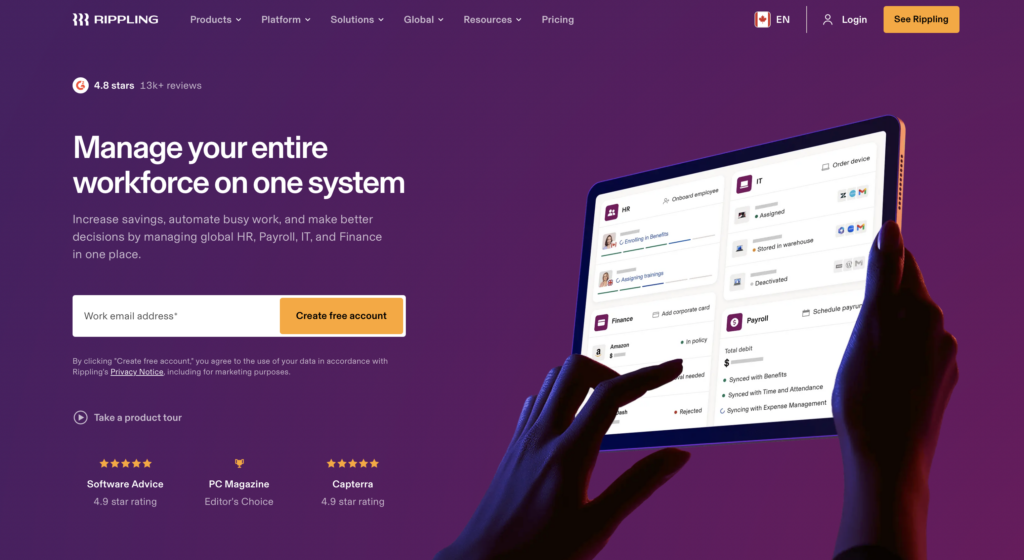
Rippling reframes the question. It does not ask "which EOR do you need?" It asks "do you want one platform for your entire workforce operating system?" HR, IT provisioning, finance automation, and EOR management run from a single interface with 500 plus third-party integrations and automated tax filing across jurisdictions.
For companies where EOR is one requirement within a broader need for unified workforce infrastructure, the Rippling approach eliminates integration overhead and data fragmentation across systems. The platform also supports a structured transition from EOR to your own Indian entity when the team reaches the scale where a subsidiary makes financial sense.
The trade-off is that the EOR module cannot be purchased standalone. The full Rippling HRIS is required, pushing total cost significantly above EOR-only alternatives. No transparent pricing is published and setup complexity is materially higher than EOR-specialist platforms.
Key Features: Full workforce OS covering HR, IT, and finance, 500 plus third-party app integrations, automated payroll and tax filing, EOR to own entity transition pathway, workflow analytics
Pros: Most complete workforce platform, seamless integrations, strong analytics, structured India entity transition support
Limitation: EOR cannot be purchased standalone. No transparent pricing. No 24/7 support. Higher setup complexity than EOR-specialist providers.
Pricing: Custom. Contact sales. Compare at Asanify vs Rippling.
12. Papaya Global: Enterprise Payroll Platform with 160 Plus Country Coverage
G2 Rating: 4.6 out of 5 | Price: $599 per month | India Entity: Partner, not direct | Best For: Large multinationals managing complex multi-region payroll with enterprise analytics requirements
Papaya Global's AI-powered payroll engine, workforce analytics, and designated country expert model serve large enterprises running complex payroll programs across many regions simultaneously. WhatsApp-based customer support and cryptocurrency payment support are distinctive features at the enterprise tier.
For India-focused buyers, two limitations are material. Papaya Global does not own a direct India entity, operating through a partner network. And $599 per month is the premium price tier without the direct-entity accountability that justifies it for India specifically. For enterprise buyers where India is one country among many in a complex global payroll program, the trade-offs may be acceptable. For companies whose primary or sole hiring market is India, paying $599 per month through a partner entity when $99 direct-entity alternatives exist is difficult to rationalise.
Key Features: 160 plus country coverage, AI-powered payroll automation, workforce analytics, designated country expert team, multi-currency payments including cryptocurrency
Pros: Strong enterprise analytics, broad country coverage, dedicated country experts, crypto payment support
Limitation: No direct India entity. $599/month without direct-entity accountability for India. Invoicing inconsistencies noted in user reviews.
Pricing: $599 per month per employee. Compare at Asanify vs Papaya Global.
13. Oyster: Purpose-Built for Non-Profits and Mission-Driven Organisations
G2 Rating: 4.5 out of 5 | Price: $599 per month | India Entity: Partner, not direct | Best For: Non-profits, NGOs, and mission-driven companies for whom Oyster's social hiring programs create specific financial value
Oyster's most distinctive feature is not a compliance capability or a platform integration. It is a social programme: the first year of EOR is free for non-profit organisations, and significant discounts apply for companies hiring refugees through the Oyster programme. For non-profits and NGOs, this creates tangible financial value that no other provider on this list matches.
For commercial companies evaluating on price, compliance depth, and platform quality, Oyster does not compete effectively with Asanify or Deel for India hiring. The $599 per month price, partner entity model for India, and $80 per month add-on for local benefits make it a weak choice outside its mission-driven niche. G2 ratings for customer support quality trail most competitors on this list.
Key Features: 185 plus country coverage, free first-year EOR for non-profits, refugee hiring discount programme, Oyster Academy with free HR tools, HRMS covering attendance, leave, expense, and equity
Pros: Non-profit and refugee hiring benefits unique in the market, broad country coverage, no setup fees
Limitation: $599/month with partner India entity. Poor customer support ratings on G2. $80/month extra for local benefits makes total cost higher than headline suggests.
Pricing: $599 per month per employee. Compare at Asanify vs Oyster.
14. Skuad: Direct-Entity India Coverage at the Mid-Budget Price Point
G2 Rating: 4.6 out of 5 | Price: $199 per month | India Entity: Direct | Best For: Budget-conscious companies wanting direct-entity India coverage combined with Southeast Asia access
Skuad occupies a specific gap in the market: direct India entity ownership at a below-$200 price point. For companies where $99 per month is genuinely unavailable as a budget option and where multi-country Southeast Asia coverage is needed alongside India, Skuad's $199 per month with direct entity provides a reasonable compromise.
G2 ratings for ease of setup and support quality are strong at approximately 9 out of 10 for both. The platform limitations are real: recurring issues with automatic leave entitlement calculations, limited third-party integrations, and a lower overall user satisfaction ranking suggest adoption challenges post-onboarding that budget-conscious buyers should evaluate carefully.
Key Features: 160 plus country coverage, direct India entity, single platform for benefits, tax, and localised contracts, 24/7 expert support, IP and data protection, worker misclassification protections
Pros: $199/month with direct India entity, 24/7 support, strong ease of setup, India and Southeast Asia coverage
Limitation: Leave calculation errors reported by users. Limited integrations. FX markup adds to total cost. Lower overall G2 user satisfaction relative to price tier.
Pricing: $199 per month per employee. Compare at Asanify vs Skuad.
15. Globalization Partners: Established Enterprise EOR for 180 Plus Country Programs
India Entity: Mixed | Price: Custom | Best For: Large enterprises already operating within the G-P ecosystem with confirmed multi-country hiring requirements across 180 plus markets
G-P is where the EOR category started. As one of the original enterprise providers, it brings 180 plus country coverage, dedicated country specialist teams, a 99% payroll accuracy claim, and enterprise SLA guarantees that large procurement teams recognise and trust. Its G-P Meridian platform provides integrated global hiring and workforce management at a scale that smaller providers cannot match.
The operational dependencies are worth understanding before signing. G-P partners with ADP and Zoho for HR and payroll infrastructure rather than operating a fully proprietary platform, creating third-party dependency at the core of the service. Pricing is not published and is typically estimated at 15% to 20% of employee gross salary or $599 to $1,500 per month depending on market and headcount. For India-primary hiring, the opaque pricing, mixed entity model, and ADP dependency make G-P difficult to justify when transparent direct-entity alternatives at $99 per month exist.
Key Features: 180 plus country coverage, dedicated country specialist teams, global recruiting services, 99% payroll accuracy claim, full tax and benefits administration, G-P Meridian integrated platform
Pros: Widest enterprise country coverage, established compliance track record, dedicated account management, global recruiting support
Limitation: No transparent pricing. ADP and Zoho dependency. Complexity beyond SME requirements. Core features carry additional charges in some tiers.
Pricing: Custom. Estimated $599 to $1,500 per month depending on market and headcount.
Which EOR Is Right for Your Situation
| Your Situation | Best Choice | The Reason |
|---|---|---|
| India is your primary or only market | Asanify | $99/month, direct Kolkata entity, complete HRMS included, 48-hour onboarding, proven customer outcomes |
| India-only, maximum compliance history priority | Remunance | 21 years, ISO 27001, owned entity, same $99/month |
| Complex multi-state India compliance advisory | Wisemonk | Hands-on advisory model, direct entity |
| India GCC plus 2 to 5 other global markets | Asanify or Gloroots | Asanify for cost efficiency, Gloroots for GCC depth plus crypto pay-ins |
| Budget global EOR, India is one of many markets | Remofirst | $199/month, 185 countries, note partner entity for India |
| AI-native workflows priority, multi-country | Borderless AI | Most advanced AI EOR platform currently available |
| Enterprise, 50 plus countries simultaneously | Atlas HXM or Deel | Direct entity global breadth at enterprise scale |
| APAC multi-country including India | Multiplier | Genuine regional depth across Southeast Asia |
| HRIS plus EOR unified on one platform | Rippling | Full workforce OS including IT and finance |
| Non-profit or NGO | Oyster | Free first year for non-profits, unique in the market |
Red Flags to Watch for in Any India EOR Contract
These are universal warning signs. They apply regardless of which provider you are evaluating.
No direct India entity disclosed in writing. If a provider cannot confirm the Indian company name and CIN registration number of the entity that will be the legal employer, ask for it. Verify it independently on the Ministry of Corporate Affairs portal at mca.gov.in. "We have India coverage" is not the same as "we own an Indian Private Limited entity."
Vague FX methodology. Ask for the exact USD to INR conversion methodology in writing. "Best available rates" is not an answer. Ask for the specific spread applied against the RBI reference rate on payroll date and get it in the contract.
No written commitment to PF and ESI filing deadlines. PF contributions must be deposited by the 15th of each month. ESI contributions must be deposited by the 21st. If a provider will not commit these deadlines in writing, that is a meaningful compliance risk signal.
Security deposits not disclosed upfront. Some providers hold $10,000 to $20,000 per employee as a deposit. This is your capital held interest-free. Confirm whether deposits are required, how much they are, and on what timeline they are returned on offboarding.
No explanation of Labour Code tracking. Ask any provider you evaluate to explain their specific process for monitoring state-level Labour Code implementation notifications. A provider that responds with a generic answer about staying current with regulations rather than a specific workflow has not built the tracking infrastructure the question is probing for.
Support availability not specified. Find out exactly what "24/7 support" means. Is it a live human with India compliance expertise or an automated ticketing system with a 48-hour response SLA? The difference matters at 11pm before payroll day.
Questions to Ask Every India EOR Provider Before Signing
The quality of answers tells you as much as the answers themselves. Use these in your evaluation calls.
What is the registered Indian company name and CIN number for the entity that will be the legal employer for my employees?
Which Indian states have you actively processed payroll in over the last 12 months and can you share the state-specific PF and ESI registration numbers?
How do you handle simultaneous hiring in Karnataka, Maharashtra, and Tamil Nadu given the different Professional Tax rates and Shops and Establishments requirements?
What is your exact process when EPFO raises a PF compliance query or audit request for one of my employees?
What FX conversion methodology applies to my USD to INR payroll and what is the spread against the RBI reference rate on payroll date?
Can you share a sample employment contract for an employee in Bengaluru including the notice period, leave entitlements, and gratuity clause?
What is your average resolution time for a payroll error reported by an employee on salary day and who specifically handles it?
How are you tracking state-level implementation of the Code on Social Security 2020 and how will you notify me when state-level changes affect my employees' contribution structures?
Frequently Asked Questions
Asanify. Direct legal entity in Kolkata, $99 per month, 48-hour onboarding, 4.9 out of 5 on G2 across 350 plus reviews, number one globally for ease of use in Core HR and Payroll, and a complete AI-native HRMS included at no extra charge. No other provider on this list combines all of those attributes at any price.
India EOR pricing runs from $99 per month at the India-specialist tier to $599 per month at the global enterprise tier. The price difference reflects two factors: geographic breadth across 150 plus countries, and platform architecture. Asanify at $99 per month is cheaper than $599 providers not because it offers less compliance quality, but because it was built for India first rather than built for 150 countries and then fitted with India coverage. India-first architecture means direct statutory relationships, no partner markup, and lower operational overhead.
A direct entity EOR owns its Indian legal entity and manages PF, ESI, TDS, and employment contracts in-house. When a compliance problem surfaces, accountability sits with the provider you contracted with and it is resolved internally. A partner model EOR routes your employees through a third-party Indian firm. When problems surface, the accountability chain involves a company you never contracted with, creating resolution delays and legal exposure gaps. Nine of the fifteen providers on this list use partner models for India. Six own their entity directly.
Provident Fund at 12% employer contribution, ESI at 3.25% employer contribution for employees earning up to Rs 21,000 per month, TDS deductions under Section 192 of the Income Tax Act, Professional Tax at state-specific rates across all states where employees are located, Gratuity accrual from day one payable after 5 years, Bonus under the Payment of Bonus Act 1965, and all state-level Shops and Establishments Act requirements.
Asanify onboards standard profiles in 24 to 48 hours. Most India EOR specialists complete onboarding in 48 to 72 hours. Global enterprise platforms like Atlas HXM and G-P can take 5 to 10 days for complex profiles. Always confirm the specific timeline for your employee's state location and role type, not just the headline number.
Yes, and multi-state capability should be a baseline requirement rather than a premium feature when you evaluate providers. This includes different Professional Tax rates, state-specific holiday calendars, state-level Shops and Establishments Act requirements, and any state-specific labour registration requirements. Wisemonk has particular depth in simultaneous multi-state onboarding. Asanify manages multi-state compliance in-house across all major Indian cities and states.
An EOR is the sole legal employer, with all employment liability sitting with the provider. A PEO is a co-employment model where liability is shared with your company. India's legal framework aligns more naturally with the EOR model for foreign companies without a local entity. PEO structures are less common and more complex to execute compliantly in India.
Evaluate the transition when you exceed 40 to 50 employees or confirm a minimum three-year commitment to India operations. Below that threshold, EOR is almost always cheaper and more flexible. Asanify and Remunance both provide structured support for the transition process. The transition involves incorporating an Indian Private Limited company, obtaining PF and ESI registrations, and transferring payroll from the EOR entity to your own.
A current India EOR provider tracks state-level implementation notifications for all four Labour Codes and updates employment contracts and payroll structures accordingly. The Code on Social Security 2020 is the most consequential for foreign employers because it expands PF and ESI coverage when fully implemented. Ask any provider you evaluate for their specific process for monitoring and implementing state-level Labour Code notifications.
Yes. EOR is the standard bridge solution for GCC setup, typically used for the first 6 to 18 months while the subsidiary is being incorporated and registered. Asanify and Gloroots both have specific experience supporting GCC setup transitions. The key is choosing a provider that can support the transition to your own entity when the time comes, not just the EOR phase.
This is a legitimate risk question that deserves a direct answer. Choose providers with direct India entity ownership, multi-year documented operating history, and transparent funding backgrounds. Ensure employment contracts name the specific Indian legal entity, not just the provider brand name. Review continuity and assignment clauses before signing. Asanify is Techstars-backed with a multi-year operating track record. Remunance has 21 years of operating history. Both represent lower continuity risk than newer entrants with limited operating history.
Yes. Asanify's Global Contractor Management platform handles contractor onboarding, contract generation, and payments in 200 plus countries from the same platform as your EOR employees. The Contractor Misclassification Quiz helps you determine correct classification before onboarding to avoid backdated liabilities.
Asanify applies transparent FX rates with no hidden spread. This is a meaningful difference from providers like Deel and Remote that apply 1% to 3% FX markup on every payroll run. On a Rs 15 lakh annual salary, a 2% markup adds approximately $400 per employee per year in charges that do not appear on the headline monthly fee.
All major cities and states including Bengaluru, Hyderabad, Pune, Chennai, NCR covering Delhi, Gurugram, and Noida, Mumbai, Kolkata, and all tier two cities. Multi-state compliance is managed in-house with no additional charge for state-level variation.
Asanify connects to ChatGPT via MCP, allowing HR teams to manage operations through natural language. You can check payroll status, approve leave requests, access employee data, generate compliance reports, and run queries through a ChatGPT conversation without logging into a separate platform. This is the only EOR provider currently offering this capability.
Asanify and Remunance both start at $99 per month and both own direct India entities. Asanify additionally includes a full AI-native HRMS, WhatsApp HR bot, ChatGPT integration, and global contractor management. Remunance offers the longer compliance track record at 21 years. Both are significantly cheaper than every other provider on this list.
The Bottom Line
You have read 15 provider profiles, a statutory compliance breakdown, a cost comparison, a decision matrix, a red flags checklist, and a question framework. If India is your primary hiring market, this guide points consistently to one answer.
Asanify gives you direct-entity compliance through its Kolkata entity, a complete AI-native HRMS that your Indian team will actually use, 48-hour onboarding backed by documented customer outcomes, transparent FX rates, and 24/7 support at $99 per month. The $60,000 per year saving for a 10-person team is real and compounds every year your team grows.
The 20-minute demo is not a sales call with a deck and a handover to a closing team. It is a conversation with someone who has handled India compliance questions like yours before and will give you direct answers. Book it when you are ready.
Not to be considered as tax, legal, financial or HR advice. Regulations change over time so please consult a lawyer, accountant or Labour Law expert for specific guidance.