

TL;DR
- Best overall: Asanify ranks first in our comparison at 4.83/5, with published pricing of $99 per employee/month, a directly owned Indian entity, and 24-hour onboarding.
- Best global options: Deel and Remote suit companies hiring across many countries, while Multiplier is a strong choice for India and wider APAC expansion.
- Typical cost: EOR services in India range from about $99 to $699+ per employee/month before salary, statutory contributions, insurance, and other employment costs.
- What to check: Compare the legal employer, entity model, payroll, statutory benefits, support, hidden fees, and ability to comply with Indian law and local regulations.
Who this guide is for:
- Foreign companies hiring their first employee or a small team in India without a local entity.
- HR, finance and founders comparing EOR providers on price, entity model and onboarding speed.
- Teams choosing between an India-focused EOR and a global EOR platform.
Hiring employees in India gives global companies access to one of the world’s largest skilled talent markets, but managing employment contracts, payroll, statutory benefits, taxes, and local compliance without an Indian entity can be complex. An Employer of Record (EOR) solves this by becoming the legal employer of your India-based workforce while your company continues to manage each employee’s day-to-day work.
EOR services in India can handle employee onboarding, payroll processing, statutory contributions, benefits administration, tax withholding, and ongoing employment requirements. This allows foreign companies to hire employees without establishing and maintaining their own local legal entity.
However, EOR providers differ considerably in pricing, entity structure, onboarding speed, local expertise, technology, and international coverage. We evaluated 15 providers and ranked the 10 strongest options to help employers compare their choices based on the factors that matter most when building a team in India.
Which EOR Is Best for Hiring Your First Employee in India?
If you’re hiring your first employee in India, Asanify is the strongest fit among the providers in this comparison. Pricing starts at $99 per employee per month, the same rate whether you’re hiring one person or scaling to a full team, and onboarding takes as little as 24 hours. That means you can make a single hire to test the market without committing to a larger contract or a pricing tier built around headcount.
This matters most for founders and small teams making their first India hire: no separate entity, PAN, or TAN is required, and the $99 monthly rate is the same one used throughout this comparison, so the cost of a single hire is predictable from day one.
Which Are the Best EOR Companies in India in 2026?
Asanify, Deel, Remote, Multiplier, Skuad, Rippling, Globalization Partners (G-P), Velocity Global (Pebl), Oyster, and RemoFirst rank among the leading providers in our 2026 comparison. Asanify ranks first at 4.83/5, followed by Deel at 4.58/5 and Remote at 4.45/5.
Here’s how they compare. If you’d like the full list and exactly how I added up the scores, you can view the full research here.
India EOR Providers at a Glance
| Rank | Provider | Score | Starting Price | India Entity | Onboarding | Best For |
|---|---|---|---|---|---|---|
| 1 | Asanify | 4.83 | $99/employee/month | Direct, owned | 24 hours | India-focused hiring with compliance, payroll management, and a complete HRMS included |
| 2 | Deel | 4.58 | $599/employee/month | Direct, owned | Approx. 3 days | Global teams hiring employees across multiple countries |
| 3 | Remote | 4.45 | $599–$699/employee/month | Owned-entity model | 7–14 days | Global hiring where IP protection and employment compliance are priorities |
| 4 | Multiplier | 4.43 | $400/employee/month | Direct-entity model | Approx. 24 hours | Companies expanding across India and other APAC markets |
| 5 | Skuad (Payoneer WFM) | 4.03 | $199–$249/employee/month* | Direct-entity model | 2–4 days | Budget-conscious companies seeking India and global workforce support |
| 6 | Rippling | 3.93 | Custom pricing | Direct-entity model | 5–10 days | Companies combining HR, IT, payroll, and EOR services on one platform |
| 7 | Globalization Partners (G-P) | 3.90 | Custom pricing | Owned-entity model | Approx. 2–3 weeks | Large multinational companies managing global payroll and employment |
| 8 | Velocity Global (Pebl) | 3.53 | $399–$599/employee/month | Claimed owned network | Varies by hire | Immigration-heavy and complex cross-border hiring |
| 9 | Oyster | 3.50 | $699/employee/month | Local entity | Approx. 48 hours | Distributed teams prioritizing documented compliance and benefits administration |
| 10 | RemoFirst | 3.50 | $199/employee/month | Local network | 5–7 days | Cost-sensitive companies comfortable with a local partner model |
Prices shown are starting platform fees based on provider or third-party pricing information reviewed for this comparison. They exclude employee salaries, statutory contributions, benefits, and other employment costs. Verify current pricing and country-specific terms directly with each provider before signing. *Skuad’s $199 applies on longer-term plans.
Hire in India Without a Legal Entity
Onboard your first employee in just 24 hours — no company setup required.
Asanify experts will guide your India hiring — book a meeting with an expert.
How We Evaluated These EOR Companies
We scored 15 Employer of Record providers from 1 to 5 using publicly available company information, review platforms, and corporate records.
| Evaluation Criteria | Weight | What We Evaluated |
|---|---|---|
| Compliance depth | 30% | Employment compliance, PF, ESI, Professional Tax, TDS, gratuity, statutory benefits, and visa or work permit support |
| India entity | 25% | Whether the provider operates through its own local entity or a local partner, and how directly it manages INR payroll |
| Pricing transparency | 20% | Published fees, pricing model, setup costs, deposits, cancellation terms, and potential additional charges |
| Onboarding and support | 15% | Employee onboarding timelines, support channels, local expertise, and dedicated account management |
| Platform quality | 10% | Payroll management, HR functionality, integrations, employee self-service, automation, and platform ratings |
Compliance and entity structure account for 55% of the score because an Employer of Record must manage payroll, employment contracts, statutory obligations, and local laws throughout the employment relationship. Asanify was assessed using the same methodology as every other provider. The 4.83 score is Asanify’s own assessment using the criteria above.
Asanify was evaluated using the same methodology as every other provider in this comparison. View the full research and scoring methodology here.
The 10 Best EOR Companies in India
The following reviews focus on what distinguishes each provider rather than repeating every detail from the comparison table. When comparing EOR services, consider the provider’s legal employment model, payroll capabilities, local expertise, statutory benefits administration, employee support, and ability to maintain compliance as your workforce grows.
1. Asanify: Best Overall India EOR
Weighted score: 4.83 / 5 | Price: $99/employee/month | India entity: Direct, owned (Kolkata) | Onboarding: 24 hours
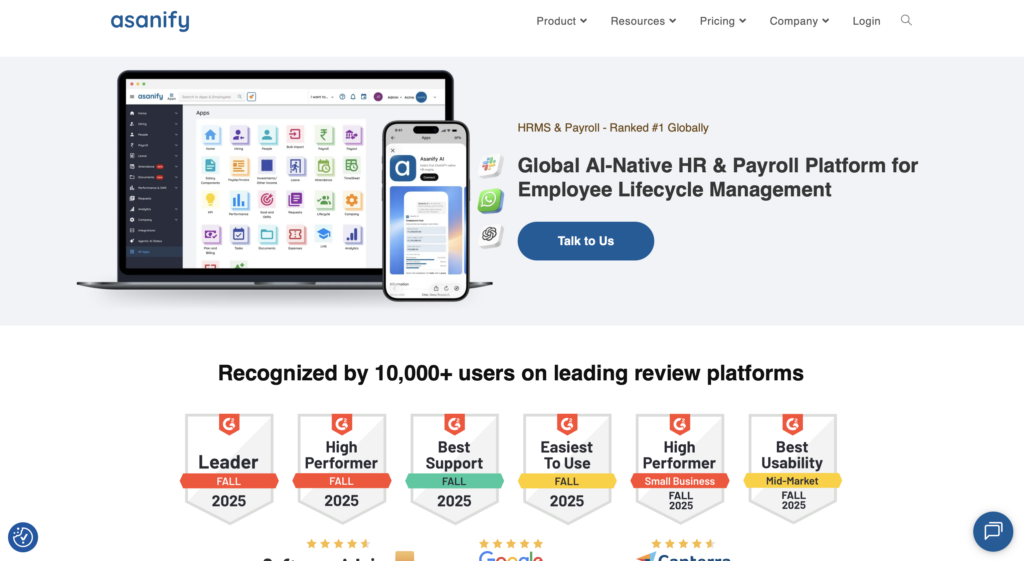
Asanify is an India-focused Employer of Record EOR platform for foreign companies that want to hire employees without establishing their own legal entity. Through its directly owned Kolkata entity, Asanify handles employment contracts, payroll processing, PF, ESI, TDS, gratuity, and other statutory obligations required under Indian law.
Its $99 per employee/month fee includes an HRMS for attendance, leave, expenses, performance, OKRs, and applicant tracking. This makes Asanify particularly suitable when an India hire requires both local employment support and HR technology without adding separate software costs. Asanify is rated 4.9/5 on G2 from 381 reviews (as of October 23, 2026).
Best for: Companies primarily hiring in India that want local compliance expertise, payroll management, employee administration, and HR software within one platform.
Key strengths:
- Directly owned legal entity in India
- 24-hour employee onboarding
- Employment contracts and statutory requirements managed in-house
- Complete HRMS included with the EOR service
- WhatsApp employee self-service and ChatGPT integration
- Support for payroll, statutory benefits, and the Employee Pension Scheme where applicable
Limitation: Companies requiring simultaneous Employer of Record coverage across dozens of countries may prefer a global-first platform.
Pricing: $99 per employee per month for India. For other countries, see Asanify’s international pricing.
Compare directly: Asanify vs Deel | Asanify vs Remote | Asanify vs Multiplier

2. Deel: Global EOR Brand with 150-Plus Country Breadth
Weighted score: 4.58/5 | Starting price: $599 per employee/month | Onboarding: approximately 3 days
Deel is an Employer of Record platform for companies managing employees and independent contractors across multiple countries. In India, its service covers employment agreements, payroll, employee benefits, taxes, and statutory requirements through local employment infrastructure.
Its international reach makes it particularly useful when an India hire is one part of a broader global expansion strategy.
Best for: Enterprises and fast-growing businesses that want one platform for international employees and contractors.
Key strengths: Broad country coverage, global payroll, contractor management, integrations, and workforce administration.
Limitation: Its starting price is substantially higher than India-focused alternatives when most employees are located in India.
Pricing: Starts at $599 per employee per month. Compare: Asanify vs Deel
3. Remote: Owned-Entity EOR with Strong IP Protection
Weighted score: 4.45/5 | Starting price: $599–$699 per employee/month | Onboarding: 7 to 14 days
Remote provides Employer of Record services for distributed companies and places particular emphasis on intellectual property protection. This can be useful for technology businesses hiring Indian employees who work with proprietary software, product designs, or confidential information.
The platform supports employment contracts, multi-currency payroll, employee benefits, and workforce administration across international markets.
Best for: Remote-first and technology companies prioritizing IP protection and standardized international hiring.
Key strengths: IP-assignment framework, employee self-service, multi-country payroll, benefits, and workforce tools.
Limitation: Premium pricing may be difficult to justify when India is the company’s primary hiring market.
Pricing: Around $599 per employee/month annually or $699 with monthly billing. Compare: Asanify vs Remote.
4. Multiplier: Best for APAC Expansion
Weighted score: 4.43/5 | Starting price: $400 per employee/month | Onboarding: approximately 24 hours
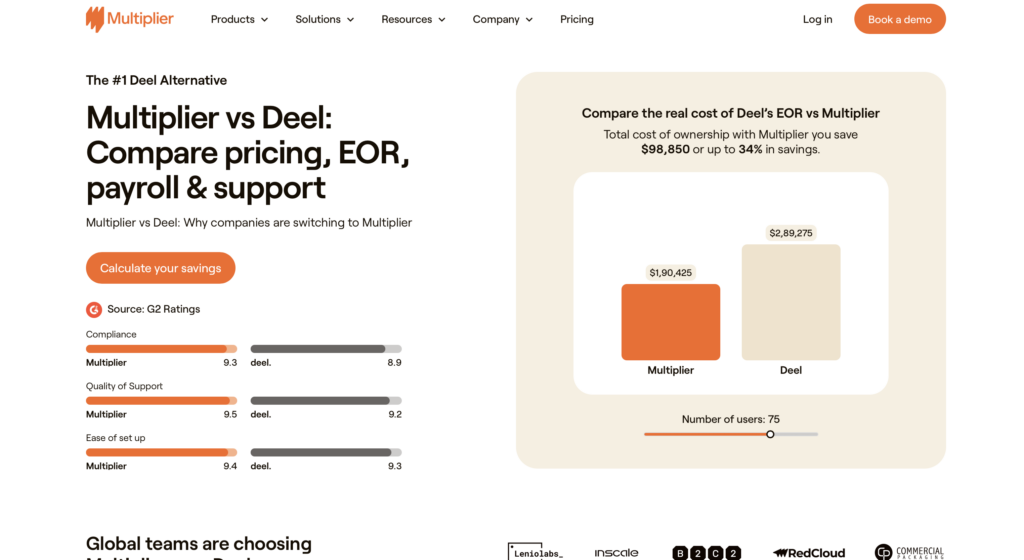
Multiplier provides EOR services across India and other Asia-Pacific markets. Companies building teams in India, Singapore, the Philippines, Vietnam, and other regional markets can manage international employment through one platform.
Its services include payroll, multi-currency payments, contractor management, and workforce administration.
Best for: Companies making an India hire while expanding across several APAC markets.
Key strengths: APAC coverage, fast onboarding, multi-currency payroll, contractor support, and centralized workforce tools.
Limitation: India-focused companies may not need the broader international infrastructure included in the service.
Pricing: Starts at approximately $400 per employee per month. Compare directly: Asanify vs Multiplier.
5. Skuad: Direct-Entity India Coverage at a Mid-Budget Price
Weighted score: 4.03/5 | Starting price: $199 per employee/month | Onboarding: 2 to 4 days
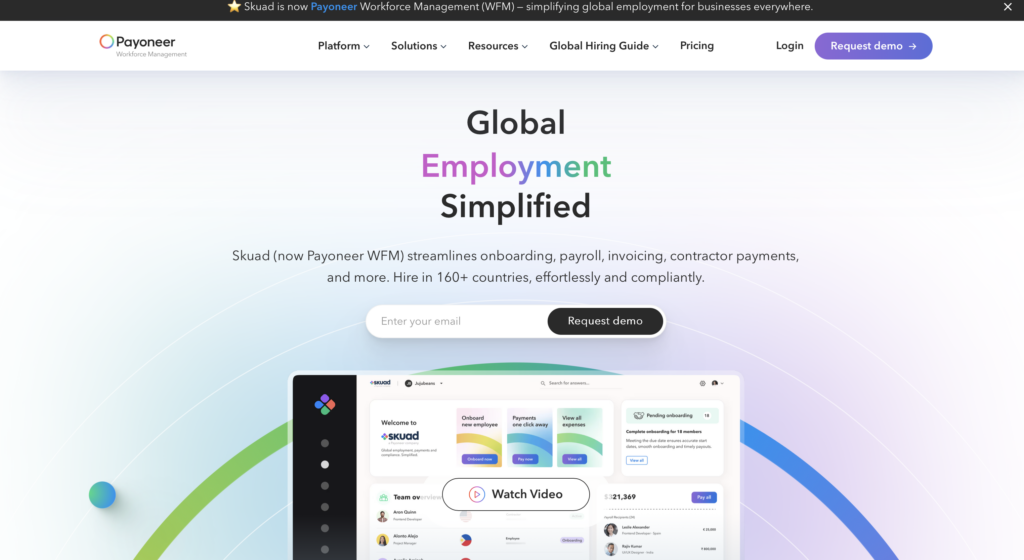
Skuad, now part of Payoneer, offers Employer of Record services for businesses hiring employees across India and other international markets. Its lower starting price makes it an option for companies that need multi-country coverage but want to control platform costs.
The service supports employee onboarding, payroll, contractor management, and local statutory requirements.
Best for: Cost-conscious businesses hiring in India alongside other countries.
Key strengths: Competitive starting price, international coverage, payroll support, contractor management, and 24/7 assistance.
Limitation: Companies should compare its HR functionality and integrations with broader workforce platforms before choosing it.
Pricing: Starts at approximately $199 per employee per month on longer-term plans. Compare directly: Asanify vs Skuad.
6. Rippling: The Workforce Platform That Includes EOR
Weighted score: 3.93/5 | Pricing: Custom | Onboarding: approximately 5–10 days
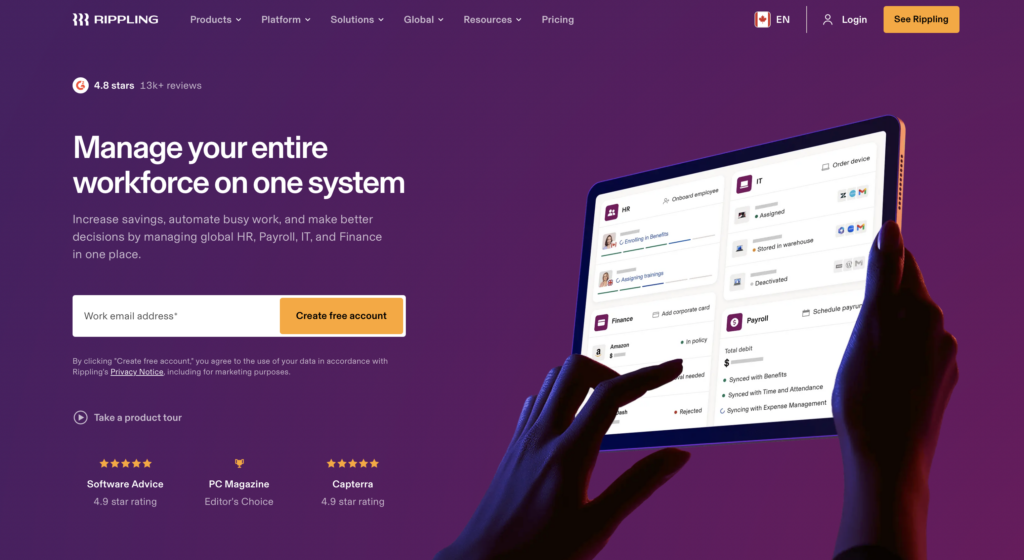
Rippling combines Employer of Record capabilities with a broader workforce platform. Companies can manage HR records, payroll, applications, devices, and IT provisioning from one system.
Its workflow automation is particularly useful for organizations that want a new employee’s onboarding to trigger both HR and IT processes.
Best for: Companies seeking one system for HR, IT, payroll, and international hiring.
Key strengths: Extensive integrations, payroll automation, device management, and centralized workforce administration.
Limitation: Pricing is not publicly disclosed, and the broader platform may be more complex than businesses requiring only EOR services need.
Pricing: Custom quote. Compare directly: Asanify vs Rippling.
7. Globalization Partners (G-P)
Weighted score: 3.90/5 | Pricing: Custom | Onboarding: approximately 2–3 weeks
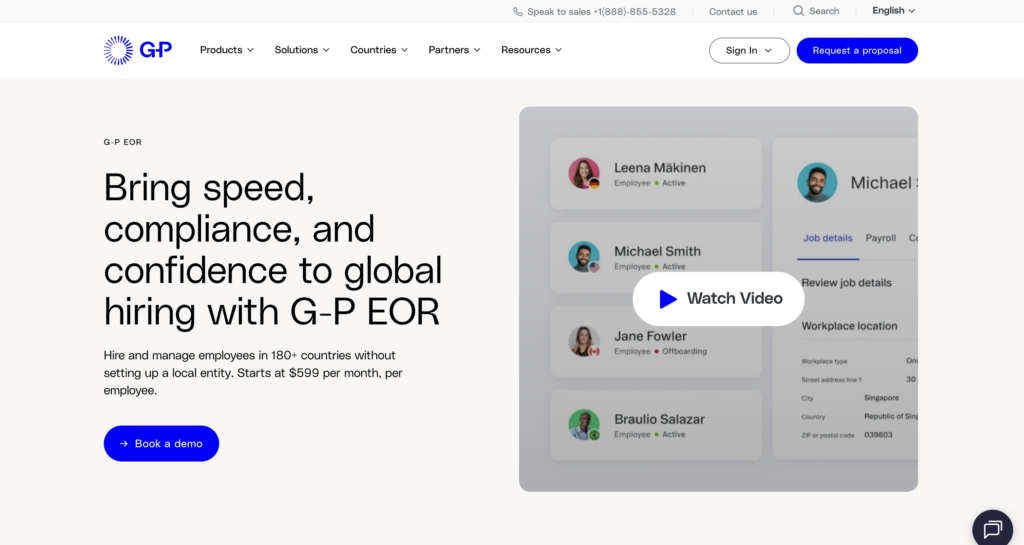
Globalization Partners (G-P) provides Employer of Record services for multinational organizations hiring across numerous markets. Its offering includes payroll, workforce administration, compliance support, and enterprise integrations.
Connections with systems such as Workday, SAP, and ADP make G-P particularly relevant to large HR teams that need international employment operations to work with existing enterprise infrastructure.
Best for: Large multinational organizations requiring extensive international coverage and enterprise integrations.
Key strengths: Broad country coverage, enterprise integrations, payroll capabilities, compliance infrastructure, and visa support.
Limitation: Quote-based pricing makes upfront cost comparison more difficult for smaller India-focused teams.
Pricing: Not publicly published.
8. Velocity Global (Pebl)
Weighted score: 3.53/5 | Starting price: approximately $399–$599 per employee/month | Onboarding: varies

Velocity Global, now operating as Pebl, combines Employer of Record services with immigration, payroll, and workforce support. It is particularly relevant for businesses managing foreign nationals, cross-border employee moves, or workforce integration following mergers and acquisitions.
For an India hire, confirm the specific employing entity, payroll arrangements, immigration responsibilities, and applicable local regulations before signing.
Best for: Companies managing complex immigration, employee mobility, or cross-border M&A.
Key strengths: Immigration support, payroll, international workforce administration, and broad geographic coverage.
Limitation: India-specific entity information and pricing are less transparent than with some alternatives.
Pricing: Approximately $399 promotional or $599 standard, subject to current terms. Compare directly: Asanify vs Velocity Global.
9. Oyster
Weighted score: 3.50/5 | Starting price: $699 per employee/month | Onboarding: approximately 48 hours.
Oyster provides EOR services in India and other markets for distributed companies. Its India documentation addresses PAN, TAN, Employees’ Provident Fund, Employee State Insurance, and Shops and Establishments registration.
The platform also supports payroll, employee benefits, expenses, leave, and employee self-service.
Best for: Distributed teams that value documented local processes and standardized international employment.
Key strengths: India-specific documentation, employee benefits, payroll support, employee self-service, and established security certifications.
Limitation: Its premium starting price may be less attractive to businesses focused primarily on hiring in India.
Pricing: Approximately $699 per employee per month. Compare directly: Asanify vs Oyster
10. RemoFirst
Weighted score: 3.50/5 | Starting price: $199 per employee/month | Onboarding: 5–7 days.

RemoFirst provides EOR services in India and other countries through a network of local providers. Its relatively low published fee makes it attractive to businesses prioritizing cost while hiring internationally.
For India, the service supports payroll and core statutory requirements. Companies should confirm how employment agreements, payroll issues, statutory filings, and employee queries are divided between RemoFirst and the in-country provider.
Best for: Cost-sensitive businesses that need international hiring support and are comfortable with an indirect local model.
Key strengths: Low published starting price, dedicated account management, international coverage, and payroll support.
Limitation: Another party participates in the employment process, so employers should understand responsibilities and escalation procedures before signing.
Pricing: $199 per employee per month. Compare directly: Asanify vs RemoFirst
How to Choose the Right EOR Company for Your Situation
Choosing the right provider requires more than comparing monthly fees. Foreign employers should evaluate the employing structure, local expertise, payroll capabilities, support model, and experience ensuring compliance with Indian labor laws. A strong India employer should also understand state-specific rules and the legal responsibilities that apply throughout the employment relationship.
| Your Situation | Recommended Provider | Why |
|---|---|---|
| Primarily hiring in India | Asanify | $99 pricing, owned Indian entity, HRMS, and fast onboarding |
| Hiring across many countries | Deel | Extensive international coverage |
| Remote technology teams | Remote | Strong IP protection |
| India plus APAC expansion | Multiplier | Strong Asia-Pacific coverage |
| Budget-conscious international hiring | Skuad | Lower starting price with broad coverage |
| HR and IT consolidation | Rippling | HR, payroll, IT, and EOR in one system |
| Large multinational workforce | G-P | Enterprise integrations and international infrastructure |
| Immigration-heavy workforce | Velocity Global (Pebl) | Immigration and employee mobility support |
| Distributed workforce | Oyster | Documented India processes and workforce tools |
| Cost-sensitive expansion | RemoFirst | Low starting fee and international coverage |
Before signing, request transparent pricing that separates the service fee from benefits, deposits, foreign exchange charges, termination costs, and other expenses. Confirm which local entity will employ your workforce and whether another provider participates in payroll or employment administration. This helps identify potential compliance risk before employees are onboarded.
The Real Annual Cost of an EOR in India
The monthly service fee is only one component of employment costs. Foreign employers should also budget for salary, statutory employer costs, social security, insurance, taxes, and applicable employee benefits.
For a team of 10 employees, published platform fees produce significantly different annual costs:
| Provider | Monthly Fee per Employee | Annual Platform Cost for 10 Employees |
|---|---|---|
| Asanify | $99 | $11,880 |
| Skuad | $199 (longer-term plan) | $23,880 |
| Multiplier | $400 | $48,000 |
| Deel | $599 | $71,880 |
| Remote | $599–$699 | $71,880–$83,880 |
| Oyster | $699 | $83,880 |
The figures above represent platform fees only. Salaries, statutory contributions, insurance, taxes, and other employment expenses are additional.
Ask each provider for transparent pricing that explains the complete employment cost. The estimate should distinguish the service fee from statutory contributions, insurance, foreign exchange charges, deposits, and other provider-specific costs.

India EOR Compliance: What Your Provider Must Handle
An EOR becomes the legal employer and assumes important legal responsibilities for the workforce. For foreign employers, this enables hiring through an established local entity while the client continues managing the employee’s day-to-day role.
A provider should have processes for generating locally compliant contracts, running payroll, making required filings, and ensuring compliance with applicable Indian labor laws.
| Requirement | What the Provider Should Handle |
|---|---|
| Employment documentation | Prepare locally compliant employment contracts covering compensation, benefits, duties, and employment conditions |
| Provident Fund | Calculate and remit applicable EPF contributions |
| Employee Pension Scheme | Administer applicable pension contributions through the EPF framework |
| Employee State Insurance | Handle applicable registration and contributions for eligible workers |
| Income tax and TDS | Calculate salary withholding and deposit applicable taxes |
| Minimum wages | Apply wage requirements relevant to the employee’s state and role |
| Gratuity | Track applicable gratuity obligations |
| Working hours and leave | Apply relevant rules covering working hours, leave, and holidays |
| Employment records | Maintain required payroll, tax, and workforce documentation |
India’s employment framework combines central legislation with state-specific rules. Depending on the workforce and establishment, relevant legislation may include the Minimum Wages Act, the Industrial Disputes Act, and applicable Shops and Establishments Act requirements.
These rules can affect wages, working hours, holidays, leave, termination procedures, and the required notice period. State-level requirements can also differ between locations, making local expertise particularly important when hiring across multiple Indian cities.
A capable provider should maintain compliant contracts and monitor regulatory changes throughout the employment lifecycle. This includes ensuring compliance when wage rules, payroll obligations, or state requirements change rather than addressing them only during initial onboarding.
India’s New Labour Codes (2026): What Changed and How It Affects Hiring
India’s labour framework affects wages, social security, employee protections, and working conditions. Providers should monitor changes and determine whether they require adjustments to payroll, employment documentation, benefits, or social security contributions.
For an India employer, the important question is how regulatory changes are implemented in practice. Ask who monitors new rules, how the provider assesses their impact, and how quickly payroll or compliant contracts are updated.
This ability to adapt is an important part of ensuring compliance as employment rules evolve.
Red Flags to Watch for in an India EOR Contract
Watch for these issues before signing an Employer of Record agreement:
- Unclear employing structure: Confirm which entity legally employs the worker and whether another in-country provider is involved.
- Unclear costs: Request a written breakdown of service fees, deposits, FX charges, insurance, benefits, and termination costs.
- Weak knowledge of labor laws: The provider should understand Provident Fund, ESI, taxes, gratuity, wage requirements, working hours, and state rules.
- Weak termination procedures: Confirm how termination, final settlement, severance where applicable, and the employee’s notice period are handled.
- Unclear support: Establish who responds to payroll errors, employee queries, and statutory notices.
- Weak data protection: Review security controls and data-processing terms before sharing employee information.
These checks help reduce compliance risk and unexpected costs after hiring begins.
Questions to Ask Every India EOR Provider Before Signing
Ask each provider:
- Which entity will legally employ our workforce?
- How do you create compliant contracts for employees in different Indian states?
- How do you handle Provident Fund, ESI, gratuity, payroll taxes, and social security?
- How do you monitor the Minimum Wages Act and applicable Shops and Establishments Act rules?
- How are working hours, leave, termination, and the notice period handled?
- What employee benefits and insurance options are available?
- Can you provide transparent pricing covering the service fee and additional charges?
- How does your team manage regulatory updates and ensure compliance over time?
- Who handles employee queries and statutory notices?
Get important operational, legal, and pricing commitments in writing before signing.
The Bottom Line: Which EOR Company Should You Choose?
For companies primarily hiring in India, Asanify combines a directly owned Indian entity, $99 per employee/month pricing, 24-hour onboarding, payroll, statutory support, and HR software. Deel and Remote are better suited to businesses prioritizing extensive international coverage, while Multiplier is particularly relevant for APAC expansion.
Whichever Employer of Record you select, compare the legal employer structure, total cost, employment contracts, payroll capabilities, local expertise, support, and ability to comply with Indian employment requirements before signing. See the full employer of record India offering or book a meeting.
Frequently Asked Questions
Based on our weighted evaluation, Asanify ranks first overall with a score of 4.83/5. It combines a directly owned local entity, $99 per employee/month pricing, 24-hour onboarding, payroll management, statutory compliance, and an included HRMS. Deel and Remote are stronger alternatives for companies prioritizing broad international coverage.
EOR services in India generally cost about $99 to $699+ per employee per month, depending on the provider and service model. This platform fee is separate from employee salary, statutory contributions, employee benefits, health insurance, and other employment costs. Companies should also check for deposits, setup fees, foreign exchange charges, and termination costs. See the employer of record India cost guide for a full breakdown.
An Employer of Record becomes the legal employer of the worker, while a Professional Employer Organization (PEO) generally operates through a co-employment arrangement where the client already has an established entity. See our full PEO vs EOR comparison for the difference in detail.
No. A foreign company can use an Employer of Record to hire employees without establishing its own legal entity in India. The EOR becomes the legal employer and manages employment contracts, payroll, statutory benefits, tax withholding, and employment compliance, while the client company manages the employee’s day-to-day responsibilities.
Yes, companies can use an EOR structure to employ workers in India, provided the employment arrangement complies with applicable Indian labor laws, tax requirements, social security obligations, and state-level regulations. Before selecting a provider, verify the local entity that will employ your workers and how the provider manages ongoing legal employment requirements.
An India EOR should manage applicable payroll and statutory obligations such as Employees’ Provident Fund (EPF), Employee State Insurance (ESI), Professional Tax, TDS on salary, gratuity, statutory bonus, leave, and employment records. Requirements can vary according to employee eligibility, compensation, location, and applicable local employment laws.
Onboarding time varies by provider and employee circumstances. Some providers advertise onboarding within 24–48 hours for a standard hire, while others may require several days or longer. The process typically includes collecting employee information, preparing employment agreements, completing payroll documentation, enrolling applicable benefits, and satisfying statutory requirements.
Yes. EOR providers can administer statutory benefits and may also offer supplementary employee benefits such as health insurance. Available plans, coverage levels, dependent options, and costs vary by provider. Employers should compare both mandatory benefits administration and optional insurance packages when evaluating services.
Many EOR providers offer immigration or work permit support, but capabilities vary. Foreign nationals generally require appropriate authorization to work legally in India. If immigration support is required, confirm whether the provider manages the process directly or through a third party, which visa-related services are included, and what additional fees apply.
Asanify is well suited to hiring a single employee in India, since pricing stays at $99 per employee per month regardless of headcount and onboarding takes as little as 24 hours. Unlike setting up your own entity, there’s no minimum team size required to get compliant, so you can hire one employee, test the market, and scale later without switching providers.
Not to be considered as tax, legal, financial or HR advice. Regulations change over time so please consult a lawyer, accountant or Labour Law expert for specific guidance.