

The Philippines has become a leading destination for global hiring thanks to its skilled workforce, strong English proficiency, and competitive labor costs. Companies across industries hire Filipino professionals to support business growth while maintaining operational efficiency.
However, the true cost of hiring extends beyond employee salaries. Employers must also consider statutory contributions, payroll administration, mandatory benefits, and compliance requirements. An Employer of Record (EOR) simplifies this process by handling employment, payroll, and compliance obligations on behalf of the employer. In this guide, we’ll explore Philippines EOR pricing, key employer costs, and why many businesses choose Asanify’s EOR solution starting from just $99 per employee per month.
What Determines EOR Pricing in the Philippines?
Employer of Record pricing varies depending on several factors. While many companies focus on the monthly service fee, the overall cost of employment is influenced by employee compensation, benefits, compliance requirements, and workforce size.
Understanding these factors helps businesses forecast hiring expenses more accurately and choose the most cost-effective expansion strategy.
Employee Salary
Employee salary is the largest cost component in any hiring decision. Compensation levels vary based on industry, role complexity, experience, and skill specialisation.
For example, a customer support representative typically commands a lower salary than a senior software engineer, finance manager, or cybersecurity specialist. Since statutory contributions and certain benefits are tied to employee compensation, salary levels directly influence total employment costs.
Number of Employees
The size of your workforce can also affect EOR pricing. Companies hiring multiple employees often benefit from customized pricing arrangements and operational efficiencies.
Organisations building larger teams should evaluate pricing models that can scale alongside their growth plans.
Employee Benefits
Many employers provide benefits beyond statutory requirements to attract and retain top talent.
Examples include:
- Private health insurance
- Internet allowances
- Home office stipends
- Wellness programs
- Learning and development budgets
- Additional paid leave
While optional, these benefits can influence the total cost of employment.
Compliance Requirements
Certain industries require enhanced compliance support due to regulatory obligations. Businesses operating in finance, healthcare, technology, or regulated professional services may require additional HR and compliance administration.
Immigration Support
Companies hiring foreign nationals may require additional assistance related to work permits, visa documentation, and immigration compliance. These services can increase overall employment costs depending on the complexity of the hiring arrangement.
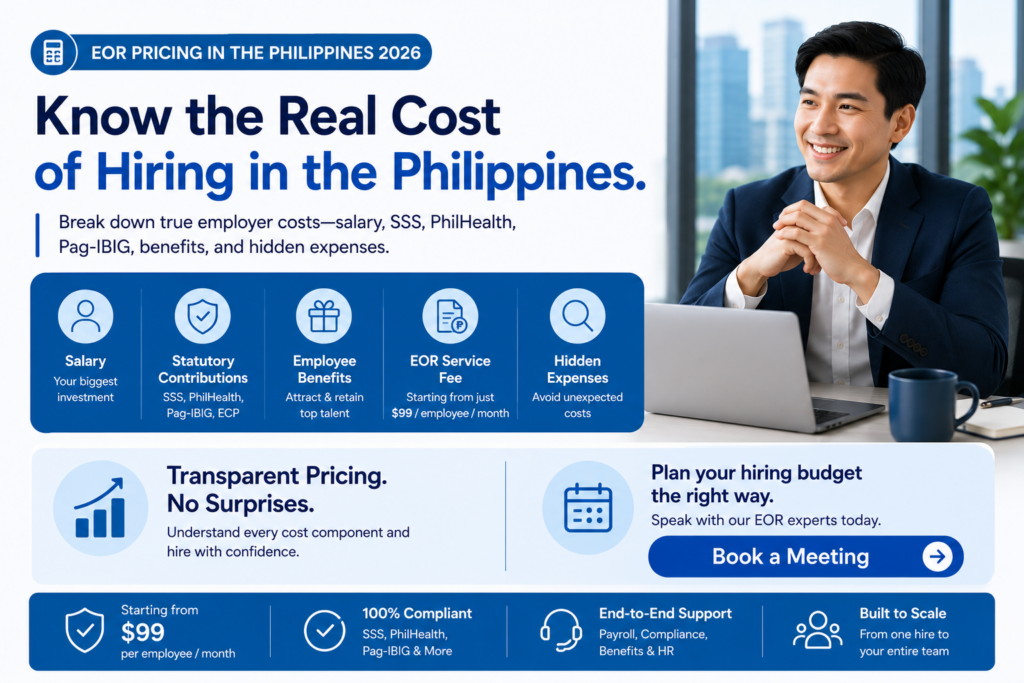
The Four Components of Total Employment Cost
Many employers incorrectly assume that employee salary represents the total cost of employment. In reality, there are four major cost categories that should be considered when budgeting for workforce expansion in the Philippines.
Employee Salary
Salary remains the primary cost component. Businesses should benchmark compensation carefully to remain competitive while maintaining budget efficiency.
Factors influencing salary include:
- Experience level
- Technical skills
- Industry demand
- Geographic location
- Language proficiency
Statutory Employer Contributions
Philippine employers are required to contribute to government-mandated programs that provide social protection and employee benefits.
These contributions typically include:
- Social Security System (SSS)
- PhilHealth
- Pag-IBIG Fund
- Employees’ Compensation Program (ECP)
These obligations must be incorporated into workforce planning and budgeting.
Employee Benefits
Beyond mandatory contributions, many employers offer additional benefits to improve employee engagement and retention.
Common benefits include:
- Medical insurance
- Performance bonuses
- Remote work support
- Additional leave entitlements
- Professional development opportunities
EOR Service Fee
The EOR fee covers the administration and compliance infrastructure required to employ workers legally.
This generally includes:
- Employment contracts
- Payroll processing
- Employee onboarding
- Tax administration support
- Contribution management
- HR support
Asanify’s Employer of Record solution starts from just $99 per employee per month, providing businesses with a predictable and transparent hiring model.
Understanding Employer Contributions: SSS, PhilHealth, and Pag-IBIG
Employer contributions are a key part of payroll costs in the Philippines. In addition to employee salaries, employers must contribute to several government-mandated programs that provide social security, healthcare, housing assistance, and workplace protection benefits. Understanding these obligations helps businesses estimate the true cost of hiring and remain compliant with local regulations.
Social Security System (SSS)
The Social Security System (SSS) provides employees with financial protection through retirement, maternity, sickness, disability, and survivor benefits. Employers are responsible for managing contributions and ensuring timely remittance.
Employer responsibilities include:
- Calculating monthly SSS contributions
- Deducting employee contribution shares
- Remitting contributions within prescribed deadlines
- Maintaining payroll and contribution records
- Ensuring compliance with SSS regulations
PhilHealth Contributions
PhilHealth is the national health insurance program that provides healthcare coverage to employees and their eligible dependents. Employers play a critical role in ensuring employees remain covered under the program.
Employer responsibilities include:
- Calculating applicable contribution amounts
- Processing payroll deductions
- Remitting employer and employee contributions
- Maintaining compliance documentation
- Monitoring contribution rate updates
Pag-IBIG Contributions
The Pag-IBIG Fund supports housing, savings, and employee welfare programs. While contribution amounts are relatively small, employer participation remains mandatory.
Employer responsibilities include:
- Registering eligible employees
- Calculating monthly contributions
- Processing payroll deductions
- Remitting contributions accurately
- Maintaining contribution records
Employees’ Compensation Program (ECP)
The Employees’ Compensation Program (ECP) provides protection for employees who experience work-related injuries, illnesses, or disabilities. This contribution is generally funded by employers and forms part of the country’s employee protection framework.
Key benefits of the program include:
- Medical assistance for work-related incidents
- Disability support benefits
- Income replacement assistance
- Rehabilitation services
- Survivor benefits where applicable
Together, SSS, PhilHealth, Pag-IBIG, and ECP contributions form an important part of total employment costs and should be factored into workforce planning when evaluating Philippines EOR pricing.
Sample Hiring Costs at ₱30K, ₱50K, ₱100K, and ₱200K Salaries
The following examples illustrate how salary levels influence total employment costs. Actual figures may vary depending on employee benefits, bonus structures, and regulatory updates.
Entry-Level Employee with a Monthly Salary of ₱30,000
| Cost Component | Estimated Cost |
| Gross Salary | ₱30,000 |
| Employer Contributions | ₱2,000–₱4,000 |
| Asanify EOR Fee | From $99 |
| Estimated Total Cost | Salary + Contributions + Fee |
Mid-Level Professional with a Monthly Salary of ₱50,000
| Cost Component | Estimated Cost |
| Gross Salary | ₱50,000 |
| Employer Contributions | ₱3,000–₱5,000 |
| Asanify EOR Fee | From $99 |
| Estimated Total Cost | Salary + Contributions + Fee |
Senior Employee with a Monthly Salary of ₱100,000
| Cost Component | Estimated Cost |
| Gross Salary | ₱100,000 |
| Employer Contributions | Based on statutory ceilings |
| Asanify EOR Fee | From $99 |
| Estimated Total Cost | Salary + Contributions + Fee |
Executive-Level Hire with a Monthly Salary of ₱200,000
| Cost Component | Estimated Cost |
| Gross Salary | ₱200,000 |
| Employer Contributions | Based on statutory ceilings |
| Asanify EOR Fee | From $99 |
| Estimated Total Cost | Salary + Contributions + Fee |

Hidden Costs Employers Often Overlook
Many businesses budget for salaries and payroll contributions but overlook several expenses that can materially affect hiring costs.
13th Month Pay
The Philippines requires employers to provide eligible employees with 13th Month Pay. This mandatory benefit effectively increases annual compensation costs and should always be included in workforce planning.
Holiday Pay
Employees may be entitled to premium compensation when working during holidays. Depending on staffing requirements, holiday pay can increase payroll expenses throughout the year.
Recruitment Expenses
Hiring costs may include:
- Recruitment agency fees
- Job advertisements
- Candidate assessments
- Background checks
These expenses can accumulate quickly during periods of rapid hiring.
Equipment and Technology Costs
Many employers provide:
- Laptops
- Software subscriptions
- Security tools
- Internet allowances
Technology expenses should be considered part of the overall employment investment.
Currency Conversion Costs
International companies often incur banking fees, foreign exchange costs, and payment processing expenses when compensating employees across borders.
Philippines EOR vs Entity Setup: Cost Comparison
One of the most important decisions employers face is whether to use an Employer of Record or establish a local legal entity.
The right option depends on hiring goals, team size, budget, and long-term expansion plans.
Cost Comparison Table
| Factor | Employer of Record | Local Entity |
| Setup Cost | Low | High |
| Setup Time | Days or Weeks | Several Months |
| Payroll Infrastructure | Included | Self-Managed |
| Compliance Management | Included | Self-Managed |
| HR Administration | Included | Internal Team Required |
| Hiring Speed | Fast | Slower |
| Ongoing Maintenance | Minimal | Significant |
When an EOR Makes More Sense
An Employer of Record is often the preferred option when:
- Hiring the first employee
- Testing a new market
- Building a small team
- Expanding rapidly
- Avoiding entity setup costs
When Entity Setup Makes More Sense
Entity establishment may be appropriate when:
- Hiring large teams
- Opening physical offices
- Building long-term operations
- Establishing a permanent local presence
For many international businesses entering the Philippines, an EOR provides the fastest and lowest-risk route to market.
Why Asanify Starts at Just $99 Per Employee Per Month
Many global EOR providers charge several hundred dollars per employee each month, making international hiring expensive for startups and growing businesses. While these solutions may work for large enterprises, companies expanding into the Philippines often need a more affordable option that still delivers strong compliance, payroll, and HR support.
Asanify’s Employer of Record service starts from just $99 per employee per month, enabling businesses to hire and manage employees in the Philippines without establishing a local entity. This transparent pricing model helps companies control hiring costs while remaining compliant with local employment regulations.
Key services include:
- Compliant employee onboarding
- Locally compliant employment contracts
- Payroll processing and salary administration
- Tax administration support
- SSS contribution management
- PhilHealth administration
- Pag-IBIG contribution processing
- Employee lifecycle management
- Ongoing HR support
- Labor law compliance assistance
Why Companies Choose Asanify for Philippines Hiring
Businesses choose Asanify because it combines affordability, compliance expertise, and operational simplicity in a single platform, making it easier to hire and manage employees through an EOR Philippines services.
Key advantages include:
- Transparent EOR Philippines pricing starting from $99 per employee per month
- Faster hiring in the Philippines without entity setup
- Local payroll, statutory contribution, and compliance expertise
- Simplified workforce administration through a single platform
- Reduced operational and employment compliance risks
- Scalable EOR Philippines support for growing global teams
- Dedicated HR and employee management assistance
- End-to-end management of payroll, SSS, PhilHealth, and Pag-IBIG obligations
- A compliant and cost-effective way to build teams in the Philippines
By combining local expertise with automated payroll and HR operations, Asanify helps companies hire, manage, and scale teams in the Philippines confidently through a reliable EOR Philippines solution.

Conclusion
Understanding Philippines EOR pricing requires looking beyond monthly service fees. Employers must consider salaries, statutory contributions, employee benefits, recruitment expenses, payroll obligations, and compliance requirements when calculating the true cost of hiring.
For many international companies, an Employer of Record provides the fastest and most cost-effective way to build a team in the Philippines. By eliminating entity setup requirements and simplifying compliance management, an EOR allows businesses to focus on growth while minimizing administrative complexity.
With transparent pricing starting from just $99 per employee per month, Asanify helps companies hire confidently, remain compliant, and scale their Philippine workforce efficiently.
Frequently Asked Questions
EOR pricing varies by provider. Asanify’s Employer of Record service starts from $99 per employee per month.
Most EOR solutions include onboarding, payroll administration, employment contracts, compliance support, statutory contribution management, and HR services.
For many businesses hiring a small or medium-sized team, an EOR is often more affordable than establishing and maintaining a local entity.
Employers typically contribute to SSS, PhilHealth, Pag-IBIG, and the Employees’ Compensation Program.
No. Government contributions are generally separate from the EOR service fee and depend on employee compensation levels.
An EOR can support compliant employment arrangements, but foreign-national hires must still satisfy applicable immigration and work authorization requirements.
Companies choose Asanify because it combines compliant hiring, payroll administration, contribution management, and HR support through a transparent EOR solution starting from $99 per employee per month.
Not to be considered as tax, legal, financial or HR advice. Regulations change over time so please consult a lawyer, accountant or Labour Law expert for specific guidance.