

Managing payroll in Singapore involves more than simply paying employees on time. Employers must also meet various statutory deadlines related to CPF contributions, Skills Development Levy (SDL) payments, tax reporting, and employment recordkeeping. Missing these deadlines can result in penalties, compliance issues, and unnecessary administrative burdens.
A clear Singapore payroll calendar helps employers stay organized throughout the year and ensures that payroll operations remain compliant with Ministry of Manpower (MOM), Central Provident Fund (CPF), and Inland Revenue Authority of Singapore (IRAS) requirements. This guide outlines the key payroll deadlines and filing obligations businesses should monitor in 2026.
Why a Payroll Calendar Matters for Employers
As a business grows, payroll compliance becomes increasingly complex. Employers must coordinate salary payments, statutory contributions, employee tax reporting, and government submissions while maintaining accurate payroll records.
A structured payroll calendar helps businesses:
- Avoid missed deadlines
- Reduce compliance risks
- Improve payroll accuracy
- Support employee satisfaction
- Maintain proper financial planning
- Prepare for audits and reporting obligations
For companies hiring local employees in Singapore, maintaining a payroll calendar is one of the simplest ways to ensure ongoing compliance.
Monthly Salary Payment Deadlines
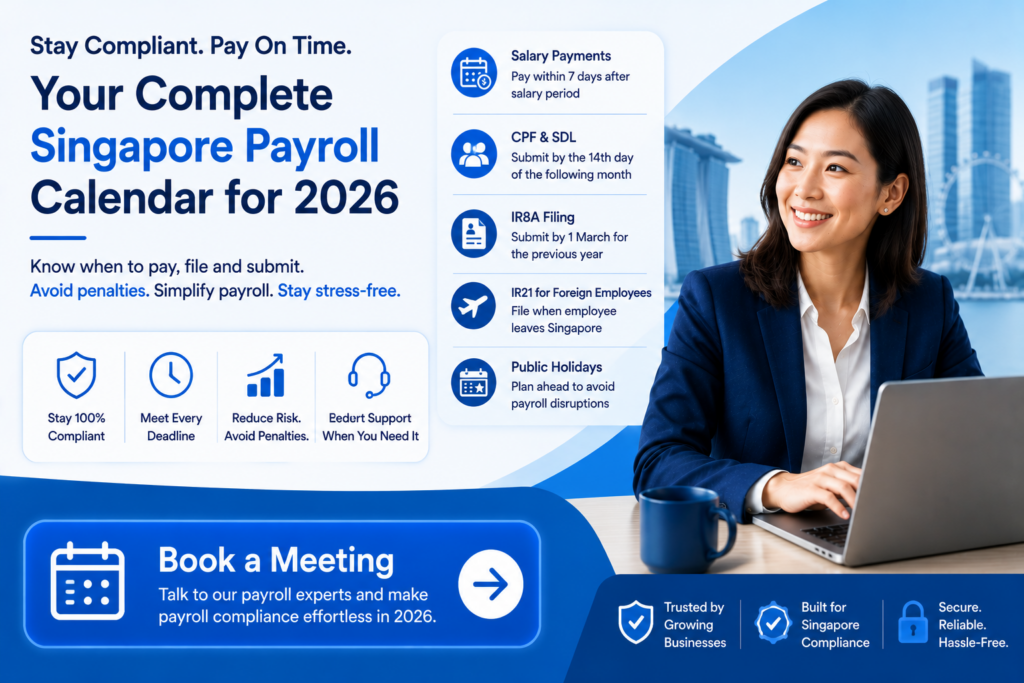
Salary payments are one of the most fundamental employer responsibilities under Singapore employment law. Employers must ensure employees are paid accurately and within the timelines required by the Employment Act.
Most businesses establish fixed payroll schedules, such as the last working day of the month or a specific payment date each month. Whatever schedule is chosen, employers should communicate it clearly and apply it consistently.
When Must Salaries Be Paid?
Under Singapore regulations:
- Salary should generally be paid at least once per month.
- Payment must be made within 7 days after the end of the salary period.
For example, if the salary period ends on 31 January, payment should generally be made by 7 February.
Overtime Payment Deadlines
Where overtime applies, overtime wages should generally be paid within 14 days after the end of the salary period in which the overtime was worked.
Maintaining a consistent payroll schedule helps employers avoid disputes and late payment issues.
CPF Contribution Deadlines
CPF contributions represent one of the most important recurring payroll obligations for employers in Singapore. Businesses employing Singapore Citizens and Permanent Residents must calculate and submit CPF contributions accurately each month.
Late CPF payments can result in penalties, interest charges, and compliance concerns.
CPF Submission Deadline
Employers generally must submit CPF contributions:
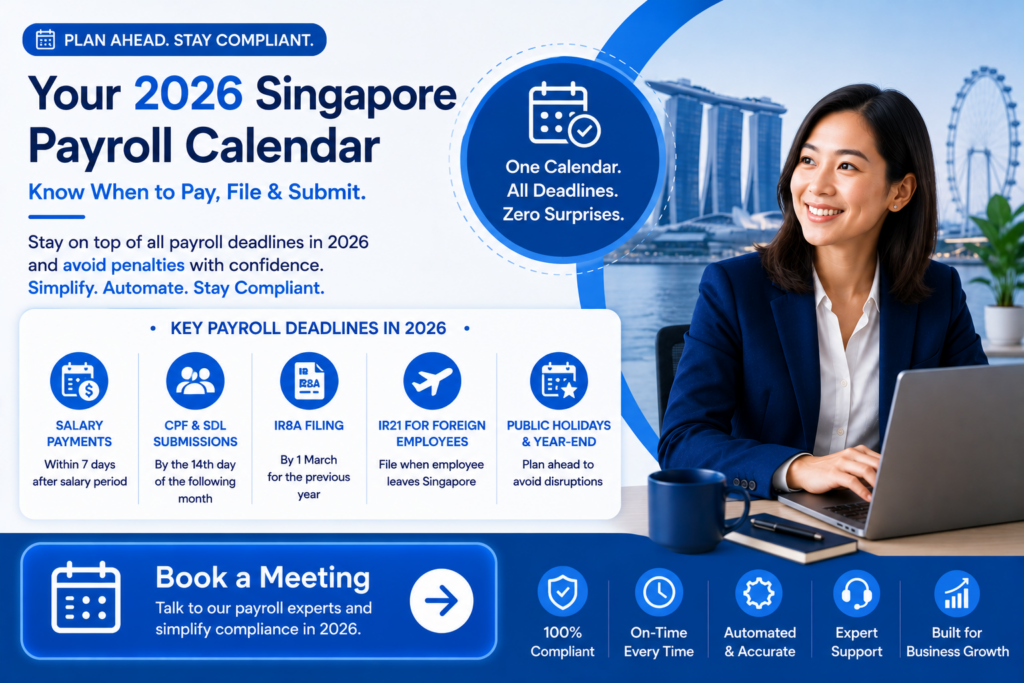
- By the 14th day of the following month
For example:
| Payroll Month | CPF Due Date |
| January | 14 February |
| February | 14 March |
| March | 14 April |
| April | 14 May |
Employers should process payroll early enough to allow sufficient time for CPF calculations and submissions.
CPF Compliance Best Practices
To reduce payroll errors, employers should:
- Verify employee CPF eligibility
- Review contribution rates regularly
- Monitor salary ceilings
- Maintain accurate employee records
- Reconcile payroll reports monthly
Skills Development Levy (SDL) Deadlines
The Skills Development Levy (SDL) is a mandatory contribution that employers in Singapore must pay for employees who render services in the country. While CPF applies mainly to Singapore Citizens and Permanent Residents, SDL has a broader scope and generally applies to all employees, including local and foreign employees, as long as they are employed in Singapore.
SDL contributions help fund national workforce development initiatives, training grants, and SkillsFuture Singapore programs. For employers, this means SDL is not just a minor payroll item but a recurring statutory obligation that should be built into every monthly payroll cycle.
When Is SDL Due?
SDL is usually paid together with CPF contributions through the CPF payment system. Employers typically need to submit SDL by the 14th day of the following month, along with CPF where applicable.
For example, SDL for salaries paid in January should generally be submitted by 14 February. If the due date falls on a weekend or public holiday, employers should process payments earlier to avoid delays.
Businesses should include SDL in their monthly payroll checklist because even small missed contributions can create compliance gaps over time.
Why SDL Compliance Matters
Although SDL amounts are usually smaller than CPF contributions, employers should not treat them as optional or insignificant. Incorrect SDL payments may lead to follow-ups, administrative corrections, and unnecessary payroll reconciliation work.
SDL compliance matters because it helps employers:
- Meet statutory payroll obligations
- Avoid missed or underpaid contributions
- Maintain clean payroll records
- Reduce year-end reconciliation issues
- Support Singapore’s workforce training ecosystem
For companies hiring in Singapore for the first time, SDL should be reviewed alongside CPF, salary payments, employment records, and tax reporting deadlines to ensure payroll is fully compliant from the start.
IR8A Submission Deadline
IR8A reporting is one of the most important annual payroll obligations for employers in Singapore. The IR8A form reports an employee’s income, benefits, allowances, and other taxable compensation to the Inland Revenue Authority of Singapore (IRAS).
Unlike monthly payroll activities, IR8A is an annual reporting requirement. However, accurate IR8A filing depends on how well the employer maintains payroll records throughout the year. If salary, bonus, allowance, and benefits data are not recorded properly each month, year-end reporting can become time-consuming and error-prone.
IR8A Filing Deadline
Employers generally must submit employee income information to IRAS by 1 March each year. The filing usually covers employment income earned during the previous calendar year.
For example, income earned from 1 January to 31 December 2026 would typically be reported by 1 March 2027.
Employers should begin preparing IR8A data well before the deadline, especially if they manage multiple employees, bonuses, commissions, allowances, or benefits-in-kind.
Information Typically Reported
IR8A reporting may include several types of employee compensation, such as:
- Basic salary
- Bonuses and commissions
- Allowances
- Benefits-in-kind
- Director fees
- Gains or profits from employment
- Other taxable compensation
Employers should ensure that payroll data, employee records, and taxable benefit details are consistent before submission.
Why IR8A Preparation Should Start Early
Late or inaccurate IR8A submissions can create problems for both employers and employees. Employees rely on accurate income reporting for their personal tax filing, while employers are responsible for providing complete and correct employment income information.
To prepare efficiently, employers should:
- Reconcile payroll records monthly
- Track bonuses and variable pay accurately
- Record taxable benefits throughout the year
- Maintain updated employee details
- Review CPF and payroll reports before filing
- Confirm reporting requirements for directors and foreign employees
A well-maintained payroll system makes IR8A filing smoother and reduces the risk of last-minute errors.
IR21 Requirements for Departing Foreign Employees
Employers sometimes overlook IR21 obligations when foreign employees leave Singapore.
The IR21 process helps ensure outstanding tax obligations are addressed before certain foreign employees cease employment or leave Singapore.
When Is IR21 Required?
Employers may need to file IR21 when:
- A foreign employee resigns
- Employment is terminated
- The employee plans to leave Singapore
Tax Clearance Requirements
Employers generally must:
- Notify IRAS
- Withhold applicable payments where required
- Complete tax clearance procedures
Businesses employing foreign nationals should understand IR21 requirements well before an employee’s departure date.
Public Holidays and Payroll Planning in 2026
Public holidays play an important role in payroll planning because they can influence salary payment schedules, banking operations, attendance tracking, overtime calculations, and workforce availability. While public holidays are announced well in advance, employers that fail to account for them may encounter payroll delays or administrative challenges that affect employee satisfaction and compliance.
Businesses should review Singapore’s annual public holiday calendar at the beginning of each year and incorporate important dates into their payroll planning process. This is particularly important for organizations with shift workers, employees eligible for overtime, or payroll schedules that coincide with public holidays.
Why Public Holidays Matter
Public holidays can affect several aspects of payroll administration and workforce management, including:
- Salary payment timelines
- Bank processing schedules
- Overtime calculations
- Public holiday compensation
- Leave planning
- Shift scheduling
For example, if a scheduled salary payment date falls on a public holiday or non-banking day, employers may need to process payroll earlier to ensure employees receive their salaries on time. Similarly, businesses operating during public holidays may need to account for additional compensation requirements depending on employee eligibility and work arrangements.
Payroll Best Practice
A proactive payroll approach helps reduce disruptions caused by public holidays. Many employers choose to process payroll several days before major public holidays, particularly when banks or payment systems may experience delays.
To improve payroll planning, employers should:
- Review the annual public holiday calendar early
- Confirm payroll cut-off dates in advance
- Coordinate with payroll providers and banks
- Review public holiday pay obligations
- Communicate schedule changes to employees
Planning ahead helps ensure a smooth payroll experience while reducing the risk of late salary payments.
Year-End Payroll Preparation
Year-end payroll preparation is one of the most important payroll responsibilities for employers in Singapore. As the financial year concludes, businesses must review payroll records, reconcile statutory contributions, and prepare information required for annual tax reporting and compliance obligations.
A structured year-end review helps identify discrepancies before regulatory submissions are due and reduces the likelihood of reporting errors. Employers that maintain accurate records throughout the year often find year-end payroll processing significantly easier and more efficient.
Key Year-End Payroll Tasks
Before the year closes, employers should review and reconcile:
- Salary records
- CPF contributions
- SDL payments
- Bonus and commission payments
- Taxable benefits
- Employee information
- Payroll reports
- Leave records
Conducting these reviews early allows businesses to correct inaccuracies before preparing annual filings and employee income reports.
Why Year-End Payroll Reviews Matter
A comprehensive payroll review provides several benefits:
- Improves payroll accuracy
- Reduces compliance risks
- Simplifies IR8A preparation
- Supports audit readiness
- Identifies missing payroll records
- Ensures statutory contributions have been submitted correctly
Employers that treat year-end payroll as an ongoing process rather than a last-minute task generally experience fewer reporting issues and smoother compliance management.
Common Payroll Deadline Mistakes Employers Make
Even organizations with established payroll systems occasionally make compliance mistakes. As payroll obligations increase, it becomes easier to overlook deadlines, reporting requirements, or statutory contribution changes.
Many payroll issues arise not because employers intentionally ignore requirements, but because they lack clear processes, regular reviews, or adequate compliance monitoring.
Most Common Payroll Compliance Mistakes
Some of the most frequent payroll mistakes include:
- Missing CPF submission deadlines
- Incorrect CPF calculations
- Late salary payments
- Poor payroll recordkeeping
- Delayed IR8A preparation
- Overlooking IR21 tax clearance requirements
- Failing to monitor regulatory updates
- Incorrect employee classification
- Inaccurate bonus or allowance reporting
Even small payroll errors can create administrative burdens and require significant time to resolve.
How Employers Can Avoid Payroll Errors
The most effective way to reduce payroll mistakes is to establish structured payroll processes and conduct regular compliance reviews throughout the year.
Employers should consider:
- Using payroll automation tools
- Maintaining accurate employee records
- Reviewing statutory contribution rates regularly
- Performing monthly payroll reconciliations
- Tracking regulatory updates
- Preparing annual reporting data in advance
By implementing strong payroll controls and compliance checks, businesses can reduce risk, improve payroll accuracy, and ensure employees are paid correctly and on time.
How Asanify Helps Businesses Manage Singapore Payroll
Managing payroll deadlines manually becomes increasingly difficult as teams grow. Employers must monitor salary payments, CPF submissions, SDL obligations, tax reporting, employee records, and regulatory updates throughout the year.
Asanify helps businesses streamline Singapore payroll management through:
- Payroll automation
- CPF calculations and administration
- Employee record management
- Leave and attendance tracking
- Compliance monitoring
- Payroll reporting
- HR workflow automation
By centralizing payroll and compliance activities, Asanify helps employers stay on top of critical deadlines while reducing administrative effort.
FAQs
Employers generally must pay salaries at least once per month and within 7 days after the end of the salary period.
CPF contributions are generally due by the 14th day of the following month.
SDL is typically collected and submitted together with CPF contributions.
Employers generally must submit IR8A information by 1 March each year.
IR21 is the tax clearance process that may apply when certain foreign employees leave Singapore.
A payroll calendar helps businesses track salary payments, CPF deadlines, tax reporting obligations, and compliance requirements throughout the year.
Not to be considered as tax, legal, financial or HR advice. Regulations change over time so please consult a lawyer, accountant or Labour Law expert for specific guidance.