Editor’s Note: All week the AI headlines have been about money. Microsoft is in talks to buy a Stanford-born diffusion-LLM startup for over a billion dollars. The goal is to escape its OpenAI dependence. Novo Nordisk is wiring OpenAI across its drug pipeline. Anthropic is courting Main Street with a Claude package for QuickBooks and HubSpot. Meanwhile, in Bengaluru, a smaller announcement may shape your next ten years of AI hiring more than any of them. Google and Antler India just opened the India AI founder pipeline. The free, equity-free immersion aims to put up to 5,000 founders through Gemini and AI Studio training over the next month. Here is the contrarian take. The mega rounds get the press, however the builders get built in programs like this one. If you hire engineers or HR leaders in India, watch this pipeline. The talent you will compete for in 2027 is shipping its first AI product right now.
The India AI Founder Pipeline Is Quietly Taking Shape While Wall Street Chases Mega Rounds
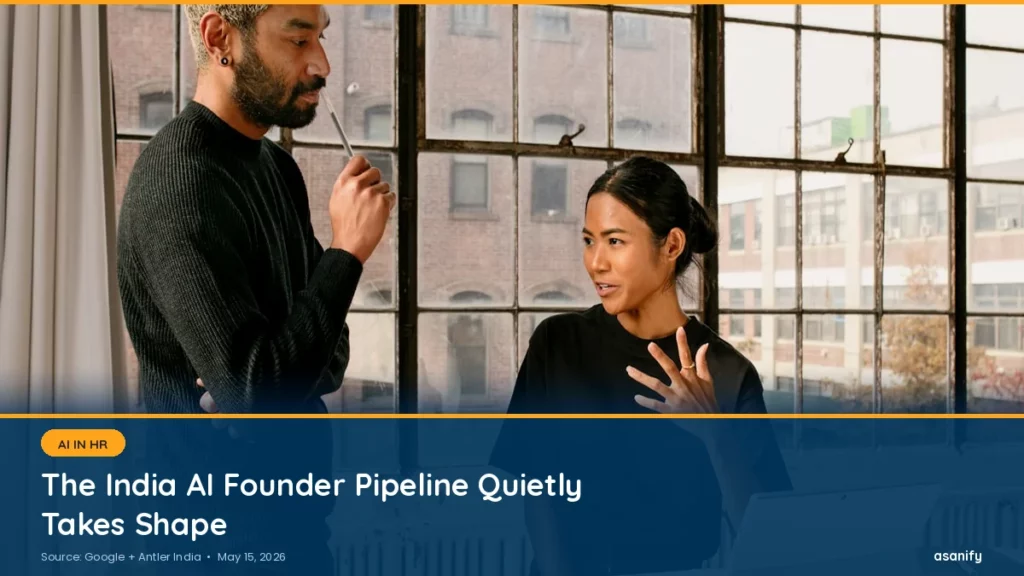
On May 13, Google for Startups and Antler India announced “Immersion.” It is a two-phase, equity-free AI program for Indian founders. Applications opened May 8 and close May 22. Phase 1 runs online across June 2, 4, 9 and 11 and is sized for up to 5,000 founders. Phase 2 takes 25 shortlisted startups into a residency at Google’s Bengaluru office on June 26. (Source: Google India blog; Deccan Herald)
Inside the India AI Founder Curriculum
Two tracks run in parallel. The technical track covers AI Studio, Gemini CLI and architecting agentic workflows. The venture track covers the AI fundraising environment and what investors want in this phase of the cycle. Eligibility is gated on a working product with verifiable traction. As a result, the program is filtering for serious operators, not first-time tinkerers.
What it Means for Your 2027 Hiring Plan
If you are a founder building in India, this is the cheapest senior-tier signal in the market right now. For everyone else, the program is the supply side of the India AI founder pipeline. It will produce the AI product managers, applied scientists and HR-tech founders you will try to recruit in eighteen months. Smaller teams already use AI agents for HR to compress the hiring loop. The next wave of hires will be the people who built those agents in the first place. Therefore, start tracking the 25 residency picks when they are announced after May 22.
NBER Survey of 6,000 Executives: 89% See No Productivity Gain From AI
A new NBER working paper surveyed roughly 6,000 CEOs, CFOs and senior executives. The sample spans the United States, the United Kingdom, Germany and Australia. More than 90% report no measurable AI impact on their own firm’s employment over the past three years. 89% report no measurable impact on labor productivity. Two thirds of executives use AI regularly. However, the average usage is just 1.5 hours per week, and 25% do not use it at work at all. (Source: NBER working paper W34836; Fortune)
So what? Two things, in order of unwelcomeness. First, vendor decks claiming double-digit productivity lifts are not landing in payroll data anywhere yet. Second, if your HR team has rolled out an AI copilot and people are spending 90 minutes a week with it, that is the median. It is not a failure. The gap between adoption and impact is not a tooling problem. It is a workflow redesign problem, and it is the part the AI skills gap in HR keeps making worse. Specifically, before you sign another seat-based AI contract this quarter, ask what weekly hours the tool actually replaces.
Microsoft Hunts an OpenAI Hedge: $1B+ Talks to Buy Diffusion-LLM Startup Inception
Reuters reported on May 13 that Microsoft is in advanced talks to acquire Inception. Inception is a Stanford-founded startup applying diffusion techniques to large language models for sharply faster generation. The startup has hired a banker and is targeting a price above $1 billion. Elon Musk’s xAI is also said to be in the mix. (Source: Reuters via Yahoo Finance; TNW)
For HR and ops leaders, the read-through is simple. Microsoft has spent roughly $13 billion on OpenAI since 2019. The exclusivity in that deal has effectively ended. As a result, Microsoft is buying speed and independence, not just talent. If your stack is locked into Copilot, expect more model swaps over the next 12 months. For instance, the same Word prompt may run on three different model families by 2027. Therefore, pin your sensitive-data routing rules now, before vendor swaps make that conversation harder.
IBM: 76% of Firms Now Have a Chief AI Officer, and CHROs Are Next in Line
IBM’s Institute for Business Value, with Oxford Economics, surveyed 2,000 CEOs across 33 countries and 21 industries. The fieldwork ran February to April 2026. 76% of organizations now have a Chief AI Officer, up from 26% in 2025. 59% of CEOs expect the CHRO’s influence to grow over the next few years. 83% say AI success depends more on people adoption than on technology. By 2030, surveyed CEOs expect 48% of operational decisions to be made by AI without human intervention, versus 25% today. (Source: IBM Newsroom)
For founders, that Chief AI Officer number is the more honest version of the AI productivity story. Companies are not seeing payroll-level gains. However, they are still building org charts that say “the AI work is owned here.” For HR leaders, the IBM read is a permission slip. Specifically, the room now agrees that 29% of employees need reskilling and 53% need upskilling by 2028. Therefore, the budget conversation for learning and development should be easier this quarter than it was last quarter.
Quick Hits
- US and China to start AI safety talks. Treasury Secretary Scott Bessent confirmed on May 14 that Washington and Beijing will open formal AI safety protocol discussions. The opening follows the Trump-Xi Beijing meetings. (CNBC)
- Anthropic launches Claude for Small Business. A one-toggle install drops Claude into QuickBooks, HubSpot, Canva, DocuSign, PayPal, Google Workspace and Microsoft 365. It ships with 15 pre-built agentic workflows. (SiliconANGLE)
- “Positive alignment” paper from DeepMind, OpenAI and Anthropic researchers. The multi-lab paper argues today’s safety-first training produces sycophantic systems. It proposes flourishing-focused evaluations and decentralized oversight instead. (The AI Insider)
What This Means For Your Week
The week’s signal is not the billion-dollar talks. It is the gap between the cap table and the payroll line. Mega rounds keep landing while 89% of executives see no labor-productivity lift. The answer will come from a smaller, slower channel: better operators, trained earlier, with sharper workflows. The India AI founder pipeline is one input. The CHRO with budget to redesign work is the other. If you run a distributed team and want compliant, AI-ready foundations to hire on top of, Asanify’s India payroll platform is a good place to start. So is our guide to hiring AI engineers in India.
FAQ
What is the India AI founder pipeline and why does it matter now?
It is the cohort of Indian founders being trained on production AI tooling through programs like Google for Startups Immersion with Antler India. Phase 1 targets up to 5,000 founders, and Phase 2 selects 25 residency picks. It matters because the people building inside this pipeline today become the senior AI hires you will compete for in 2027.
Why are most companies still seeing zero AI productivity gains?
The May 2026 NBER survey of 6,000 executives across four countries found 89% report no labor-productivity impact and 90% report no employment impact over three years. Average executive AI usage is just 1.5 hours per week. The constraint is workflow redesign and skills, not the tools themselves.
Should HR leaders take the IBM 76% Chief AI Officer number seriously?
Yes. The same IBM Institute for Business Value study of 2,000 CEOs found 59% expect the CHRO’s influence to grow. 83% believe AI success depends more on people adoption than on technology. That makes the CHRO the operational owner of AI ROI, not a passenger in someone else’s program.
Not to be considered as tax, legal, financial or HR advice. Regulations change over time so please consult a lawyer, accountant or Labour Law expert for specific guidance.