
10 Best EOR Companies in India (2026)
TL;DR Best overall: Asanify ranks first in our comparison at 4.83/5, with published pricing of $99 per employee/month, a directly owned Indian entity, and 24-hour onboarding. Best global options:…

TL;DR Best overall: Asanify ranks first in our comparison at 4.83/5, with published pricing of $99 per employee/month, a directly owned Indian entity, and 24-hour onboarding. Best global options:…
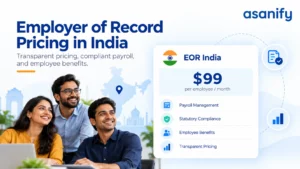
TL;DR Asanify's Employer of Record India cost is $99 per employee per month, a flat fee with no setup charge and the full HRMS included. Statutory add-on: every employer in…

TL;DR EOR: best for companies hiring in a country where they have no legal entity. The EOR becomes the legal employer and manages payroll, benefits, taxes, and compliance. PEO: best…

HRMS software in India has evolved from a basic HR tool into a critical part of business infrastructure. By 2026, HRMS platforms are no longer limited to employee records or…

Quick Answer Salaried employees in India save tax mainly under the old regime through the ₹50,000 standard deduction, Section 80C investments (up to ₹1.5 lakh) covering PPF, EPF, ELSS, and…

Hiring remote employees in India has become a strategic priority for global startups, scaleups, and enterprises seeking access to skilled talent at scale. However, onboarding employees in India goes beyond…

Darwinbox is one of India's most recognised enterprise HRMS platforms, and for good reason. It serves 2.2 million employees across 850+ companies in 110 countries, counts Mahindra, Swiggy, and Starbucks…

If you are evaluating greythr pricing for your Indian company, you are in the right place. greytHR is one of India's most widely used payroll and HRMS platforms, trusted by…
Enterprise EOR platforms have quietly crossed a pricing threshold that most growing companies cannot justify. Deel starts at $599 per employee per month. Remote charges the same. Papaya Global runs…

The short version: Hiring in India through an Employer of Record does not automatically create a permanent establishment (PE), and it does not automatically shield you from one. PE risk…

Global hiring has become significantly easier over the past few years, but choosing the right Employer of Record (EOR) platform is still a major decision. Two companies that dominate the…

Global hiring is now a core growth strategy for startups, SMBs, and mid-market companies. Businesses no longer hire only where they have local entities. They hire where the right talent…
Notice period buyout occurs when an employee pays the employer (or vice versa) to shorten the mandatory notice period. The payment usually equals the salary for the unserved notice days. It allows early exit while ensuring contractual obligations are settled.

Expanding into South Korea gives global companies access to a highly educated, digitally advanced talent pool—but onboarding employees in the country requires careful attention to compliance. South Korea’s employment laws…

Expanding your workforce into Spain offers access to a highly skilled talent pool, strong labor protections, and seamless access to the EU market. However, employee taxation in Spain is complex,…
![Read more about the article Top Employer of Record (EOR) Service Providers in the Philippines [2026]](https://media.asanify.com/wp-content/uploads/2025/12/08130304/Project-Managers-in-Switzerland-300x200.jpg)
The Philippines has emerged as one of the most attractive destinations for global companies looking to build remote teams across customer support, IT, finance, healthcare operations, and shared services. With…

Expanding your workforce into Italy offers access to one of Europe’s most skilled talent pools but it also introduces one of the region’s most complex tax and employment systems. For…

Hiring employees in Italy offers global companies access to a highly skilled workforce across engineering, design, finance, and operations. However, Italy’s employment framework is one of the most regulated in…

Expanding into the Netherlands gives global companies access to a highly skilled, productive, and internationally oriented workforce. However, it also comes with a complex tax landscape, high statutory rates, and…

Karnataka is one of India’s most economically significant states, home to global IT hubs like Bengaluru, advanced manufacturing clusters, and a fast-growing startup ecosystem. For global companies expanding into India,…