
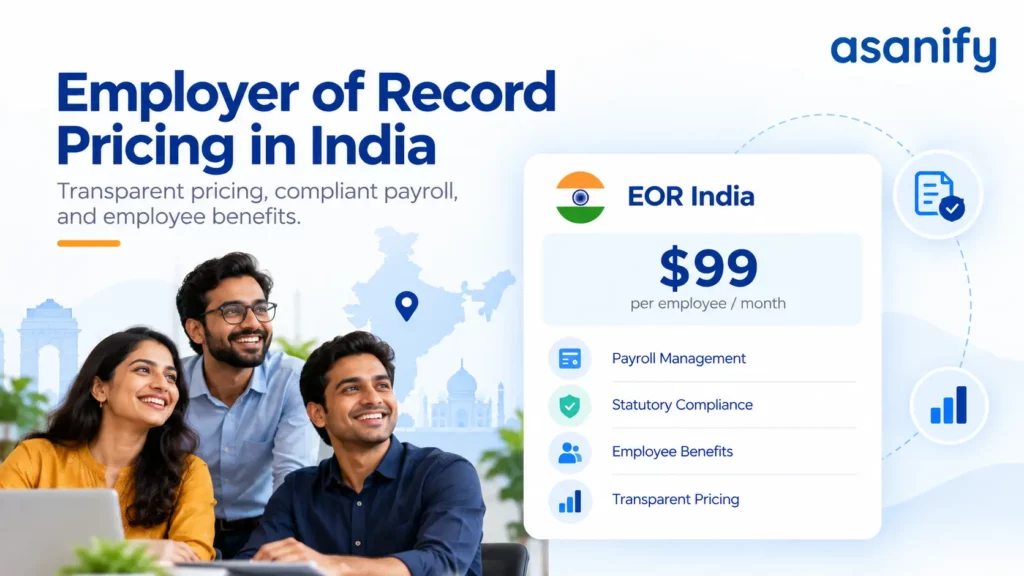
- Asanify's Employer of Record India cost is $99 per employee per month, a flat fee with no setup charge and the full HRMS included.
- Statutory add-on: every employer in India also pays mandatory contributions of about 2.5 to 3.5% on top of CTC (EDLI and EPF admin charges plus gratuity accrual; employer Provident Fund is already inside the CTC).
- All-in example: for an employee on ₹12,00,000 a year, the total monthly cost through Asanify is about ₹1,12,055, of which the Asanify fee is only about ₹9,400, roughly 1.12 times CTC.
- Real cost = salary + statutory (2.5 to 3.5%) + Asanify's $99 fee. A quote showing only the fee understates the bill.
- Hidden costs to watch: setup fees, security deposits, FX markups and offboarding charges. Asanify charges none of these beyond the flat $99.
- Location and seniority move the number more than the provider does, because salary drives statutory contributions.
Hiring in India through an Employer of Record lets a global company employ people legally without setting up a local entity. The service fee is the visible number, but the real cost of employment is the service fee plus statutory contributions. This guide breaks down both, shows a fully worked example, compares providers on price, sets EOR against contractors and against building your own entity, and covers the hidden fees that inflate a headline quote. For the product itself, see employer of record India. For India-specific benchmarks on cost, compliance and permanent establishment risk, see our State of India EOR 2026 report.
What do you pay for with an Employer of Record in India?
An EOR becomes the legal employer of your workforce in India while you keep full control of daily work. Your cost has two parts:
- The EOR service fee, charged either as a flat monthly amount per employee or as a percentage of payroll.
- Statutory employer contributions, which are set by Indian law and are the same whichever provider you use.
A quote that shows only the service fee understates your true cost. The table below shows what is typically bundled into an EOR India fee and what usually sits outside it.
| Cost component | Typically included | Notes |
|---|---|---|
| Monthly EOR service fee | Yes | $99 to $699 per employee, provider dependent |
| Payroll processing | Yes | Usually within the service fee |
| Employment contracts | Yes | Drafted to Indian labour law |
| Statutory compliance filing | Yes | PF, ESI, PT, TDS |
| Employee onboarding | Usually | Some providers charge separately |
| Setup fee | Varies | $0 with Asanify; $1,000 to $5,000 elsewhere |
| Benefits administration | Varies | Private insurance often an add-on |
| FX conversion | Varies | Spread applies when you fund in your home currency |
Asanify Employer of Record India cost: $99 per employee per month
Asanify charges a flat $99 per employee per month for EOR in India, with no setup fee and no percentage-of-payroll markup. That fee includes payroll, statutory compliance, employment contracts aligned to Indian law, and the full Asanify HRMS at no extra charge. See the current India EOR pricing for plan details.
Flat per-employee pricing matters as salaries rise. Providers that charge a percentage of payroll get more expensive with every raise you give, while a flat fee stays predictable. For a full model of your own numbers, use the India employee cost calculator.
What statutory costs make up EOR India pricing?
The service fee is the smaller part of employing someone in India. The larger and non-negotiable part is statutory contributions. These are fixed by law and apply no matter which EOR you choose, so understanding them is essential to budgeting accurately.
| Statutory component | Rate | Applies when |
|---|---|---|
| Provident Fund (PF), employer share | 12% of PF wages up to the ₹25,000 per month ceiling (maximum ₹3,000 a month), paid within the CTC | All eligible employees |
| EDLI (0.5%) and EPF admin charges (0.5%) | 0.5% + 0.5% of PF wages (₹125 + ₹125 a month at the ceiling), paid on top of the CTC | All eligible employees |
| ESI, employer share | 3.25% of gross salary | Employees earning up to ₹21,000 per month |
| Gratuity | 15 days salary per year of service, accrues from day one, payable after 5 years | All employees |
| Professional Tax (PT) | Up to ₹2,500 per year, varies by state; deducted from the employee pay, not an employer cost | Applicable states |
| Bonus | 8.33% to 20% of salary under the Payment of Bonus Act | Eligible employees |
| TDS | Deducted under Section 192 | All employees |
Together, the contributions that sit on top of the CTC add about 2.5 to 3.5%, and the percentage falls slightly as salary rises. The biggest item, employer Provident Fund, is already inside the CTC. It is mandatory on basic wages up to the EPFO wage ceiling of ₹25,000 per month (raised from ₹15,000 by Gazette notification S.O. 5109(E), effective 17 September 2026, following Cabinet approval on 16 September 2026), so employer PF is capped at 12%, or ₹3,000 a month. EDLI (0.5%) and EPF admin charges (0.5%) are paid on top, at ₹125 each a month at the ceiling. Gratuity adds about 4.81% of basic. Second, ESI (3.25% employer share) applies only to employees earning up to ₹21,000 per month, so most mid-level and senior hires fall outside it, and employers often provide private group health insurance instead, which is an added cost not shown in these figures.
Planning a hire in India? Get a clear, all-in cost breakdown from an Asanify expert.
Worked example: the true EOR India cost for one employee
To show the all-in figure, here is a single fully worked example for one employee hired through Asanify.
Assumptions: one employee, annual gross salary of ₹12,00,000 (₹1,00,000 per month), hired through Asanify at $99 per employee per month.
| Cost component | Monthly amount (INR) | Monthly amount (USD) |
|---|---|---|
| Monthly CTC (includes employer PF of ₹3,000) | ₹1,00,000 | ~$1,053 |
| Employer PF (12% of the ₹25,000 wage ceiling), already inside the CTC | ₹3,000 (included) | ~$32 (included) |
| EDLI (0.5%) and EPF admin charges (0.5%) on ceiling wages | ₹250 | ~$3 |
| Gratuity accrual (approximately 4.81% of basic) | Approximately ₹2,405 | ~$25 |
| Asanify EOR fee ($99) | Approximately ₹9,400 | $99 |
| Total monthly cost to employer | Approximately ₹1,12,055 | ~$1,180 |
Assumptions: the salary shown is the monthly CTC, and basic wages are 50% of it (₹50,000). Employer PF is 12% of the ₹25,000 wage ceiling (₹3,000) and sits inside the CTC. EDLI and EPF admin charges are 0.5% each on the same wages (₹125 each) and are paid on top. Gratuity accrues from the first month at 15 days of wages per completed year (about 4.81% of basic), so it is part of the monthly cost from day one and not a lump sum at exit. Professional tax is deducted from the employee pay and is not an employer cost. Exchange rate used: ₹95 per US dollar.
The all-in monthly cost is about ₹1,12,055, of which the EOR service fee is about ₹9,400. That is a total employer cost of about 1.12 times CTC, and the costs on top of the CTC (₹2,655) are 2.7% of it. The annual all-in cost is roughly ₹13.45 lakh. ESI does not apply because the employee earns above ₹21,000 per month.
Calculate your exact India employee cost
How much does an EOR cost by salary band in India?
Because statutory contributions scale with salary, total cost rises with pay even when the service fee is flat. The table below estimates total monthly employment cost by salary band, using Asanify’s flat $99 fee (about ₹9,400) plus statutory contributions of about 2.5 to 3.5% of CTC.
| Annual salary (INR) | Monthly salary (INR) | On top of CTC (approx.) | Asanify EOR fee | Estimated total monthly cost |
|---|---|---|---|---|
| ₹3,00,000 to ₹6,00,000 | ₹25,000 to ₹50,000 | ₹850 to ₹1,450 | ₹9,400 | ₹35,250 to ₹60,850 |
| ₹6,00,000 to ₹12,00,000 | ₹50,000 to ₹1,00,000 | ₹1,450 to ₹2,655 | ₹9,400 | ₹60,850 to ₹1,12,050 |
| ₹12,00,000 to ₹24,00,000 | ₹1,00,000 to ₹2,00,000 | ₹2,655 to ₹5,060 | ₹9,400 | ₹1,12,050 to ₹2,14,450 |
| ₹24,00,000 and above | ₹2,00,000 and above | From ₹5,060 | ₹9,400 | From ₹2,14,450 |
Total cost includes gross salary, employer statutory contributions, gratuity accrual, and the flat EOR fee. Two things to note: the effective statutory percentage falls at higher salaries because Provident Fund and ESI are capped, so the top band is proportionally cheaper than it looks. And with a percentage-of-payroll provider rather than a flat fee, the service-fee column would climb with every band instead of staying at ₹9,400. Run your own figures through the India employee cost calculator.
Is an EOR cheaper than setting up a legal entity in India?
Yes, for teams under about 20 people. An EOR costs $0 to $1,000 upfront against $15,000 to $25,000 or more to register a legal entity, and it lets you hire in days rather than the 2 to 6 months an entity takes. Many companies assume a legal entity is cheaper, but in the short to medium term it usually is not, because of upfront setup and ongoing overhead. The comparison below sets the two side by side.
| Factor | Employer of Record | Local entity |
|---|---|---|
| Initial setup cost | $0 to $1,000 | $15,000 to $25,000 and up |
| Time to start hiring | 2 to 7 days | 2 to 6 months |
| Payroll infrastructure | Included | Must be built internally |
| Compliance and statutory filing | Included | Internal responsibility |
| HR administration | Included | Internal team required |
| Ongoing fixed costs | Low | Moderate to high |
| Ideal team size | 1 to 20 employees | 20 to 30 and up |
| Expansion flexibility | High | Moderate |
For teams under 20 in India, an EOR is generally the lower-cost and lower-risk option. Once headcount consistently passes 20 to 30 and operations are established, a local entity can become more economical on a pure cost basis, though many companies stay on an EOR for the administrative simplicity. For a deeper breakdown, see the guide to EOR versus entity establishment in India.
EOR vs contractor vs entity: which is cheapest in India?
Before choosing an EOR, many companies weigh hiring the person as an independent contractor instead, which looks cheaper on paper. The catch is misclassification risk: if a contractor works like an employee, Indian authorities can reclassify them, leaving you liable for back contributions, penalties, and permanent establishment exposure. The table sets the three routes side by side.
| Factor | Contractor | Employer of Record | Own legal entity |
|---|---|---|---|
| Upfront cost | None | $0 to $1,000 | $15,000 to $25,000 and up |
| Time to start | Days | 2 to 7 days | 2 to 6 months |
| Ongoing admin cost | Low | Flat per-employee fee | High, internal payroll and compliance |
| Statutory compliance | Not handled | Included | Your responsibility |
| Misclassification risk | High | None, worker is properly employed | None |
| Benefits and IP protection | Weak | Full, employment contract | Full |
| Best for | Genuine short-term project work | Employing 1 to 20 people compliantly | 20 to 30 and more, long-term |
A contractor can be the right call for genuinely independent, short-term work. For anyone working full time under your direction, an EOR gives you compliant employment without the misclassification exposure, at a predictable $99 per employee per month.
Employer of record India pricing comparison (2026)
Employer of record India pricing starts at $99 per employee per month and reaches $699 across the providers below. India specialists sit at the low end, while global platforms charge several times more for the same India hire. The table lists each provider’s published starting price. For features, compliance depth and a ranked shortlist, see the guide to the best EOR service providers in India.
| Provider | Starting price (USD per employee per month) | Notes | Source |
|---|---|---|---|
| Asanify | $99 | No setup fee, full HRMS included | Asanify |
| Wisemonk | From $99 | Wisemonk | |
| Hire with Columbus | $179 | Flat fee across 193 countries | Hire with Columbus |
| RemoFirst | $199 | No setup fee | RemoFirst |
| Skuad | From $199 | Skuad | |
| Gloroots | $199 | Starting rate | Gloroots |
| Multiplier | $459 (Core), $519 (Growth) | Billed annually | Multiplier |
| Deel | $599 | Deel | |
| Papaya Global | From $650 | Papaya Global | |
| Remote | $699 | Monthly billing | Remote |
| Oyster | $699 | Refundable deposit | Oyster |
Referred from each provider’s own pricing page. Published pricing changes, so confirm the exact quote with each provider.
Cheapest employer of record in India: what the price includes
Asanify and Wisemonk both publish a starting price of $99 per employee per month. Compare what each fee covers. Asanify’s $99 includes the full HRMS, employment contracts, payroll, statutory filings and onboarding through its own Indian entity in Kolkata, with no setup fee. The deciding factors are what is bundled, whether the fee is flat or a percentage of payroll, and the hidden costs below.
EOR India reviews: how providers are rated
Price is only half the decision. The table compares G2 and Trustpilot ratings for the providers above. A dash means no rating was found.
| Provider | G2 rating (reviews) | Trustpilot rating (reviews) |
|---|---|---|
| Asanify | 4.9 (381) | - |
| Wisemonk | 4.8 (219) | - |
| Deel | 4.8 (6,032) | 4.6 (9,499) |
| Multiplier | 4.7 (1,451) | 4.9 (2,870) |
| Payoneer Workforce Management (Skuad) | 4.6 (366) | - |
| Remote | 4.5 (4,309) | 4.6 (3,446) |
| RemoFirst | 4.5 (407) | - |
| Papaya Global | 4.5 (55) | - |
| Oyster | 4.4 (1,526) | - |
What influences your Employer of Record India cost?
Three variables move the number most:
- Salary and seniority. Higher salaries raise statutory contributions and, for percentage-based providers, the service fee too. Flat-fee pricing removes the second effect.
- Team size. Larger teams often qualify for volume pricing, and the per-employee fee can fall with scale.
- Benefits and payroll complexity. Private insurance, allowances, and non-standard pay structures add administration and cost.
How do location and role change your EOR India cost?
Because salary drives statutory contributions, where and who you hire moves your total cost more than which provider you pick. Salaries differ sharply across Indian cities: metro hubs like Bangalore command materially higher pay than other cities for the same role, and every downstream statutory contribution scales off that base salary. The benchmark below is for a mid-level software engineer in 2026.
| City | Typical salary (mid-level engineer) | Approx. USD per year |
|---|---|---|
| Bangalore | ₹20 to ₹35 LPA | ~$23,800 to $41,700 |
| Hyderabad | ₹18 to ₹30 LPA | ~$21,400 to $35,700 |
| Pune | ₹15 to ₹25 LPA | ~$17,900 to $29,800 |
| Tier 2 cities (Indore, Coimbatore, Jaipur) | Below Pune levels | Lowest, thinner senior talent pool |
Figures are indicative market ranges from 2026 salary guides and vary with skills; AI, cloud, and distributed-systems expertise command a premium. Hiring the same role in Hyderabad or Pune rather than Bangalore can cut salary, and therefore total employer cost, by 15 to 30%.
The service fee, if it is a flat fee, does not change with location. The salary and the statutory load do. This is why a flat per-employee fee is easier to budget across a distributed India team than a percentage-of-payroll model, where your cost swings with every city and seniority band.
What are the hidden EOR costs in India?
The advertised service fee is rarely the full bill. These are the charges that commonly sit outside the headline number, and the ones that most often surprise finance teams.
| Hidden cost | Typical range | What it is |
|---|---|---|
| Setup or onboarding fee | $0 to $2,000 per employee | One-time charge for contract drafting, background checks, and statutory registration. Asanify charges $0. |
| Refundable security deposit | 1 to 2 months of total cost | Held by some providers as a buffer against payroll defaults, returned on exit, but it ties up capital. |
| FX or currency markup | 2 to 10% of payroll | A spread added inside the exchange rate when you fund in your home currency. Rarely shown as a line item. |
| Offboarding or exit fee | Often similar to setup | Charged for exit paperwork and final settlement. Ask before you sign. |
| Off-cycle payroll run | $50 to $250 each | For bonus payouts, corrections, or mid-month joiners. |
| Benefits administration | Varies | Managing private health insurance or supplementary perks, sometimes billed separately. |
Asanify prices at a flat $99 with no setup fee and transparent FX with no hidden spread. To stay ahead of these charges with any provider, apply three checks:
- Compare on total cost, not headline fee. Ask each provider for an all-in quote that includes statutory contributions, onboarding, offboarding, and FX.
- Read the contract for add-ons. Onboarding, benefits administration, and FX conversion are the usual places extra charges appear. Confirm what is inside the fee and what is billed separately.
- Use scale as leverage. Providers are often flexible on fees for larger teams or longer commitments.
Why companies choose Asanify for EOR in India
Asanify’s employer of record India service is built India-first, which is why it can price at $99 while matching the compliance coverage of global platforms. Specific reasons companies pick it:
- Flat $99 per employee per month, no setup fee and no hidden charges
- Rated 4.9 out of 5 on G2 from 381 reviews
- Full HRMS included in the EOR fee at no extra cost
- Onboarding in as little as 24 hours through a direct Indian entity in Kolkata
- Employment contracts, payroll, and statutory filing (PF, ESI, PT, TDS) handled end to end
Ready to see your own numbers? Talk to an Asanify expert.
Frequently asked questions: Employer of Record India cost
How much does an Employer of Record cost in India?
Employer of Record India cost ranges from $99 to $699 per employee per month depending on the provider. Asanify charges a flat $99 per employee per month, plus the mandatory statutory contributions that every employer in India pays, which add about 2.5 to 3.5% on top of CTC.
Is an Employer of Record cheaper than setting up an entity in India?
For most companies hiring fewer than 20 people, yes. A local entity costs $15,000 to $25,000 or more to set up, plus ongoing compliance and payroll overhead, and takes 2 to 6 months. An EOR charges a per-employee monthly fee and lets you hire in 2 to 7 days with no upfront investment.
Why is Asanify more affordable than global competitors?
Asanify is India-focused, so it does not carry the overhead of maintaining infrastructure across hundreds of countries. That is why it can charge a flat $99 per employee per month, against $599 to $699 for global platforms like Deel, Remote and Oyster, with the same core compliance coverage.
Is Employer of Record pricing based on salary?
It depends on the provider. Some charge a fixed monthly fee per employee, while others charge a percentage of payroll. Fixed-fee pricing, such as Asanify’s $99, is more predictable and does not rise as salaries increase. Statutory contributions, however, scale with salary regardless of the pricing model.
Which Employer of Record is the cheapest in India?
Asanify and Wisemonk both publish a starting price of $99 per employee per month, and Asanify’s fee includes the full HRMS with no setup fee. India-focused providers generally price below global EOR platforms because they specialise in local compliance and payroll rather than maintaining a worldwide network.
Are there hidden costs in Employer of Record pricing?
There can be. Common extras are onboarding fees, refundable security deposits, FX conversion spreads of 2 to 10%, benefits administration, and offboarding charges. Asanify prices at a flat $99 with no setup fee and transparent FX. Always review the agreement to confirm what sits inside the fee.
Is it cheaper to hire a contractor than use an EOR in India?
On the headline number, a contractor looks cheaper because you skip statutory contributions. The risk is misclassification: if a contractor works like an employee, Indian authorities can reclassify them and hold you liable for back Provident Fund, ESI, penalties, and permanent establishment exposure. For anyone working full time under your direction, an EOR at $99 per employee per month is usually cheaper than the cost of getting classification wrong.
What is the cheapest way to hire an employee in India?
For a global company without a local entity, the cheapest compliant way to hire in India is through an India-specialist Employer of Record. Asanify does this at $99 per employee per month flat, with statutory contributions of about 2.5 to 3.5% on top of CTC. It is cheaper and faster than setting up an entity (which costs $15,000 or more) and safer than hiring a contractor, which carries misclassification risk.
How much does it cost to hire a software engineer in India through an EOR?
A mid-level software engineer in India on a gross salary of about ₹1,00,000 per month (roughly $1,053) costs around ₹1,12,055, or about $1,180, per month all-in through Asanify. That figure includes gross salary, employer Provident Fund, gratuity accrual, professional tax, and the flat $99 EOR fee. Salaries and therefore total cost are higher in Bangalore than in Hyderabad, Pune, or Tier 2 cities.
Is Asanify cheaper than Deel for hiring in India?
Yes. Asanify charges $99 per employee per month for EOR in India, while Deel’s reference price is around $599 for the same India hire. For a team of ten, that difference is about $500 per employee per month, or roughly $60,000 a year, and Asanify includes a full HRMS in the fee at no extra cost.
Not to be considered as tax, legal, financial or HR advice. Regulations change over time so please consult a lawyer, accountant or Labour Law expert for specific guidance.