Every dollar chasing AI used to flow toward training bigger models. This week it moved one layer down. General Compute borrowed $400 million against inference chips, not GPUs. Lenders are calling it the first inference chip financing deal on record. That is not funding-round trivia. It is a bet that running AI models, not just building them, is now bankable infrastructure. Meanwhile, Google admitted Gemini 3.5 Pro is delayed for a third time. And Anthropic found that the answers Claude gives can change based on which language you type in. If your HR stack leans on one AI vendor’s roadmap this quarter, today’s stories are your reminder: the plumbing underneath it is still being built in public.
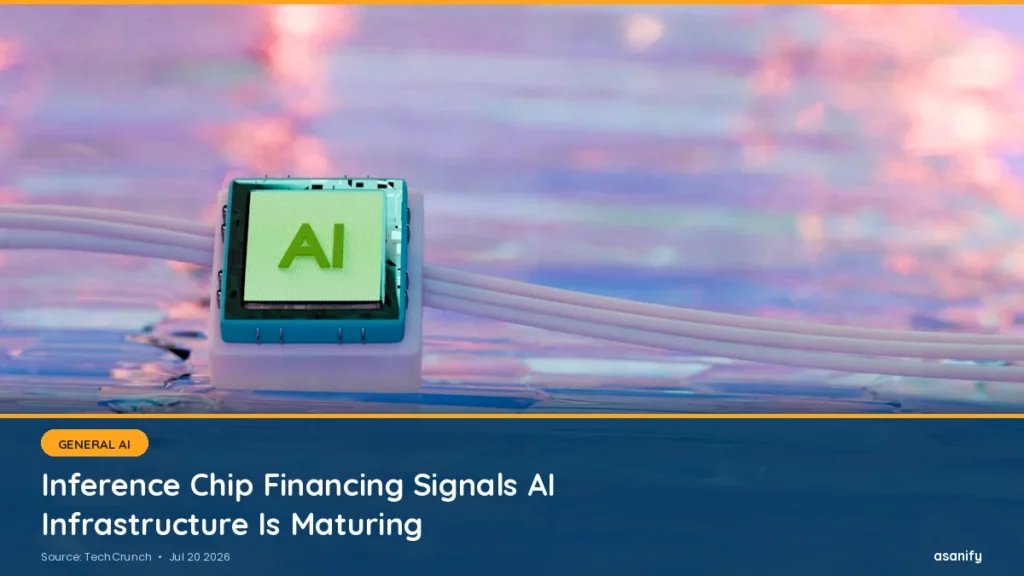
General Compute’s Inference Chip Financing Deal Signals AI Infrastructure Is Maturing
Inference cloud startup General Compute closed a $400 million loan from investment firm Upper90 on July 17. Instead, it used its fleet of SambaNova SN50 inference chips as collateral, not the Nvidia training GPUs lenders have relied on until now. (Source: TechCrunch) It is, as far as anyone can tell, the first deal of its kind. Specifically, General Compute says its SN50 chips run inference up to 16 times faster than GPU-based clouds. In addition, they skip water cooling entirely. That is why a lender was willing to treat them as bankable assets instead of depreciating hardware.
Why This Is an Inference Chip Financing Story, Not Just Another Funding Round
Training chips lose value fast. A GPU cluster bought to train one frontier model is often obsolete for that job within 18 months. Inference chips depreciate differently, because they run whatever model you point them at today, or next year. That is exactly why Upper90 was comfortable lending against them. For the first time, a lender is treating AI compute like real infrastructure, not a research bet. Founded by CEO Finn Puklowski and CTO Jason Goodison, General Compute raised a $15 million seed round in May. So the jump to $400 million in debt is a real vote of confidence, only two months later.
Here is why this should register with you, even if you have never heard of General Compute. Inference chip financing means more inference capacity is coming online faster. And that capacity is what actually runs the AI tools you already use: your ATS’s resume ranker, your HRIS chatbot, your payroll anomaly detector. When inference gets cheaper and more available, AI features vendors promised you 18 months ago finally ship on schedule. When capacity stays scarce, you get exactly what happened to Gemini 3.5 Pro this week. More on that below.
What to do about it: Ask any AI vendor bidding for your HR stack whether their roadmap depends on inference capacity they do not yet have. Deals like this one are a leading indicator of where that capacity is headed next. Treat them as a signal, not just funding-round trivia.
Anthropic Finds Claude’s “Personality” Shifts By Language, Not Just By Model
Anthropic mapped 309,815 anonymized Claude.ai conversations across three model versions and its top 20 languages. It compressed the model’s expressed values into four axes: Deference vs. Caution, Warmth vs. Rigor, Depth vs. Brevity, and Candor vs. Execution. (Source: Anthropic) The pattern held up across the dataset. For instance, Hindi prompts pulled warmer, more reassuring answers. Russian and English prompts, by contrast, pulled more rigorous, challenge-your-assumptions answers. Arabic prompts pulled briefer, more deferential ones.
So what does that mean for you? Most HR teams outside a single-country startup have employees who work across languages. The same AI copilot can give two employees materially different advice on one policy question, depending on which language they typed it in. That is not a hypothetical edge case. It is a live bias vector nobody has been auditing for. Before you roll an AI assistant out company-wide, test it in every language your workforce actually uses, not just English.
Google Confirms Gemini 3.5 Pro Is Delayed Again, and DeepMind Is Bleeding Talent
Google confirmed on July 16 that Gemini 3.5 Pro still has not shipped, months past its original June target. DeepMind scrapped an earlier build after finding structural failures in recursive tool-calling and complex SVG scene generation. Then it ordered a full pre-training restart. (Source: 9to5Google) Google is now testing the rebuilt 3.5 Pro alongside an upgraded Flash model to plug the gap. The delay lands weeks after four senior DeepMind researchers left in a single week. Gemini co-lead Noam Shazeer went to OpenAI. John Jumper, Jonas Adler, and Alexander Pritzel joined Anthropic. As a result, Alphabet lost roughly $225 billion in market value the day the departures became public.
Delays like this are the downstream cost of the same capacity crunch General Compute’s financing deal is trying to solve. If you picked a vendor because “it runs on Gemini,” you are now exposed to a roadmap that has slipped three times in two months. Diversify which model powers your critical HR workflows. At minimum, confirm your vendor has a fallback that is not Google-only.
Cognizant Is Building a New Job Category: The “Frontier” Workforce
Cognizant announced on July 9 it will scale to 5,000 “Frontier Certified Engineers” and 10,000 “Frontier Business Operators.” These are new roles built around running AI agent fleets alongside human teams, not just using AI tools. (Source: PR Newswire) The first cohort is expected to be assessed and deployment-ready by Q4 2026. Specifically, credentialing runs directly through frontier-model companies, including GitHub Copilot, Google Gemini, Anthropic’s Claude, and OpenAI’s Codex.
This matters because Cognizant just did your job-architecture homework for you. Specifically, maybe you are an HR leader trying to figure out what “AI-fluent” actually means, beyond a training module. “Manages agent fleets and human teams against a committed outcome, in real time” is a real, gradable job description. Borrow the framing. Your next hire for an AI-facing role should be evaluated on that, not on whether they have used ChatGPT. Companies still building out this muscle can lean on AI agents for HR to see how the workflow side is already shifting.
Quick Hits
- Myntra’s AI onboarding hub cuts seller signup from 15 days to 2. The Flipkart-owned platform’s AI Seller Growth Hub also cut catalog-generation time from a full day to about 4 hours. (Source: Deccan Herald)
- PrismML open-sourced Bonsai 27B, a 27B-parameter model that fits on a phone. Built on Qwen3.6 and compressed under 4GB, it keeps roughly 90% of full-precision performance and runs offline. (Source: MarkTechPost)
- Japan is standing up an AI Reform Council to rewrite its AI laws from scratch. The mandate covers structural legal reform, not soft-law guidance. Specifically, medical care, transportation, and administrative services come first. (Source: Nippon.com)
If today’s inference chip financing story has you thinking about how fragile your AI vendor’s infrastructure bet really is, Asanify’s HRMS is built model-agnostic on purpose. One lab’s delay or one startup’s loan does not become your outage. Companies still closing the AI skills gap in HR should treat today’s Cognizant and Anthropic stories as a checklist, not just headlines. It is worth a look before your next AI-vendor renewal conversation.
FAQ
What is inference chip financing, and why does it matter for AI in HR?
Inference chip financing is when a lender treats AI inference hardware, chips that run already-trained models, as collateral for a loan. That is different from requiring training GPUs. General Compute’s $400 million deal with Upper90 in July 2026 was the first deal of its kind. It matters for HR teams because more available inference capacity means AI features vendors promised, like resume screening or payroll anomaly detection, actually ship on schedule instead of slipping again due to hardware scarcity.
Why did Google delay Gemini 3.5 Pro again?
Google scrapped an earlier rebuild of Gemini 3.5 Pro after finding structural failures in recursive tool-calling and complex SVG generation. It then restarted pre-training from scratch. The delay was confirmed on July 16, 2026, shortly after four senior DeepMind researchers left the company. That group included Gemini co-lead Noam Shazeer, who joined OpenAI, and three researchers who joined Anthropic.
Does Claude give different answers depending on what language you use?
Yes. Anthropic’s July 2026 study of more than 300,000 conversations found Claude’s expressed values shift by language. For example, it leans warmer and more reassuring in Hindi. It leans more rigorous and challenging in Russian and English, and more brief and deferential in Arabic. Companies deploying AI assistants across multilingual teams should test outputs in every language their employees actually use, with a proper AI HR tools evaluation rather than assuming one language’s output represents them all.
Not to be considered as tax, legal, financial or HR advice. Regulations change over time so please consult a lawyer, accountant or Labour Law expert for specific guidance.