

Darwinbox is one of India’s most recognised enterprise HRMS platforms, and for good reason. It serves 2.2 million employees across 850+ companies in 110 countries, counts Mahindra, Swiggy, and Starbucks among its customers, and crossed unicorn status in 2025. If you are researching Darwinbox pricing and trying to understand what it actually costs, you are not alone: Darwinbox does not publish a price list. This page gives you a realistic cost picture, a plain-English feature overview, and an honest comparison with Asanify so you can decide which platform fits your company size and timeline.
Darwinbox Pricing Explained
Darwinbox does not publish pricing publicly. All quotes are customised based on three variables: number of employees, modules selected, and implementation scope. There is no free trial and no freemium tier.
What drives the cost
Employee count determines your tier. Darwinbox structures pricing across four bands: under 500 employees, 500 to 2,500, 2,500 to 10,000, and above 10,000. The per-employee monthly rate decreases as headcount grows.
Module selection adds to the base. Core HR is the foundation. Recruitment, payroll, performance management, LMS, and the Darwin AI analytics layer are each part of the package configuration. More modules means a higher quote.
Implementation is a separate line item. Darwinbox is a highly configurable enterprise platform. Independent analyst estimates (ITQlick, 2026) put implementation costs in the range of $5,000 for smaller deployments to upwards of $50,000 for large enterprises, depending on customisation complexity. This is not included in the per-seat licence fee.
Realistic cost estimates
Darwinbox does not confirm per-seat pricing publicly, so the figures below are compiled from third-party analyst sources and buyer-reported data on G2 and TrustRadius. Treat these as directional estimates, not published rates.
| Company size | Estimated cost per employee per month | Notes |
|---|---|---|
| 100 employees | ~$5 | Third-party analyst estimate (ITQlick, 2026) |
| 500 employees | ~$4 | Mid-tier band estimate |
| 1,000+ employees | ~$3 | Volume pricing estimate |
| Implementation (one-time) | $5,000 to $50,000 | Varies with customisation scope |
These are analyst estimates from third-party review platforms. Actual Darwinbox pricing is available only via direct quote. Contact Darwinbox sales for a confirmed figure.
What makes Darwinbox pricing opaque in practice
Beyond the per-seat fee, buyers consistently report that the fully loaded cost of a Darwinbox deployment includes internal project management time, a configuration workstream, and ongoing admin resource to manage workflows and reporting. A Gartner Peer Insights contributor flagged “the instability of product and support from the technical team” as a concern, suggesting some buyers encounter post-go-live overhead they did not anticipate.
For companies evaluating Darwinbox, the honest question to ask during the sales process is: what is the fully loaded first-year cost, including implementation, training, and any premium support tier?
Darwinbox Features Overview
Darwinbox is a full-stack Human Capital Management (HCM) suite designed to cover every stage of the employee lifecycle in a single platform, with a mobile-first interface and an AI analytics layer called Darwin AI.
Core HR: Centralised employee database, org charts, document management, company calendars, role-based access controls, and onboarding workflows with digital documentation.
Recruitment and ATS: Branded career pages, multi-channel candidate sourcing, interview coordination, applicant tracking, and background check integrations.
Attendance and workforce management: Geo-fencing, facial recognition, biometric integrations, shift scheduling, timesheets, overtime tracking, and manpower budgeting.
Payroll and compliance: India payroll with PF, ESIC, professional tax, and TDS. Multi-country payroll for global operations across 110+ countries.
Performance management: Goal cascading, OKR tracking, 360-degree feedback, compensation modelling, and performance review workflows.
Employee engagement: eNPS surveys, rewards and recognition, internal social network, and employee feedback tools.
Learning and development: LMS module for training management and certification tracking.
Analytics: Workforce analytics dashboards, predictive insights, and reporting through Darwin AI, including attrition prediction and talent insights at scale.
Darwinbox is well-suited to companies that need breadth across all of these modules and have the internal HR tech capacity to configure and maintain a platform of this complexity.
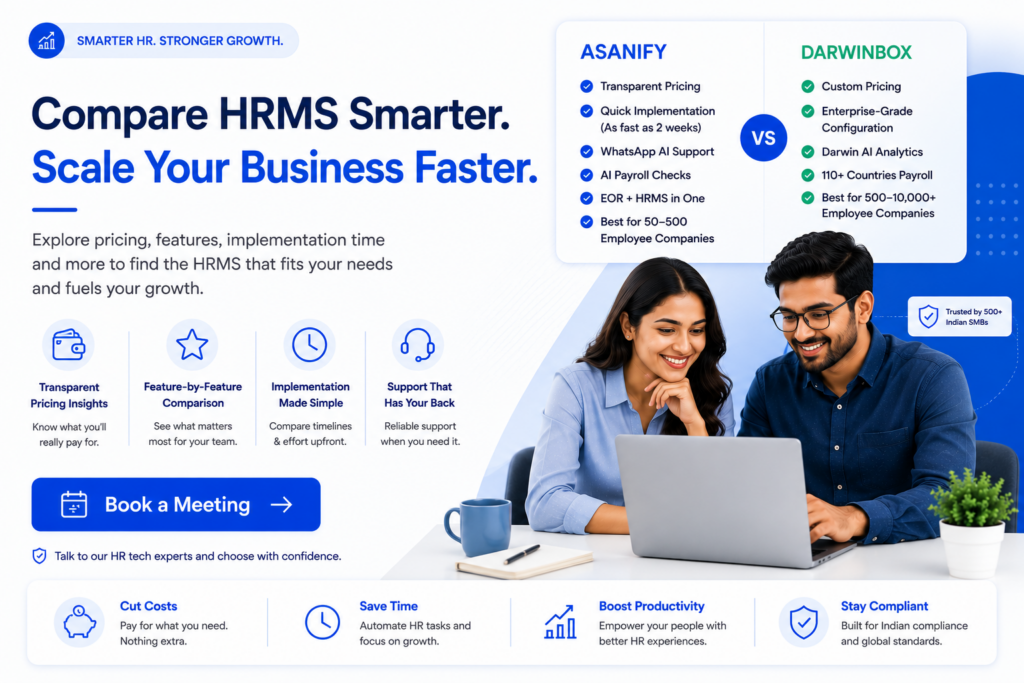
Darwinbox vs Asanify: Side by Side
Comparison Table
| Feature | Asanify | Darwinbox |
|---|---|---|
| Pricing model | Transparent, per employee / flat monthly | Quote-only, no public pricing |
| Pricing transparency | Published at /pricing-india/ | Not published; requires sales call |
| Free trial | âš ï¸ Confirm with sales team | No |
| Best fit company size | 50 to 500 employees | 500 to 10,000+ employees |
| WhatsApp AI employee self-service | Yes, native AI chatbot | No |
| AI payroll checks | Yes, pre-processing anomaly detection | Darwin AI analytics (post-processing focus) |
| Leave management | Full, configurable | Full |
| Attendance and geo-fencing | Yes | Yes |
| Performance management | AI-assisted reviews | OKRs, 360 feedback, goal cascading |
| India payroll compliance (PF, ESIC, TDS, PT) | Native, no add-on required | Native |
| Multi-country payroll | India and APAC via EOR | 110+ countries |
| EOR and HRMS from one vendor | Yes | No (HRMS only) |
| G2 overall rating | 4.8 / 5 (286+ reviews) | 4.4 / 5 (184 reviews) |
| G2 ease of use | #1 globally in Core HR and Payroll | Not ranked #1 in ease of use |
| Implementation time | 2 weeks (CSM-led, included) | 2 to 4 weeks light; 3 to 6 months enterprise |
| Customer support | Dedicated CSM, India timezone | Online, email, phone; delays reported at peak onboarding |
Where each platform leads
Asanify’s strongest ground:
Asanify is purpose-built for Indian companies in the 50 to 500 employee range that need to go live fast, keep payroll compliant, and give a workforce of any collar type a self-service channel they will actually use. The WhatsApp AI assistant is the clearest differentiator: employees apply for leave, check payslips, and raise queries through a chat interface they already use, without a portal login. For HR teams managing blue-collar or distributed workforces, this drives self-service adoption in a way that browser-based tools have not replicated.
Pricing transparency is the second structural differentiator. Asanify publishes its India pricing. Buyers can assess fit before a sales call. For HR teams under pressure to justify software spend to finance, that removes significant friction from the evaluation process.
Darwinbox’s strongest ground:
Darwinbox is best evaluated by companies with 1,000 or more employees that need breadth across every HCM module, multi-country payroll, and a platform that can scale to 10,000-plus employees. Its Darwin AI layer is built for workforce analytics at enterprise scale: predicting attrition, modelling compensation, and generating talent insights across large datasets. If your HR function runs a dedicated HR tech team and has the runway for a 3 to 6 month implementation, Darwinbox’s depth is genuinely useful. If you do not, the configurability that makes it powerful for large enterprises becomes overhead for mid-market buyers.
Where Darwinbox Fits Best vs Where Asanify Wins
Darwinbox is the right call if:
- You have 1,000 or more employees and a dedicated HR tech team that can manage platform configuration and ongoing administration.
- You need multi-country payroll across a large number of countries, with localised compliance handled natively.
- You are running complex OKR and performance cycles at scale and need a unified data layer for workforce analytics and predictive insights.
- You can absorb a 3 to 6 month implementation timeline and a five-figure implementation budget as part of the project scope.
- You already run enterprise integrations with ERP, communication, and finance tools and need an HCM platform with API depth to connect them.
Asanify is the right call if:
- You are in the 50 to 500 employee band and need to be live in two weeks, not six months.
- Your workforce is blue-collar, grey-collar, or field-based: the WhatsApp AI assistant removes the portal adoption problem before it starts.
- India payroll compliance is non-negotiable and you want PF, ESIC, professional tax, TDS, and gratuity handled natively without a configuration project.
- Pricing transparency matters: you want to see what you will pay before a sales call, not after three weeks of discovery.
- You want EOR and HRMS from one vendor. If you are hiring across India or into Southeast Asia, Asanify covers employer-of-record and HRMS on a single platform with no integration overhead.
- You want AI-powered HR that is live today: the WhatsApp bot, AI payroll checks, and AI-assisted performance reviews are production features, not roadmap items.
The honest summary: Darwinbox is a strong platform built for enterprise complexity. Asanify is built for the 50 to 500 employee segment that needs AI-native HR, fast deployment, and transparent pricing. They are solving different problems for different buyer profiles.
Darwinbox Alternatives in India (2026)
Buyers researching Darwinbox are typically evaluating it against a shortlist of India-focused HRMS platforms. Here is an honest overview of the main alternatives:
Asanify is the AI-native option for Indian companies in the 50 to 500 employee range. WhatsApp self-service, AI payroll checks, and a 2-week implementation are the defining differentiators. Transparent pricing is published at Asanify Pricing. Rated #1 globally on G2 for ease of use in Core HR and Payroll. See the full Asanify HRMS feature list for module-level detail.
Keka is a strong mid-market HRMS well-regarded in India for payroll accuracy and a polished interface. It tends to fit companies in the 200 to 2,000 employee range and positions between Darwinbox’s enterprise complexity and Asanify’s SMB focus. For a detailed breakdown, see Keka vs Asanify.
greytHR is a payroll-first HRMS built for Indian SMBs, with strong EPF, ESI, and professional tax coverage. Best suited for companies under 500 employees where payroll accuracy is the primary pain and talent management depth is not a current requirement.
Zoho People is the most price-competitive option in the category, starting at $1.25 per user per month. Best suited for teams already in the Zoho ecosystem or very small teams under 25 employees. Configuration complexity increases significantly as team size grows.
HROne is a mid-market HRMS with a popular inbox-style task closure model used across manufacturing and logistics sectors in India.
For a broader view of the India HRMS market, see India Payroll Software and the Global HRMS India overview.
FAQ
Darwinbox does not publish pricing. All quotes are custom, based on employee count, modules selected, and implementation scope. Based on third-party analyst estimates (ITQlick, 2026), companies with around 100 employees can expect roughly $5 per employee per month, with rates declining toward $3 per employee per month at 1,000 employees. Implementation costs add between $5,000 and $50,000 depending on complexity. For an exact number, you will need to go through Darwinbox’s sales process. If you want to compare against transparent, published pricing, see Asanify’s India pricing.
For most Indian SMEs under 500 employees, Darwinbox is likely more platform than required. Multiple independent reviewers and analyst sources describe Darwinbox as best suited to enterprises with 1,000 or more employees that have a dedicated HR technology team. The quote-based pricing, implementation timeline, and configuration scope are designed for enterprise procurement cycles. SMEs looking for a fast, affordable, and AI-powered HRMS will typically find better fit in platforms built specifically for that segment, such as Asanify or Keka.
The best alternative depends on your company size and primary pain point. For 50 to 500 employee Indian companies that need AI-native HR, WhatsApp self-service, transparent pricing, and a 2-week go-live, Asanify is the closest fit. For mid-market companies prioritising payroll accuracy and a polished UI, Keka is worth evaluating. For very small teams on a tight budget already using Zoho products, Zoho People is the most affordable option. See Darwinbox Alternatives in India above for the full comparison.
Darwinbox targets enterprises with 1,000 or more employees. Keka targets mid-market companies in the 200 to 2,000 employee range. Asanify targets companies in the 50 to 500 employee band that want AI-native HR and fast deployment. Pricing transparency increases from Darwinbox (fully quote-based) to Keka (semi-transparent, tiered) to Asanify (published pricing). On G2, Asanify holds a 4.8/5 rating and the #1 ease of use ranking in Core HR and Payroll globally. Darwinbox holds a 4.4/5 rating with a predominantly enterprise reviewer base. For a direct Asanify vs Keka breakdown, see Keka vs Asanify.
It varies. Some lighter deployments go live in 2 to 4 weeks. Enterprise deployments at 1,000 or more employees with extensive customisation typically run 3 to 6 months. TrustRadius reviewers note that support can be delayed during peak onboarding periods, which can extend timelines when issues arise mid-implementation. Asanify’s implementation model is structured for a 2-week go-live across the 50 to 500 employee range, managed by a dedicated customer success manager included in the onboarding engagement.
Not to be considered as tax, legal, financial or HR advice. Regulations change over time so please consult a lawyer, accountant or Labour Law expert for specific guidance.