Employment Laws in India: A Complete Guide for Employers & Employees

Hire Top Talent Anywhere - No Entity Needed

Build your team in as little as 48 hours—no local company setup needed.

Table of Contents

Last updated: November 27, 2026

TL;DR: Employment Laws in India

India has replaced 29 central labour laws with four codes (Wages, Industrial Relations, Social Security, and Occupational Safety, Health and Working Conditions), effective 21 November 2025. State Shops and Establishments Acts and state rules still sit on top, so compliance is central plus state.

  • Who regulates: Ministry of Labour and Employment, state labour departments, EPFO and ESIC. Track the Labour Code rollout state by state.
  • Labour Code status: the four codes took effect on 21 November 2025 and the Centre notified final Central Rules on 8 May 2026. State rules are uneven: on 20 November 2026, Business Today named at least seven states and union territories with final rules under all four codes.
  • Fixed-term staff: under the Code on Social Security, fixed-term employees earn pro rata gratuity after one year of continuous service, not five.
  • Contributions: EPF 12% employer and 12% employee on basic, with the wage ceiling at ₹25,000 from 17 September 2026. ESI is 3.25% employer and 0.75% employee up to ₹21,000 a month. Full monthly mechanics are in payroll in India.
  • Exit costs: gratuity is 15 days of wages per completed year after five years of continuous service (several High Courts treat 4 years and 240 days as enough), capped at ₹20 lakh and payable within 30 days, accrued at about 4.81% of basic. Final wages are due within two working days of exit. The Industrial Relations Code treats 300 workers as the key threshold for standing orders and for prior permission on layoff, retrenchment or closure. See termination costs.
  • Classification risk: the EPFO amnesty for misclassified workers closed on 30 April 2026, so back-claims now carry 12% interest plus damages. Test your contractors with the misclassification quiz and read section B4.
  • EOR is not a PE shield: six rulings between July 2025 and March 2026 narrowed the dependent-agent test, so role design decides. Run the PE risk quiz.
  • Probation and pay: see probation period in India and salary structure in India.
  • No Indian entity? Asanify’s employer of record India service acts as the legal employer for $99 USD per employee per month.
  • Terminating through an EOR: you make the business decision and the EOR runs the legal process: grounds review, termination letter, notice, full and final settlement and statutory closures. See the EOR termination steps.

Overview of Employment Laws in India

India’s employment law framework has undergone significant transformation with the codification of labour laws into four unified codes. The system balances worker protections with business flexibility while maintaining strong social security provisions. Employment regulations combine central government codes with state-specific rules, creating a multi-layered compliance landscape. The framework emphasizes formal employment relationships, mandatory benefits including provident fund and health insurance, and comprehensive protections against unfair treatment. Employers must navigate federal and state requirements, industry-specific regulations, and extensive documentation obligations to ensure full compliance.

For the current state-by-state position, see the post-2025 Labour Code rollout, tracked by state in Asanify’s State of India EOR 2026 research.
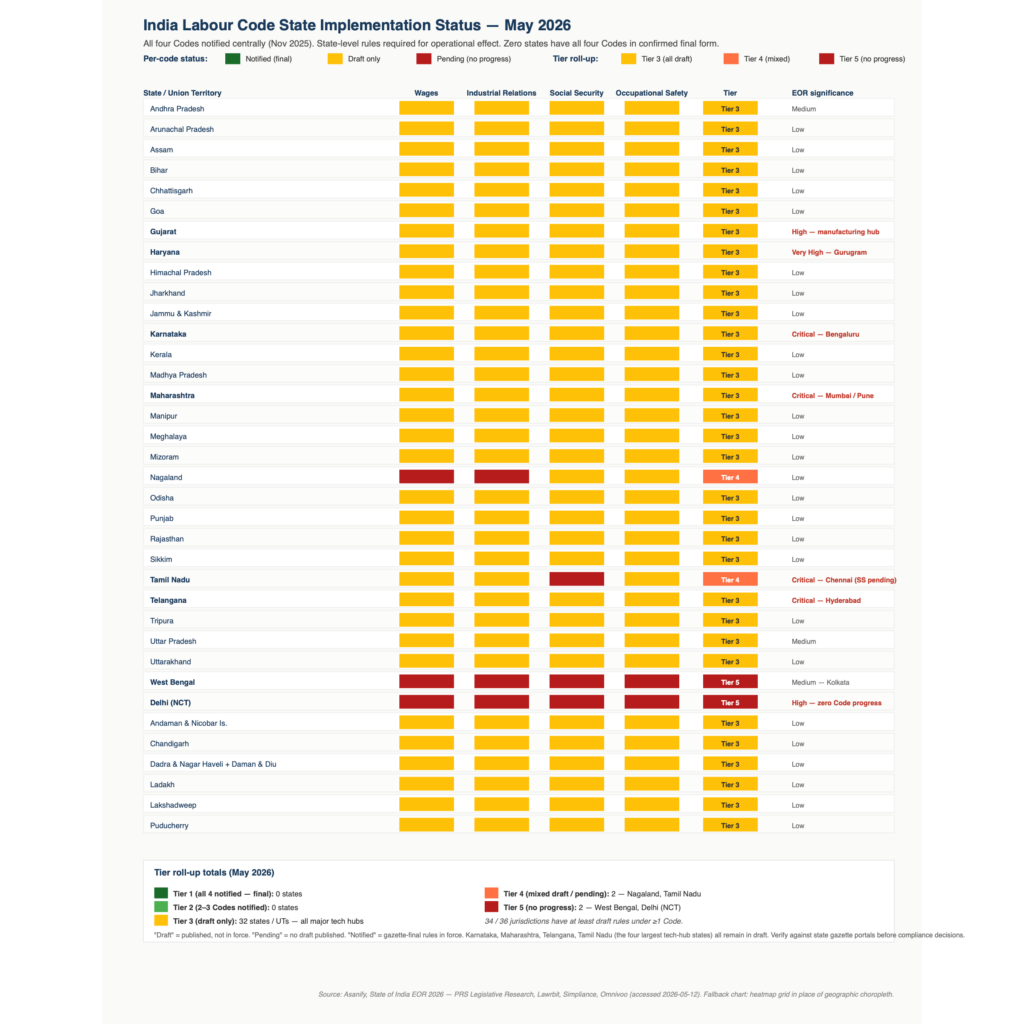
India state-by-state Labour Codes 2026 notification status: Wages, Industrial Relations, Social Security, OSHWC codes by state including Karnataka Maharashtra Tamil Nadu Telangana Haryana Delhi
Figure D7: Labour Codes 2026 notification status by state. From State of India EOR 2026, Section B7 →

Two other 2025–2026 shifts most overview articles miss: a Supreme Court ruling on Hyatt and five tribunal rulings between July 2025 and March 2026 that narrowed the dependent-agent PE test, and the EPFO amnesty for misclassified workers that closed April 30, 2026.

Source: State of India EOR 2026

What changed in 2025–2026: six PE rulings, the $1,800 landed-cost reality, EPFO amnesty closed

Asanify’s 25,000-word primary-source research on India EOR breaks down the Supreme Court and tribunal rulings on permanent establishment (July 2025 to March 2026), the real landed cost waterfall, the contractor-misclassification trap after the April 30, 2026 EPFO amnesty closure, and the 52-employee EOR-to-entity crossover.

Read the State of India EOR 2026 →

What Employment Laws Apply in India?

Employment relationships in India are primarily governed by four labour codes covering wages, industrial relations, social security, and workplace safety. In addition to these central laws, employers must comply with state-specific Shops and Establishments Acts, minimum wage notifications, professional tax regulations, and sector-specific requirements.

Employment Area Primary Regulation
Wages & Bonus Code on Wages
Social Security Code on Social Security
Working Hours & Safety OSHWC Code
Trade Unions & Termination Industrial Relations Code
State Employment Rules Shops and Establishments Acts

What Is the Status of India’s New Labour Codes in 2026?

India’s four Labour Codes have applied since 21 November 2025, and the Ministry of Labour and Employment notified final Central Rules under all four codes on 8 May 2026. State rules lag: on 20 November 2026, Business Today named at least seven states and union territories with final rules under all four codes, so check each employee’s state.

DateMilestoneSource
21 November 2025Code on Wages, Industrial Relations Code, Code on Social Security and OSH Code take effect, replacing 29 central labour lawsPIB press release, 21 November 2025
30 December 2025Draft Central Rules published for consultationKPMG Flash Alert 2026-127
8 May 2026Final Central Rules notified under all four codes, including the Social Security (Central) Rules, 2026 (G.S.R. 344(E))PRS Legislative Research; KPMG Flash Alert 2026-127
17 September 2026EPF wage ceiling raised from ₹15,000 to ₹25,000 a monthMinistry of Labour and Employment notification, 17 September 2026
October 2026Six of 37 states and union territories had notified rules under all four codes; about 10 under at least oneBusiness Standard, 20 November 2026
20 November 2026At least seven states and union territories named as having final rules under all four codes, including Gujarat and Arunachal Pradesh; the Centre’s 31 October 2026 target was not metBusiness Today, 20 November 2026

Where a state has not notified its own rules, its existing rules and transitional notifications continue to apply alongside the central codes. The Central Rules already require written appointment letters, overtime at twice the ordinary rate capped at 144 hours a quarter, pro rata gratuity for fixed-term employees after one year, and a Re-Skilling Fund payment of 15 days’ wages within 10 days of a retrenchment. For the state-by-state position, see the State of India EOR 2026 report, and for how this affects pay, see payroll in India. Labour Code status checked on 27 November 2026.


Labour Laws in India and Governing Authorities

India has consolidated 29 central labour laws into four labour codes covering wages, social security, industrial relations, and occupational safety. The Ministry of Labour and Employment develops policy and oversees implementation. State Labour Departments enforce regulations and conduct inspections within their jurisdictions. The Employees’ Provident Fund Organisation (EPFO) administers mandatory retirement savings. The Employees’ State Insurance Corporation (ESIC) manages health insurance. Labour courts and industrial tribunals adjudicate disputes. Both central and state governments share jurisdiction, with some industries falling exclusively under central government authority.

Key Labour Laws and Regulations in India

Indian employment is now primarily governed by four comprehensive labour codes that consolidate previous legislation:

  • Code on Wages: Regulates minimum wages, wage payment, bonus, and equal remuneration across all sectors
  • Industrial Relations Code: Covers trade unions, standing orders, dispute resolution, and layoffs/retrenchment
  • Code on Social Security: Administers EPF, ESI, gratuity, maternity benefits, and emerging gig worker protections
  • Occupational Safety, Health and Working Conditions Code: Establishes safety standards, working hours, leave entitlements, and workplace conditions

Additional laws including the Shops and Establishments Acts (state-level) and specific industry regulations continue to apply.

Which Government Bodies Enforce Employment Laws in India?

Multiple authorities enforce and administer employment compliance across central and state jurisdictions:

  • Ministry of Labour and Employment: Central policy formulation and oversight of labour codes
  • State Labour Departments: Local enforcement, inspections, and registration of establishments
  • EPFO (Employees’ Provident Fund Organisation): Manages mandatory provident fund contributions and retirement benefits
  • ESIC (Employees’ State Insurance Corporation): Administers health insurance and medical benefits scheme
  • Labour Commissioners: Investigate complaints and mediate disputes at state level
  • Labour Courts and Industrial Tribunals: Adjudicate employment disputes, unfair dismissals, and code violations

How Do Employment Contracts Work in India?

Employment contracts in India can be oral or written, though written agreements are strongly recommended and often required by state Shops and Establishments Acts. Contracts must specify designation, salary structure, working hours, leave entitlements, notice period, probation period in India, and applicable policies. The Industrial Relations Code requires establishments with 300+ workers to define service conditions through certified standing orders. Contracts must comply with minimum wage requirements, statutory benefits, and cannot waive employee rights. Foreign companies hiring in India typically require entities registered under the Companies Act unless using an Employer of Record arrangement.

What Types of Employment Contracts Are Legally Recognized in India?

Indian labour law recognizes various employment arrangements with specific legal implications and compliance requirements:

Contract TypeDurationKey Features
Permanent/RegularIndefiniteFull statutory benefits, EPF/ESI, strong dismissal protections, gratuity eligibility
Fixed-TermSpecified periodEqual benefits as permanent, pro-rata gratuity, expires automatically
Probationary3-6 months typicalEvaluation period, shorter notice, converts to permanent
Part-TimeVariesReduced hours, pro-rated benefits, limited regulatory framework
Contract LabourVia contractorEngaged through contractor, separate compliance regime, prohibited for core activities

How to Correctly Classify Workers: Employee vs Independent Contractor in India

Indian authorities strictly distinguish between employees and independent contractors, with classification based on control, integration, and economic dependency rather than contract labels. Employees work under employer supervision, follow fixed hours, use employer resources, receive regular salary with deductions, and are integrated into the organizational structure. Independent contractors control work methods, use own equipment, invoice for services, serve multiple clients, and bear business risks. Misclassification triggers significant liabilities including retrospective EPF/ESI contributions, penalties, and potential reclassification with full employment benefits. The Code on Social Security extends some protections to gig and platform workers.

The controlling judicial test is the multi-factor “economic reality” framework from Sushilaben Indravadan Gandhi v. New India Assurance Co. Ltd., AIR 2020 SC 1977, a 2020 Supreme Court bench ruling that the label on the contract does not control. Foreign companies converting a long-standing “contractor” relationship should size both EPF back-claim and PE compounding exposure before conversion. Read the full contractor analysis or take the 4-minute Misclassification Risk Quiz.

What Happens If a Contractor Is Misclassified in India?

For a foreign company with no Indian entity, misclassification means a “contractor” who works like an employee can be treated as one, with back EPF and ESI contributions plus 12% interest and damages, gratuity, bonus and leave dues, and possible permanent establishment exposure. Indian courts look at control, integration into your business and economic dependence, not the contract label.

The Supreme Court restated these tests in General Manager, U.P. Cooperative Bank Ltd v Achchey Lal (September 2025), an Industrial Disputes Act case: control over the work, integration into the business, and a multifactor test covering pay, tools, risk and the power to dismiss. Moving a long-term contractor onto Asanify’s payroll as an employee puts the relationship on a lawful employment footing from the first payroll run.

If reclassified, you may oweBasis
Back EPF contributions with 12% a year interest and damages up to 100% of arrearsEPF Act s.7Q and s.14B
Back ESI contributionsCode on Social Security, 2020
Gratuity, statutory bonus and leave duesCode on Social Security; Code on Wages
Income tax exposure, including a PE argument for deal-making rolesIncome-tax Act, 2025; tax treaty

Worker misclassification can create significant liabilities for employers. If authorities determine that an independent contractor functions as an employee, companies may become liable for unpaid EPF contributions, ESI contributions, gratuity, bonus payments, leave benefits, tax liabilities, interest, and penalties.

Following the closure of the EPFO Employees’ Enrolment Campaign in April 2026, employers face increased scrutiny regarding worker classification and social security compliance.

Working Hours, Overtime, and Rest Periods in India: What Employers Must Know

The OSH Code sets a normal limit of 8 hours a day and 48 hours a week; overtime is paid at twice the normal rate. Some state Shops and Establishments Acts still set their own daily limits until a state’s OSH rules take effect, so check the employee’s state. Employees must receive at least one weekly rest day. Daily work periods cannot exceed 12 hours including overtime. Workers are entitled to rest intervals totaling at least 30 minutes after 5 hours of continuous work. Spread over (interval between start and finish) cannot exceed 12 hours. Night shifts may require additional compensation under state rules. IT/ITES companies often enjoy exemptions under state-specific regulations, but must still ensure reasonable working conditions.

How Does Overtime Work in India? Calculation and Compensation Rules

Overtime applies to hours worked beyond 8 hours per day or 48 hours per week, whichever threshold is reached first. The Occupational Safety Code mandates overtime compensation at twice the ordinary rate of wages for all excess hours. Some state Shops and Establishments Acts specify different rates (typically 1.5x to 2x) and may have varying thresholds. Overtime must be accurately recorded and paid with regular wages. Maximum overtime is generally limited to 50-60 hours per quarter or 100-120 hours annually depending on state regulations. IT/ITES sector employees may be exempt from overtime provisions under specific state exemptions, though best practices encourage fair compensation.

What Are the Minimum Wage and Salary Requirements in India?

The Code on Wages establishes a floor-level minimum wage applicable nationwide, while state governments set region and skill-specific minimum wages that typically exceed the floor. Minimum wages vary significantly by state, industry, skill level, and geographic zone (metropolitan/non-metropolitan). Wages must be paid monthly for most establishments, with payment due by the 7th of the following month. The wage structure includes basic pay, dearness allowance (DA), and house rent allowance (HRA). Employers must maintain wage registers, display wage rates, and issue payslips. Equal remuneration provisions prohibit gender-based wage discrimination. States revise minimum wages periodically, requiring ongoing monitoring.

What Leave Entitlements Are Employees Legally Entitled to in India?

Indian employment law provides statutory leave entitlements that vary based on establishment type, state regulations, and applicable labour codes. The Occupational Safety Code establishes minimum standards supplemented by state-specific Shops and Establishments Acts. Employees accrue earned leave, are entitled to public holidays, and receive comprehensive maternity and sick leave protections. Casual leave and other leave types are often provided by company policy rather than statute. Unutilized earned leave can typically be encashed on separation. Leave provisions are mandatory and cannot be substituted with payment except upon termination.

Statutory Paid Leave Requirements in India

Indian employees are entitled to various categories of statutory leave, with specifics varying by state and establishment type:

  • Earned Leave/Privilege Leave: Minimum 1 day per 20 days worked (approximately 15 days annually), accumulates over employment, encashable on termination
  • Casual Leave: Typically 7-12 days annually per company policy (not statutorily mandated but customary)
  • Sick Leave: Varies by state Shops and Establishments Acts, typically 7-12 days annually with medical certificate
  • Public Holidays: Approximately 10-15 national and state holidays annually with full pay
  • National Holidays: Republic Day, Independence Day, Gandhi Jayanti are mandatory nationwide

State-specific regulations often provide additional leave entitlements beyond central code minimums.

Understanding Maternity, Paternity, and Parental Leave Rights in India

India provides comprehensive maternity protections among the most generous in Asia, with specific provisions for paternity and adoption:

  • Maternity Leave: 26 weeks (6 months) paid leave for first two children; 12 weeks for third child onwards, applicable after 80 days of employment
  • Maternity Benefit: Full wages paid during leave period for establishments under the Maternity Benefit Act (shops, factories, establishments with 10+ employees)
  • Paternity Leave: Not mandated by central law; many states provide 7-15 days under Shops and Establishments Acts or company policy
  • Adoption Leave: 12 weeks for adopting mothers of children under 3 months of age
  • Commissioning Mother Leave: 12 weeks for commissioning mothers in surrogacy arrangements
  • Work from Home: Option available after exhausting maternity leave as mutually agreed

Payroll, Taxes, and Statutory Contributions: A Complete Breakdown for India

Indian payroll involves calculating gross salary, statutory deductions, and employer contributions to multiple schemes. Employees pay income tax based on progressive slabs (0-30%) with various deductions and exemptions. EPF requires 12% employee and 12% employer contributions on basic+DA (wage ceiling applies). ESI mandates 0.75% employee and 3.25% employer contributions for those earning below threshold. Professional Tax varies by state (up to ₹2,500 annually). Employers must register with EPFO and ESIC, file monthly returns, and remit contributions by the 15th of following month. TDS certificates and Form 16 must be issued annually. Non-compliance attracts penalties and interest.

Quoted EOR fees rarely equal landed cost. Once 18% IGST (sunk for foreign clients with no Indian GST registration), an FX spread, employer EPF on the ₹25,000 ceiling (raised from ₹15,000 effective September 2026), and gratuity provisioning at 4.81% of basic are layered on, a $1,700 quote is closer to $1,800 actual per hire per month. See the detailed waterfall in Section B6.

What is the actual landed cost of an India EOR hire in 2026?

A typical quote of $1,700/month (e.g., a $1,500 employee CTC plus a $200 management fee) typically lands at approximately $1,800/month once you add 18% IGST on the management fee (sunk for foreign-only clients with no Indian GST registration), FX spread of around 2.25% on USD-to-INR remittance, SWIFT/wire charges, employer EPF contribution (12% on the ₹25,000 statutory wage ceiling, raised from ₹15,000 effective September 2026), and gratuity provisioning at 4.81% of basic. ESI is typically not applicable above ₹21,000/month gross. CFOs should model landed cost, not salary plus management fee.

What Are the Legal Requirements for Terminating Employment in India?

Employment termination in India requires adherence to contractual notice periods, payment of dues, and compliance with the Industrial Relations Code for establishments with 300 or more workers. Employers must have valid grounds (misconduct, poor performance, redundancy) and follow due process including show cause notices and opportunities to respond. Summary dismissal requires proven misconduct. Layoffs and retrenchment trigger additional requirements including notice, compensation, and government approvals for establishments above specified thresholds. Unlawful termination can result in reinstatement orders, back wages, and compensation. Fixed-term contracts typically expire automatically without termination procedures.

Can an Employee Be Terminated Without Notice in India?

In most cases, employers must provide contractual notice or payment in lieu of notice when terminating employment. Immediate termination without notice is generally limited to cases involving serious misconduct following a proper disciplinary process and investigation.

Employers should ensure termination decisions are documented appropriately and comply with both employment contracts and applicable labour laws to reduce dispute risks.

Notice Period and Termination Process in India

Notice periods in India are contractually determined rather than statutorily mandated, typically ranging from 30 to 90 days depending on seniority and industry. Either party can provide notice or payment in lieu thereof. The termination process requires written communication specifying grounds for termination. For misconduct dismissals, employers must issue show cause notices, conduct inquiries, and provide opportunities for employee response. Industrial establishments with 300 or more workers require prior government permission for layoff, retrenchment or closure. The Industrial Relations Code mandates written termination orders. Full and final settlement including salary, earned leave encashment, and gratuity must be completed within specified timelines.

When Is Severance Pay Required and How Are End-of-Service Benefits Calculated?

Gratuity is mandatory for employees completing 5 years of continuous service in establishments with 10+ employees, calculated as 15 days’ wages for each completed year of service (last drawn salary basis). Maximum gratuity is capped at ₹20 lakhs. Gratuity is payable on retirement, resignation, death, or disablement regardless of termination reason. Retrenchment compensation equals 15 days’ average pay for each completed year of service when a workman is retrenched (industrial establishments with 300 or more workers also need prior government permission). Pay in lieu of notice equals the wages for the notice period the employee does not serve. The period comes from the employment contract, the standing orders or the state Shops and Establishments Act; for retrenchment of a worker with one year of service, the Industrial Relations Code requires one month’s notice or wages in lieu. Accumulated earned leave must be encashed at the time of separation.

Is Gratuity Payable After 4 Years and 240 Days in India?

Often, yes. Gratuity normally needs five years of continuous service, but the Madras, Kerala and Delhi High Courts have treated 4 years plus 240 days worked in the fifth year as five years. The Supreme Court has not settled the point, and the Code on Social Security has not yet been tested on it. Fixed-term employees qualify pro rata after one year.

Mettur Beardsell Ltd v Regional Labour Commissioner (Madras HC, W.P. 2135/1987, 1996); Sreeja B v Regional Joint Labour Commissioner (Kerala HC, 2015); TV Today Network v Ankita Sodhi (Delhi HC, 2024).

The “continuous service” threshold is not a clean five years in every state. In Mettur Beardsell Ltd. v. Regional Labour Commissioner (Central) (Madras HC, 1996), the court read 4 years and 240 days as sufficient for gratuity eligibility, a meaningful difference for termination timing planning. Read the full termination cost waterfall, including the 2-day F&F window, in Section B8.

How Does Termination Work When You Hire Through an EOR in India?

When you hire through Asanify, you decide a role should end and document the reason. Asanify, as the legal employer, checks the ground and notice, issues the termination letter, calculates notice pay, leave encashment, gratuity and retrenchment dues, pays the full and final settlement within two working days, and closes PF and ESI records. A foreign parent company should not send the termination letter itself.

StepYou (the client)The EOR (Asanify)
Decide the role endsMake the business decision and raise the requestReview that the ground is lawful and the route fits: resignation, performance, misconduct or retrenchment
Grounds and recordsProvide the documented performance or conduct recordCheck the record is sufficient before any notice is served
Notice and duesApprove the costCalculate notice pay, gratuity, leave encashment and any retrenchment compensation
Termination letterDo not send it directlyIssues it as the legal employer
Full and final settlementFund the costPays the settlement within the statutory window
Statutory closuresNoneFiles PF, ESI and other closures
Legal liabilityLower when the process is followedCarries the employer’s obligations

What severance and final dues are payable on an EOR termination in India?

ComponentWho is entitled and how muchDeadlineLaw
Final wages and leave encashmentAll exiting employees: wages to the last working day plus encashable leaveWithin 2 working days of exitCode on Wages, 2019, s.17(2)
Notice or pay in lieuPer contract, standing orders or state Shops and Establishments Act; one month’s notice or wages in lieu for retrenchment of a worker with one year of serviceOn exitIndustrial Relations Code, 2020, s.70
Retrenchment compensationWorkers (not managerial staff) with one year of continuous service: 15 days’ average pay per completed yearWith the retrenchmentIndustrial Relations Code, 2020, s.70
Re-Skilling FundRetrenched workers: 15 days’ last drawn wages, paid by the employer into the fundWithin 10 days of retrenchmentIndustrial Relations Code, 2020, s.83
Gratuity5 years of continuous service (fixed-term: pro rata after 1 year); 15 days’ wages per completed year, wages divided by 26, capped at ₹20 lakhWithin 30 days of becoming dueCode on Social Security, 2020
Prior government permissionIndustrial establishments (factories, mines, plantations) with 300 or more workers, for lay-off, retrenchment or closure; not a paymentBefore actingIndustrial Relations Code, 2020

The retrenchment and permission rules apply to workers and industrial establishments; most professional and managerial hires are governed by their contract and the state Shops and Establishments Act.

Settlement timing: wages and dues are due within 2 working days of the last working day under the Code on Wages. Settlement covers pending salary, notice pay where applicable, earned leave encashment and gratuity where eligible.

Gratuity example (illustrative): for last drawn basic of ₹70,000 and 5 completed years of service, gratuity is ₹70,000 ÷ 26 × 15 × 5 = ₹2,01,923, within the ₹20 lakh cap.

What a foreign employer should not do:

  • Send the termination letter from the parent company.
  • Terminate by email or chat without notice or documentation.
  • Skip the show-cause notice and inquiry for a misconduct dismissal.
  • Delay full and final settlement past the statutory window.

For exits during probation, see probation period in India. For the severance maths in depth, see severance pay in India. To draft the letter, see how to write a termination letter. Termination costs by scenario are in State of India EOR 2026. Source for the Labour Codes effective date: Press Information Bureau, 21 November 2025.

What Employee Protections and Anti-Discrimination Laws Apply in India?

Indian employment law prohibits discrimination based on religion, race, caste, sex, place of birth, or any of these factors under the Constitution. The Equal Remuneration Act mandates equal pay for equal work regardless of gender. The Code on Social Security includes anti-discrimination provisions. The Sexual Harassment of Women at Workplace Act requires establishments with 10+ employees to constitute Internal Complaints Committees and implement prevention policies. The Rights of Persons with Disabilities Act mandates reasonable accommodation and reservations. Whistleblower protections shield employees reporting violations. The Industrial Relations Code prohibits unfair labour practices and protects union activities. Violations can result in criminal penalties and civil compensation.

Compliance Risks for Global Employers Hiring in India

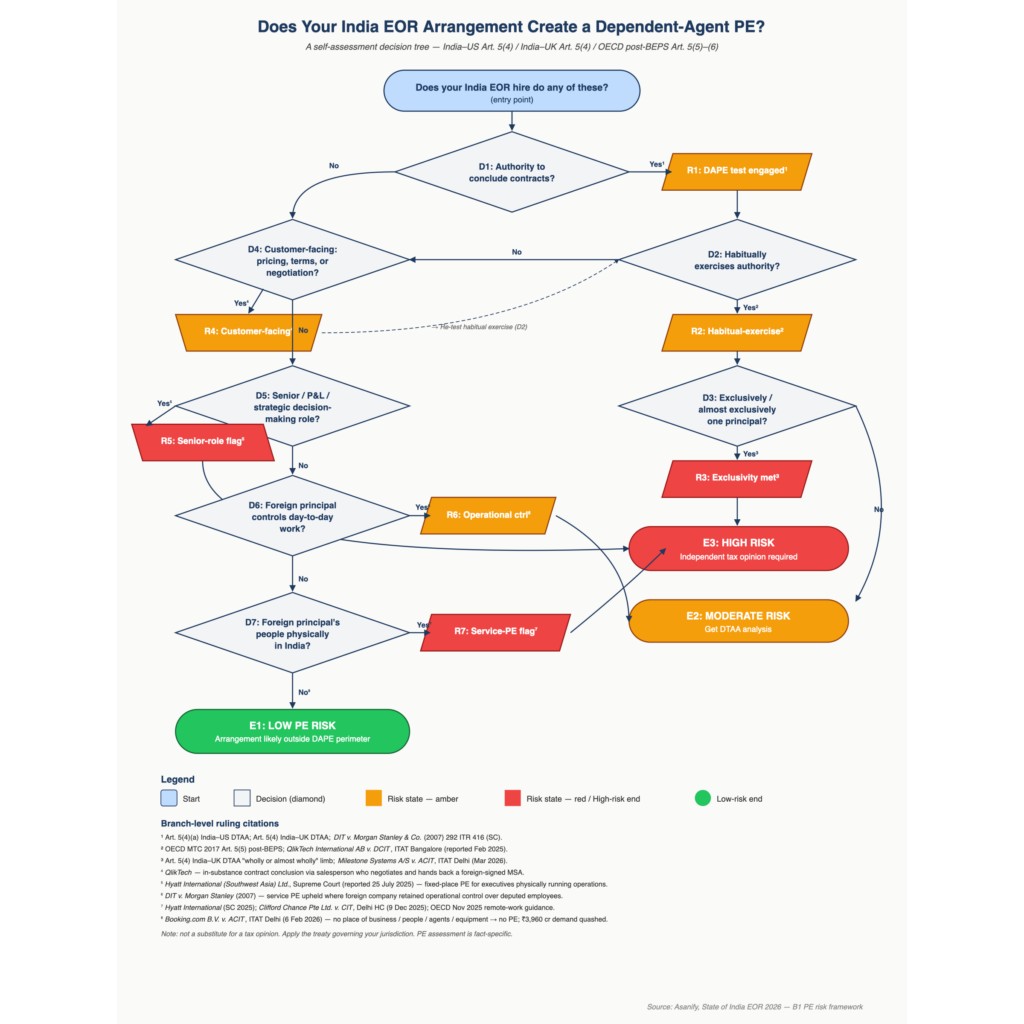
Permanent Establishment risk decision flowchart for India EOR engagements: fixed-place-of-business test, dependent-agent test, service-PE day count thresholds
Figure D1: Four-factor PE test for foreign EOR users. From State of India EOR 2026, Section B1 →

What changed in 2025 to 2026: the new risk surface

  • Six PE rulings (Jul 2025 – Mar 2026) narrowed the dependent-agent test. EOR helps; role design decides. See B1
  • EPFO amnesty closed April 30, 2026. Section 7Q (12% pa interest) and Section 14B (1% per month damages, post-Jun 2024) now apply at the statutory baseline. See B4
  • Landed cost reality: $1,700 quoted is approximately $1,800 actual after GST + FX + statutory employer contributions. See B6

Has the EPFO amnesty for misclassified workers in India ended?

Yes. The Employees’ Enrolment Campaign 2025, which covered workers hired between July 2017 and October 2025 at a flat ₹100 penal damage per establishment with the employees’ share waived, closed on April 30, 2026. After that date, EPF back-claims on misclassified workers attract 12% per annum simple interest under Section 7Q of the EPF & MP Act 1952 and damages at 1% per month under Section 14B (capped at 100% of arrears) following the June 2024 EPFO amendment. Foreign companies with India contractors should reassess classification urgently. Full mechanics in the State of India EOR 2026 report (Section B4).

International companies entering the Indian market face complex compliance challenges across multiple regulatory dimensions:

  • Entity Registration Requirements: Most foreign companies need registered entities (private limited, branch, liaison office) to hire directly, with exceptions for EOR arrangements
  • EPF/ESI Non-Compliance: Failure to register and remit contributions triggers retrospective liabilities, penalties, and interest charges
  • State-Level Variations: Different Shops and Establishments Acts across states create compliance complexity for multi-location operations
  • Misclassification Risks: Incorrect worker classification results in benefit liabilities, statutory contributions, and penalties
  • Termination Disputes: Improper termination procedures lead to labour court litigation, reinstatement orders, and back wage payments
  • Tax Compliance: Incorrect TDS calculations, late filing, or non-compliance attracts interest, penalties, and potential prosecution

What Are the Risks of Hiring Employees in India Through an EOR?

Hiring through an EOR is legal in India but not risk-free. The main risks are permanent establishment if staff sign deals for you, unpaid PF, ESI or wages if the EOR defaults, weak IP and data terms, and providers that subcontract. Asanify employs every hire through its own Indian entity, Asanify Technologies Pvt Ltd, operating since 2019.

RiskWhat triggers itHow Asanify handles itWhat stays with you
Permanent establishmentEmployees who habitually negotiate or sign contracts for the foreign companyEmploys staff through its Indian entity; an EOR does not remove PE risk if the role changesKeep contract-signing authority with your home entity; take tax advice for sales roles
Liability if the EOR fails to payA provider that misses wage, PF or ESI remittancesFiles EPF, ESI, professional tax and TDS under its own Indian registrationsAsk for monthly proof of remittance
Provider without its own entityEOR resellers that subcontract to local partnersEmploys through Asanify Technologies Pvt Ltd, an Indian entity operating since 2019Check the employing entity named in the contract
Intellectual propertyContracts without an assignment clauseEmployment contract assigns work product to your companyKeep your own confidentiality and access controls
Personal dataPayroll and identity data held offshore without safeguardsHandles employee data under India’s Digital Personal Data Protection Act, 2023Limit what you collect directly
Termination disputesExits without a valid ground, notice or inquiryReviews grounds, issues letters, pays full and final dues within two working daysDocument performance or misconduct before you decide

How Can an Employer of Record (EOR) Ensure Compliance with Employment Laws in India?

An Employer of Record enables foreign companies to hire employees in India without establishing a local entity by acting as the legal employer. The EOR handles all statutory compliance including EPF and ESI registration, monthly returns filing, contribution remittance, income tax withholding and TDS filing, professional tax compliance, gratuity management, and adherence to applicable Shops and Establishments Acts. The EOR drafts compliant employment contracts, processes payroll with accurate deductions, manages leave and benefits, and ensures proper termination procedures, from the termination letter to full and final settlement (see how termination works through an EOR). This model provides immediate market access while eliminating entity setup costs, ongoing regulatory burden, and compliance risks.

One important caveat: EOR is not a blanket permanent-establishment shield. The 2025–2026 case law tightened the dependent-agent test in ways that favor carefully structured engineering roles and meaningfully expose customer-facing roles. The four-factor PE analysis is at B1 of the State of India EOR 2026.

What Statutory Compliance Does an EOR Handle in India?

As your employer of record, Asanify runs every recurring obligation for each hire: monthly payroll, EPF and ESI contributions, TDS on salary, professional tax and Labour Welfare Fund where a state levies them, statutory bonus, gratuity provisioning, leave and the full and final settlement on exit, all filed under Asanify’s own Indian entity.

ObligationRate or rule (2026)DeadlineLaw
Salary paymentMonthly wage periodBy the 7th of the following monthCode on Wages, 2019
EPF12% employer and 12% employee on wages, wage ceiling ₹25,000 a month from 17 September 2026ECR and payment by the 15th of the following monthCode on Social Security, 2020; EPF Scheme
ESI3.25% employer and 0.75% employee, for wages up to ₹21,000 a monthBy the 15th of the following monthCode on Social Security, 2020
TDS on salarySlab rates for the employee’s chosen regimeDeposit by the 7th of the following month; quarterly returnsIncome-tax Act, 2025 (Section 392 from 1 April 2026)
Professional taxSet by each state, up to ₹2,500 a yearState scheduleState PT Acts
Labour Welfare FundFixed amounts in states that levy itState schedule, often half-yearly or annualState LWF Acts
Statutory bonus8.33% to 20% for employees earning up to ₹21,000 a monthWithin 8 months of year endCode on Wages, 2019
Gratuity15 days’ wages per completed year; provision about 4.81% of basicWithin 30 days of becoming dueCode on Social Security, 2020
Shops and EstablishmentsRegistration and state rules on hours, leave and holidaysBefore or on commencement, per stateState Shops and Establishments Acts

For the full monthly process, see payroll in India.

Can an EOR Handle State-Specific Employment Compliance Across Indian States?

Yes. Labour is a concurrent subject, so minimum wages, professional tax, Labour Welfare Fund, Shops and Establishments rules, holidays and Labour Code rules differ by state. Asanify covers all 28 states and 8 union territories and applies the rules of the state where each employee works.

State-level itemHow it variesWhat Asanify does
Minimum wagesSet by each state by skill and zoneChecks each salary against the state table
Professional taxLevied in some states, up to ₹2,500 a year; not levied in others such as DelhiDeducts and files where levied
Labour Welfare FundLevied in some states onlyDeducts and files where levied
Shops and Establishments ActEach state’s Act sets hours, leave and notice termsBuilds the terms into the contract
HolidaysState festival lists differApplies the state holiday calendar
Labour Code rulesStates notify their own rules at different speedsApplies notified state rules, or existing rules until then

Does an Employer of Record protect a foreign company from permanent establishment risk in India?

Not automatically. Between July 2025 and March 2026, six tribunals and one Supreme Court bench (Hyatt International) ruled on permanent establishment for foreign principals with Indian-side help. Engineers building internal product are generally on the protected side. Sales leaders with customer-facing authority and country managers running local P&L generally are not. The four-factor test the Assessing Officer applies looks at day-to-day control, customer-facing authority, contract-signing authority (formal or in substance), and economic substance. EOR handles statutory compliance, but the foreign company remains responsible for evaluating role-level PE exposure. See the full four-factor analysis.

What Compliance Risks Does an EOR Help Reduce?

  • Employment contract compliance
  • Payroll and tax compliance
  • EPF and ESI registration obligations
  • Leave and benefits administration
  • Worker classification risks
  • Termination documentation and settlements
  • State-specific employment law compliance

While an EOR significantly reduces employment compliance risks, companies should separately evaluate permanent establishment (PE) exposure based on employee roles, authority levels, and business activities conducted in India.

How Asanify Supports Compliant Employment in India

Asanify, rated 4.9 out of 5 from 350+ reviews on G2, provides end-to-end employment compliance for companies hiring in India. Our services include drafting state-specific compliant employment contracts, registering with EPFO and ESIC on your behalf, processing accurate payroll with EPF, ESI, professional tax, and TDS calculations, filing monthly returns and remitting contributions within deadlines, managing statutory benefits including gratuity calculations, administering leave entitlements per applicable regulations, and handling compliant separation procedures with full and final settlements. Asanify’s India expertise ensures accurate application of central codes and state-specific regulations across multiple locations, transparent reporting through our platform, dedicated local HR support, and proactive compliance monitoring to mitigate risks.

Employment Laws in India vs Other Global Markets: A Comparative Analysis

India’s employment framework is characterized by comprehensive social security systems and extensive procedural protections, creating a middle ground between highly flexible markets and rigid European systems. Compared to the US and UK, India mandates significantly more employer contributions (EPF, ESI) and provides longer maternity leave (26 weeks vs 12-16 weeks). Unlike many Western countries, India lacks a universal minimum wage, instead using state and sector-specific rates. Notice periods are contractual rather than statutory as in many European countries. Gratuity provisions are unique compared to markets without mandatory severance. India’s retrenchment approval requirements for larger establishments parallel those in France and Italy but differ from at-will employment jurisdictions. The emerging gig worker protections place India ahead of many markets in platform economy regulation.

Your Compliance Roadmap: Staying Compliant with Employment Laws in India

Maintaining employment law compliance in India requires systematic management of central and state-level obligations:

  1. Register Appropriately: Obtain necessary registrations with EPFO, ESIC, state labour departments, and Shops and Establishments authorities
  2. Draft Compliant Contracts: Create written employment agreements specifying all statutory terms and applicable state regulations
  3. Implement Accurate Payroll: Calculate EPF, ESI, professional tax, and TDS correctly with proper wage classification
  4. File Monthly Returns: Submit EPF ECR, ESI returns, and TDS challan by the 15th of each month
  5. Maintain Statutory Records: Keep wage registers, attendance records, leave registers, and other mandatory documentation
  6. Monitor Minimum Wages: Track state-specific minimum wage revisions and adjust compensation accordingly
  7. Manage Leave Accurately: Administer earned leave accrual, track entitlements, and process encashments correctly
  8. Follow Termination Protocols: Provide proper notice, conduct due process, calculate gratuity, and complete full and final settlement

Frequently Asked Questions About Employment Laws in India

What are the main employment laws that apply in India?

Indian employment is governed by four labour codes: Code on Wages (minimum wages, payment), Industrial Relations Code (unions, disputes, retrenchment), Code on Social Security (EPF, ESI, gratuity, maternity), and Occupational Safety Code (working hours, safety, leave). State-level Shops and Establishments Acts supplement these central codes with additional requirements.

What types of employment contracts can I use when hiring in India?

Indian employers can use permanent/regular contracts (indefinite with full benefits), fixed-term contracts (specified duration with equal benefits), probationary contracts (evaluation period), and part-time arrangements. Written contracts are strongly recommended and often required by state Shops and Establishments Acts. Contract labour engaged through contractors has separate compliance requirements. Fixed-term employees earn pro rata gratuity after one year of continuous service.

What is the current minimum wage requirement in India?

India has state and skill-specific minimum wages rather than a universal rate, varying significantly by region, industry, and job classification. States revise minimum wages periodically. The Code on Wages establishes a national floor wage that states must meet or exceed. Employers must monitor applicable state rates and revisions for their specific locations and industries.

What are the standard working hours and how is overtime calculated in India?

The OSH Code sets a normal limit of 8 hours a day and 48 hours a week; overtime is paid at twice the normal rate. Some state Shops and Establishments Acts still set their own daily limits until a state’s OSH rules take effect, so check the employee’s state. Overtime applies to hours exceeding these limits and must be compensated at twice the ordinary rate. Maximum daily working time including overtime is 12 hours, with at least one weekly rest day mandatory.

How should employers handle payroll and tax compliance in India?

Employers must register with EPFO and ESIC, calculate and deduct employee EPF (12%), ESI (0.75%), professional tax, and income TDS based on applicable slabs. Employer contributions include EPF (12%) and ESI (3.25%). Monthly returns must be filed and contributions remitted by the 15th. Annual TDS returns and Form 16 issuance are mandatory.

What are the legal requirements for terminating an employee in India?

India has no at-will employment. An exit needs a valid ground, notice or pay in lieu, a fair inquiry for misconduct, and full payment of dues: final wages within two working days, gratuity within 30 days, and retrenchment compensation and Re-Skilling Fund payments where they apply. When you hire through Asanify, Asanify runs this process as the legal employer.

How does using an Employer of Record help with employment law compliance?

An EOR acts as the legal employer, managing all compliance including EPF/ESI registration and returns, accurate payroll with all statutory deductions, TDS filing, gratuity management, and adherence to state-specific regulations. This eliminates the need for entity establishment while ensuring full statutory compliance and providing employees with all mandated benefits.

Can my company hire employees in India without establishing a local legal entity?

Yes, using an Employer of Record allows you to hire employees in India without registering a local company. The EOR becomes the legal employer, handling all statutory registrations, compliance obligations, and employment administration while you direct the employee’s day-to-day work. This approach provides rapid market entry without entity setup costs or ongoing compliance burden.

Hire Compliantly in India Without Legal Complexity

Asanify manages compliant contracts, payroll, and local labour regulations in India – so you can hire confidently without setting up a local entity.